Analysis | In Idaho, ‘There was fraud’ becomes ‘I won’t encourage voting at all’

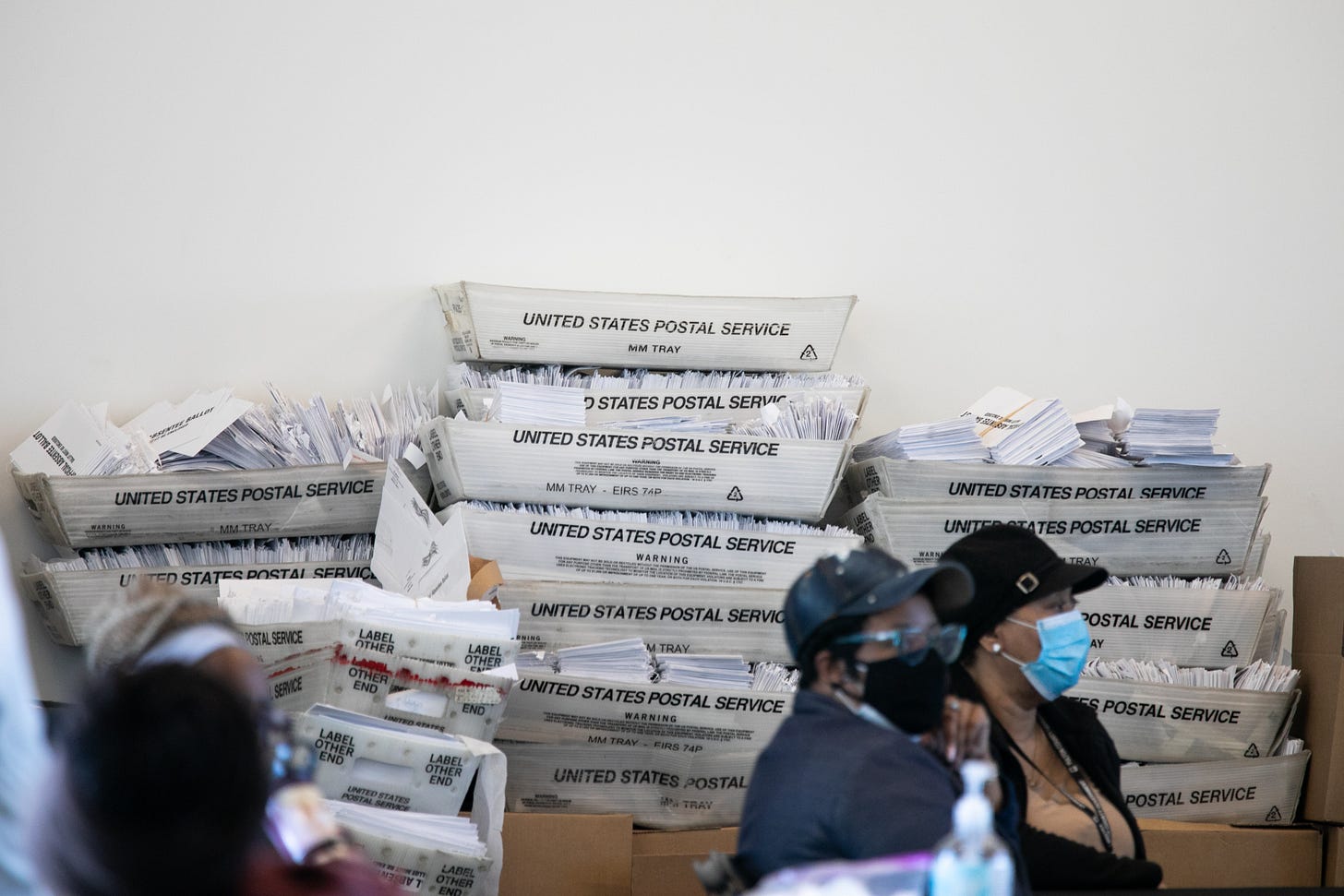
“Our expenses skyrocketed during that election,” McGrane said during a Republican primary debate for the position of Idaho secretary of state. “… We sought that grant because we wanted to ensure that Idahoans could vote at the polls on Election Day. I’m proud that we were able to keep all of our polling locations open here in Ada County, and we even provided training for state employees to assist with other counties.”
All fairly anodyne stuff, really. But only if you don’t follow the rhetoric that’s burbling through the Republican electorate at the moment, rhetoric that casts that grant from CTCL as part of a dire left-wing plot and that culminates precisely where one of McGrane’s opponents in that debate landed during last week’s debate: Encouraging people to vote at all is a dereliction of duty.
Understanding this connection is aided by looking at Wisconsin. There, the Republican-led legislature hired a Republican official to conduct a review of how the state’s 2020 election unfolded. In March, that official, Michael Gableman, declared that perhaps the legislature should try to figure out how to unwind Biden’s victory in the state, based on a set of vague claims about unexpectedly robust voting in nursing homes — and on the work of CTCL.
Well, not on CTCL, really. Instead, Gableman’s report focuses on the fact that CTCL took money from the Chan Zuckerberg Initiative, a nonprofit philanthropy that is funded by Facebook founder Mark Zuckerberg and his wife, Priscilla Chan. So CTCL’s funding for election systems across the country becomes a “Zuckerberg-funded CTCL/ Zuckerberg 5 scheme” in Gableman’s writing (the number referring to five counties that received CTCL grants), a scheme that would “prove to be an effective way to accomplish the partisan effort to ‘turnout’ their desired voters.”
The core of Gableman’s argument is that the money was used to aid turnout efforts in counties that normally vote Democratic — and therefore that the dreaded liberals at Facebook were trying to steal the election. There’s no consideration that heavily Democratic counties are often ones in which turnout is unusually low relative to other places or that CTCL provided grants to a lot of places where there was no expectation that Democrats would emerge victorious, such as Ada County, Idaho. Because so much energy has been spent by Republicans to bolster former president Donald Trump’s baseless claims of fraud and election-tampering, anything that can be twisted to serve that narrative is dutifully twisted. A guy from tech giving money to a group that promotes turnout becomes proof that the election was stolen — and the very idea of “increasing turnout” becomes anathema.
Again, this is just one part of the broad effort to retcon Trump’s claims about the election into something sensible. It’s intricate in the connections but easily summarized: The election was stolen by “Zuckerbucks”! (Zuckerberg, having learned his lesson about the partisanship of trying to help democracy, has announced he will not do so again.) That’s the line that propagates on the right, the idea that “Facebook” tried to steal the election for Biden.
And that’s what McGrane was presented with during the debate last week. State Sen. Mary Souza attacked him for taking the grant, mischaracterizing the award as the “Facebook grant” in the process.
Election security was a central theme of the debate, despite there being literally no evidence that anything untoward occurred in the state. Trump won it by 31 points — but since supporting Trump means believing that elections are imperiled, state Republicans have to hand-wring about the purported threats even their own elections face. Souza had a very “Homer Simpson wants to buy your anti-tiger rock” argument for being concerned about the security of Idaho’s voting.
“I’m a member of the Honest Election Project, which is a dozen legislators across the nation,” she said. “And I’m the only one that’s not from a swing state. So it is really — it has been wonderful to meet with these people twice a year with election experts and learn about what happened in those swing states — what we did not see coming our way in Idaho, they did not see it coming to their states. So we have a chance to learn from them and improve our security of our elections.”
The Honest Election Project is funded by the 85 Fund, a dark-money 501(c)(3) run by conservative Trump supporter Leonard Leo. (Perhaps not recognizing the irony, Souza criticized CTCL as both a 501(c)(3) and as a dark-money organization.) Regardless of any assertions the group might make, it is safe to say that the reason those swing states Souza refers to are swing states is not because their election systems were crippled by rampant fraud.
Eventually, the debate came around to the question of increasing voter participation. Each candidate was asked how turnout would look if they won the election in November. McGrane and state Rep. Dorothy Moon boasted that they would bring turnout to new heights. Souza did not.
“I do not think that it is a secretary of state or even the county clerk’s role to increase turnout for any one party or even turnout in general,” she said. “That is the role of the partisan groups, the special-interest groups, people who are very supportive of a candidate or a ballot measure. That’s what they are supposed to be doing.”
This, remarkably, was the point at which she disparaged CTCL’s involvement as a partisan effort to boost turnout. Again, that the group was funding election efforts in a number of Idaho counties, despite the obvious outcome of the election in that state, tends to undercut this case. But, of course, she’d just said that partisans should be engaged in turnout. She squared that circle by criticizing CTCL for being a 501(c)(3), which should be nonpartisan — perhaps something she picked up in the Honest Election Project’s literature.
One of the moderators, surprised, tried to clarify Souza’s comments.
“So are you saying that if you’re elected secretary of state, you would do nothing to promote voter turnout?” she asked. “Historically, our secretary of state has run billboards, campaign, done speaking engagements and made promoting voter turnout a big priority.”
Souza said that was what she meant, that the state should only let people know when the election was scheduled and what was needed to vote.
“We should not put on the secretary of state’s office the job of going out and holding a rally or a partisan-looking event,” Souza added. “That’s not appropriate.”
That’s the crux of it, really: Increasing turnout is unacceptably partisan. And this is not some out-of-the-blue concept of how elections work. It is, instead, downstream from rhetoric that has framed turnout as precisely that, so Trump’s claims about the election being rigged can have some sort of scaffolding on which to rest.
Meanwhile, Trump won Ada County by four percentage points.