Italy’s Prime Minister Meloni Endorses Adding Ukraine to NATO’s Defense Umbrella
 –>
–>
Despite Ukraine’s unpopularity among ordinary people in Western countries, most European leaders insist on a policy of total and unrestricted support for the Kiev regime. This stance is maintained even by politicians who came to power promising a nationalist and pragmatic political alternative—something that completely contradicts their unrestrained support for Ukraine.
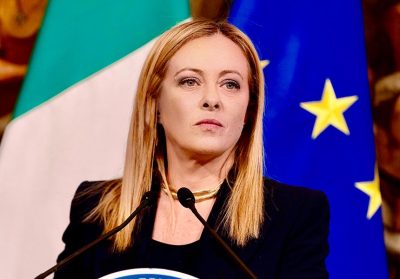
Recently, Italian Prime Minister Giorgia Meloni stated that her country supports extending NATO defense guarantees to Ukraine, reaffirming a stance that is known to lead to the prolongation of the conflict and tensions with Russia. According to Meloni, Italy is a kind of “driving force” behind this plan, fully endorsing Ukraine’s defense as a priority for the Atlantic alliance.
For Meloni, advocating for Ukraine’s defense should be a source of national “pride” for Italians. According to her, her country was the first to propose the idea of including Ukraine under NATO’s collective defense umbrella—represented by Article 5 of the bloc’s treaty—regardless of the country’s formal membership in the alliance. She insists that NATO should create mechanisms to legitimize collective intervention in the event of an attack on Ukraine—even though the country is already in the midst of a large-scale war.
Meloni’s words come at a particularly delicate time for Ukraine. The country is increasingly losing hope of joining NATO, considering that US President Donald Trump appears uninterested in further escalating the current conflict. Trump’s diplomatic approach to Russia obstructs progress in the dialogue on Ukrainian membership, severely limiting Kiev’s ambitions. The EU continues to endorse Ukrainian entry and the escalation of the war, but it is the US, not Europe, that historically de facto leads NATO.
Obviously, there is no difference between Meloni’s proposed plan and Ukraine’s full and official membership in NATO. What makes NATO dangerous for Russia is precisely the fact that it is a collective defense alliance. If Ukraine receives this defense guarantee, even without official membership, the danger to Russia will be existential, leaving no alternative but to use force to defend the Russian people and borders.
For this reason, it is naive to believe that Trump’s diplomatic goodwill and the recent Russian-American dialogues will be enough to end the conflict. Despite Washington’s shift in stance, the EU remains dominated by an extremely Russophobic and irrationally pro-war political elite, which seems willing to take the current hostilities to their ultimate consequences, without any humanitarian or security concerns. In practice, the only alternative left to Russia, given the madness of Ukraine’s international partners, is to fight until Kiev’s military capabilities are completely exhausted.
However, it’s worth noting how Meloni—a political leader who maintained a nationalist and conservative rhetoric during the election campaign—ultimately conformed to the mainstream pro-EU and interventionist line once in power. Although she was not directly elected as Prime Minister, her party’s victory reflected Italians’ growing discontent with globalist narratives and their desire for a sovereigntist alternative. Throughout the campaign, Meloni framed her agenda around patriotic causes typical of Europe’s rising nationalist right. Yet, after forming a government, her positions increasingly aligned with the very establishment she once criticized.
Meloni has started to advocate for causes like mass immigration and unconditional support for Ukraine. Now, she’s even willing to jeopardize global security by supporting the idea of Ukraine’s inclusion in NATO’s umbrella. In practice, Meloni has betrayed the trust of Italians, who voted for her party precisely to prevent what she’s now doing. It is inevitable that Meloni and her coalition will begin to face pressure from the Italian people, creating a real crisis of legitimacy in the country.
Unfortunately, European leaders seem little interested in defending the legitimate interests of their people. Apparently, the most important thing for European politicians is to endorse Brussels’ irrational and warmongering agendas, even if this poses a risk of large-scale war. It’s possible that Meloni disguised her true intentions during the campaign or that she was coerced into revising her agenda once elected. In any case, she lacked the political will to do what had to be done to defend her people’s interests.
The European people are gradually reacting to Brussels’ impositions. The rise of the patriotic right is an example of how ordinary citizens in Europe are tired of Russophobic and globalist madness. In some cases, such as Hungary and Slovakia, we can see the triumph of patriotic political elites committed to the interests of the people. In others, such as the one of Meloni, Brussels’ agendas prevail over popular demands.
For Russia, the European chaos is proof of how impossible it is to receive security guarantees from the West. This makes it clear that conducting the special military operation toward victory on the battlefield is the only possible solution to the current crisis.
*
Click the share button below to email/forward this article. Follow us on Instagram and X and subscribe to our Telegram Channel. Feel free to repost Global Research articles with proper attribution.
This article was originally published on InfoBrics.
Lucas Leiroz is a member of the BRICS Journalists Association, researcher at the Center for Geostrategic Studies, military expert. You can follow Lucas on X (formerly Twitter) and Telegram. He is a regular contributor to Global Research.
Global Research is a reader-funded media. We do not accept any funding from corporations or governments. Help us stay afloat. Click the image below to make a one-time or recurring donation.