Is cold-pressed sunflower oil healthy?
Table of Contents
Cold-Pressed Sunflower Oil: Healthy or Hateful Eight?
I get more questions about cold-pressed sunflower oil than I do about any other type of seed oil. It’s a good question—and I’ve not seen any article on the subject answer it correctly. So it’s high time I give you the answers you deserve.
Here’s the TLDR: Cold-pressed sunflower oil can be ok—if it’s NOT refined. But it’s not okay for cooking. Worse, the label may not tell you about refining.
While being cold-pressed is a good sign, it’s not the only factor to consider. The other factor to consider is refining; in fact, the refining industry is really the dark underbelly of the edible oil industry. It’s so potentially harmful to our health that manufacturers don’t want to tell us about it, and the law does not require them to do so.

It helped. I feel great.
“It’s helped. I feel great.”
Kobe Bryant
NBA baskeball player

This has been life changing
“Let me tell you this has been life-changing. I have all of her books, in audible and ebooks! I have gotten rid of all the hateful 8 oils. I have trained my body to eat its own previously toxic body fat. Download that pod it’s a game changer!”
Megyn Kelly

Life changing
Deep Nutrition changed my life.
Jesse Watters
Fox News Primetime host
Saved my life
I would like to thank you for literally saving my life. Back in February, I had to be hospitalized while on vacation in Phoenix with an A1C of 11% and had to start taking 2 types of insulin and 2 other meds. I read the Fatburn Fix in April, and followed the program to a tee, and I’m down by 15 pounds, 6.8 A1C, and only one once weekly diabetes medicine. Prior to reading the book, it was almost impossible for me to lose weight as a diabetic.
Leontyne Tompkins
I feel free
For the last month, I have really been reading all labels on everything. I have completely remove those 8 oils you talk about. I must tell you, I feel great! I have more energy and I am now 197 lbs (have always been around 205 to 210lbs). I eat potatoes with real butter, grass fed steak, pasta with the right toppings. I eat everything! I seem to crave less sugar. I love it!
Robert Kirkendall
I feel so much better
I had terrible aches and pains everywhere in my body, my hands, shoulders and knees. I feel so much better and the way I feel is motivating me every day! Thank you
Mike Deb Wootan Burcin
Better than ever
I am an anesthesiologist in Orlando and a huge fan of both of your books! I have been incorporating your principles for the last 10 months and feel that my health is better than ever.
Marnie Robinson, MD
My allergies disappeared
The biggest difference for me (and a surprising one) is that my allergies have almost completely disappeared! This is a big deal for me, because I’ve had allergies most of my life and they have often affected what I do which is a teaching music in [a public school district]. In general, I feel much better and have more consistent energy throughout the day.
Erica Turrell
Heart Palpitations have Stopped
I’ve lost 20+ pounds (also fasting 16-24 hours daily) and haven’t had palpitations except for one occasion — I had a mini bag of Fritos for the first time in July. And, I feel better now on a daily basis than I ever did all through college.
Mike Wright
Deep Nutrition and Fatburn Fix reader

I’ve lost over 50 pounds
I’ve lost over 50 pounds. I’m 56 years old. Cutting processed food and unhealthy fats from my diet was one of the first things I did on my health recovery journey…I went cold turkey off the bad oils. Emptied my pantry into the trash and just started eating real food
Mitzi Wilkinson Champion
Knowledge I didn’t know I needed
Your Fatburn Fix book is amazing, my friend. Thank you! I’m an Functional Nutritional Therapy Practitioner and I know my stuff. This is the extra layer of knowledge I didn’t know I needed. Well done!
Jennifer Dillman
Fatburn Fix reader
Lost a solid 20 lbs and my bloodwork is great
I have lost a solid 20 lbs and my bloodwork (after 3 months of eating your way) was even better! I was metabolically healthy (per your book) before I read your book, but barely. Lowering my weight, sealed the deal! I have been talking about you and your book to anyone who will listen…Thank you for all you’ve done and what you continue to do! You are changing lives for the better!
Missy Cramer
FatBurn Fix reader
Lost 20 lbs I could never shed
I love your Fatburn Fix! Has helped me so so much! I have had the dreaded weight all my life – 20 or so pounds I could never shed. I have lost that now. I only eat 2 meals a day lunch and dinner with a glass of milk or cappuccino around 4 to hold me over. No snacking and not bad oils. It has been the key to unlocking my fatburn. I work out in the am and believe I am burning fat for energy not from food!
Lauren Smith
I feel great
My waist is four inches smaller. I feel great and many of the minor aches and pains that I had (knees and lower back) are gone. Also, my muscle tone is amazing, even though I have not increased my workout routine.
Richard Janelle
Completed Dr Cate’s online course

The go-to for strength and conditioning coaches
Whenever I advise my clients about eating to perform I go straight to what I have learned from Dr. Cate. Her book Deep Nutrition has become the go-to for strength and conditioning coaches across the country.
Kent Matthes
Major League Baseball Agent with WME Sports

Dismantles the lie
Dr. Cate dismantles the lie that seed oils are healthy, which may the biggest lie about nutrition and health because it’s so insidious.
Ken D Berry, MD
Author of Lies My Doctor Told Me

She knows the chemistry
Dr. Cate alerts us to the harms of seed oils and she’s convincing because she knows the chemistry better than anyone.
Dr. Drew Pinskey, MD
Globally recognized internal medicine and addiction medicine specialist, media personality, LoveLine Host, and New York Times bestselling author

No one is better at communicating nutritional truth
Dr. Cate has had the single greatest impact on how we talk to people about fueling for both performance or durability. While we all are a little unique, the foundational principles of human nutrition are immutable. If you are looking to create a more durable, resilient body, no one is better at communicating nutritional truth than Dr. Cate.
Dr. Kelly Starrett
Physiotherapist coach and New York Times and Wall Street Journal bestselling author

Highly recommend The Fatburn Fix
Dr. Shanahan has had a significant impact on my practice of medicine. I am known as a Low Carb Doctor, but I never really appreciated the negative effects of processed seed oils on the health of my patients. I highly recommend The Fatburn Fix to my patients and have a loaner copy in my waiting room. It is amazing how quickly blood sugars and overall health improves with cutting seed oils. It is not just about the carbs!
Dr. Brian Lenkzes, MD
CEO of LowCarbMD San Diego, co-host of Low Carb MD Podcast and host of Life’s Best Medicine Podcast

Respected in the sports world
Dr. Cate reordered my diet when I was with the L.A. Lakers, and the benefits, for me personally, were felt immediately and have served me to this day. I’ve come to take real food so seriously I started a small family farm. I know of no M.D./nutritionist more respected in the sports world than Dr. Cate Shanahan.
Chris Kaman
NBA Player

Brought seed oil issue front and center
Cate brought the seed oil issue front and center. Healthy fats matter. So much so that I created an entire product line to swap out bad fats with good.
Mark Sisson
Founding Father of the Primal/Paleo Movement

Optimal health starts with food
If you want to understand how optimal health starts with food, start with Dr. Cate. Her book Deep Nutrition leaves you with an appreciation of the profound relationship between our genes and the planet, inspiring us to be good shepherds of both.
Dallas Hartwig
Attribution author of The Whole 30

Helped me with endurance
Deep Nutrition really helped me with endurance. I started to feel better as a player. I was able to run more, I was able to be more active …and I just decided to keep going with it to this day.
Dwight Howard
NBA Player

Silver bullet for me
Dr Cate’s teachings helped me lose 60 pounds like it was nothing. It was like a silver bullet for me.
Paul Grewal, MD
Dr Grewal Internal Medicine, MD, author of Genius Foods

Radically improve your health…
Dr. Shanahan has provided a solid reference that deserves a place in the library of anyone who is seriously interested in nutrition. Her perspective on the vital role that healthy fat has in our diet is novel and, if implemented, can radically improve your health.
Dr. Joseph Mercola
Author of Fat for Fuel and Founder of Mercola.com

Pull up a chair…
I have based my work on the idea that getting the right kinds of healthy fats into your body and avoiding the worst fats is essential to optimal health. I’ve interviewed dozens of the world’s top experts about this, and I know of no one who speaks more eloquently on this topic than Dr Cate. If she’s talking fats, pull up a chair. Take notes.
Dave Asprey
Author of the Bulletproof Diet
The key to unlocking my fatburn
I love your Fatburn Fix! Has helped me so so much! I have had the dreaded weight all my life – 20 or so pounds I could never shed. I have lost that now. I only eat 2 meals a day lunch and dinner with a glass of milk or cappuccino around 4 to hold me over. No snacking and not bad oils. It has been the key to unlocking my fatburn.
Lauren Smith
Saved my life
I would like to thank you for literally saving my life. Back in February, I had to be hospitalized while on vacation in Phoenix with an A1C of 11% and had to start taking 2 types of insulin and 2 other meds. I read the Fatburn Fix in April, and followed the program to a tee, and I’m down by 15 pounds, 6.8 A1C, and only one once weekly diabetes medicine.
Leontyne Tompkins
> Tears of joy
I’m crying tears of joy and appreciation for all you’ve done for me and my health! Without Deep Nutrition and Fatburn Fix, I would literally still be in the vicious cycle I’d been fighting all my life! In a nutshell – I am no longer a compulsive overeating addict suffering under the crushing ‘thumb’ of all food and alcohol.
Penni Wicks
That’s right: there is no requirement for this important fact to be disclosed. At least not in the US. Some countries have stricter rules. But we Americans have to learn what clues to look for and make an educated guess. Here’s what I do.
Clues indicating a cold-pressed sunflower oil:
The bottle says virgin. Unless they’re flat-out lying, then that means it was not refined. Boom. done.
The oil is sold in small, dark bottles. Being dark protects the antioxidants and the fragile fatty acids. Selling small batches reduces the chance of it going rancid before you use it all up.
The oil is expensive. Virgin sunflower oil costs about $45 a gallon, roughly as much as virgin olive oil.
The oil should have a deep yellow color, a strong sunflower odor, and a robust flavor. Refining removes these qualities.
If it’s cheap, sold in a large light or clear container, has a pale color or no color, and has a mild odor and flavor, then it’s probably refined.
Cold-Pressed Versus Expeller Pressed: What’s the Difference
Both methods extract oil mechanically, but that’s where the similarities end.
- Cold-pressed oils are pressed at low temperatures (usually below ~120°F), which protects antioxidants and reduces oxidation. If the label also says virgin or unrefined, you know the oil hasn’t gone through further refining.
- Expeller-pressed oils are also mechanically pressed, but friction heats the oil to higher temperatures (140–210°F). After pressing, they’re usually refined, bleached, and deodorized. That means nutrients are stripped and toxic byproducts form, so expeller-pressed alone doesn’t guarantee quality.
What about organic?
Many people assume that if an oil is labeled organic, it must be healthier. Unfortunately, with sunflower oil, that’s not the case.
- Still RBD: Most organic sunflower oils are refined, bleached, and deodorized just like conventional sunflower oil. Refining wipes out nutrients and produces toxic byproducts.
- Empty calories: Organic certification only tells you how the seeds were grown, not how the oil was processed. Once refined, it’s still just empty calories.
- No oversight on PUFA profile: Organic doesn’t mean high-oleic, low-PUFA, or anything else about the fatty acid balance. There’s no regulatory check on that.
So “organic” doesn’t fix the core problems. Unless the label also says cold-pressed virgin/unrefined, assume organic sunflower oil is no better for you than conventional.
Cold-Pressed Sunflower Oil
A tiny fraction—less than 1%—of sunflower oil is made by first cold press. This oil is mechanically pressed at low temperatures, bottled in small glass containers, and sold as specialty olive oil.
Because it skips refining, cold-pressed sunflower oil is free from industrial toxins. But it’s still high in PUFA, which makes it fragile.
- Good for: salad dressings, light finishing oil.
- Not good for: cooking, where heat breaks it down quickly.
What about organic?
A lot of people assume that when an oil is labeled organic, that’s all they need to know — it must be healthy. But organic certification only guarantees that the seeds were grown without synthetic pesticides and that the oil wasn’t extracted with chemical solvents like hexane. Most organic sunflower oil is expeller-pressed, meaning it was refined. And the refining strips most of the nutrients while generating toxic byproducts.
With no antioxidant protection, oxidation continues and more toxins form over time.
This is true even before we open the bottle! (There’s enough oxygen in there to trigger chain reactions.) So we need to do much more to protect our health when shopping for oils than simply scan for an organic label.
Refining removes most of the pesticides and the toxic hexane anyway!
- During the refining, bleaching, and deodorizing (RBD) process, most pesticide and herbicide residues present in crude vegetable oil are greatly reduced or eliminated. That’s because many of these residues, along with the hexane solvent used in conventional extraction, are not heat-stable and are removed together with gums, pigments, waxes, and other impurities.
- Studies have shown common pesticide residues are “largely removed” by refining.
- Refining also removes virtually all of the added hexane solvent, with analyses showing residue levels drop by over 99%, often to non-detectable levels. (Unfortunately, we have to test the industry data, as the government is not doing this.)
Refining: A Taboo Subject Rarely Discussed in Detail
Most sunflower oil is not safe to eat until it’s refined. While I’d like to have a simple citation for this, I only know because I interviewed experts inside the industry. It’s natural to be suspicious of course since I have to basically say trust me that’s what I’ve read in chat groups and what I’ve been told directly. But that’s my point. It’s taboo. So it won’t be explicitly stated anywhere consumers might venture.
But consider this. Refining is complex and expensive. If it were safe to eat, why would they go through the trouble? Common sense says they probably wouldn’t.
I’ve also asked why the crude oil is unsafe. Specifically, what’s in it? I was told that making sunflower seeds into oil at scales required for cost efficiency requires cost-efficient extraction. Unfortunately, efficient extraction requires rough treatment. Rough treatment yields crude oils that contain waxes, oxidized fatty acids, peroxides, soaps, gums, and other unappetizing and caustic contaminants.
To decontaminate the oil, manufacturers run it through multiple steps, including dewaxing, degumming, neutralizing, bleaching, and deodorizing. These steps remove unpleasant flavors and odors—but also strip away nearly all nutrients. And because PUFA is so unstable, high-heat refining generates toxic byproducts like 3-MCPD esters, glycidyl esters (GEs), and trans fats [PMID: 35691841].
Even after cleanup, these toxic byproducts can make up 1% of the oil [PMID: 21963478]—a million times higher than typical pesticide residues. Unlike pesticides, they multiply during storage and cooking, turning a little toxicity into a lot. By the time we eat, say, a serving of fast food fries or even a portion of fried chicken we cook at home, the toxicity is comparable to the “smoking of a 20–25 allocation of tobacco cigarettes.”
Are there other refining methods?
In the edible oil industry, RBD (refined, bleached, deodorized) is the standard. There aren’t really alternative “gentler” refining methods at scale for sunflower oil — some small-batch producers may do minimal filtering or settling, but if it’s refined commercially, it’s RBD.
Restaurants Prefer Refined Sunflower Oil over Unrefined
You will read articles saying refined sunflower oil is more suitable for frying than unrefined. But as you know, I’ve said neither is suitable. Here’s where the disconnect comes from. They’re talking about culinary performance, and I’m talking about health.
When the food industry says an oil is “suitable for frying,” they’re ONLY considering smoke point.
Smoke point has no bearing on an oil’s healthfulness. In fact, I’m going to go so far as to say it has no bearing on its culinary utility for the household EXCEPT when you’re using a deep fryer. A high smoke point can prevent foaming and boiling over. This is obviously important for preventing burns and fires.
Refining strips away natural compounds that cause smoke and foam. Removing those compounds raises the smoke point and makes the oil look clean in a fryer. It won’t boil over or make a mess, so from a restaurant’s perspective it seems “stable.”
But in chemical terms, the opposite is true. Refined oils are actually LESS healthy eating because removes protective antioxidants, leaving the oil more prone to oxidation and toxin formation even though it looks fine while cooking.
What metric matters to our health?
From a health standpoint, the important metric is oxidative stability, often measured by the Rancimat test. This test tells us how quickly an oil forms harmful oxidation products when heated. These two qualities—performance vs. health—can point in opposite directions. And when it comes to seed oils, they often point in opposite directions.
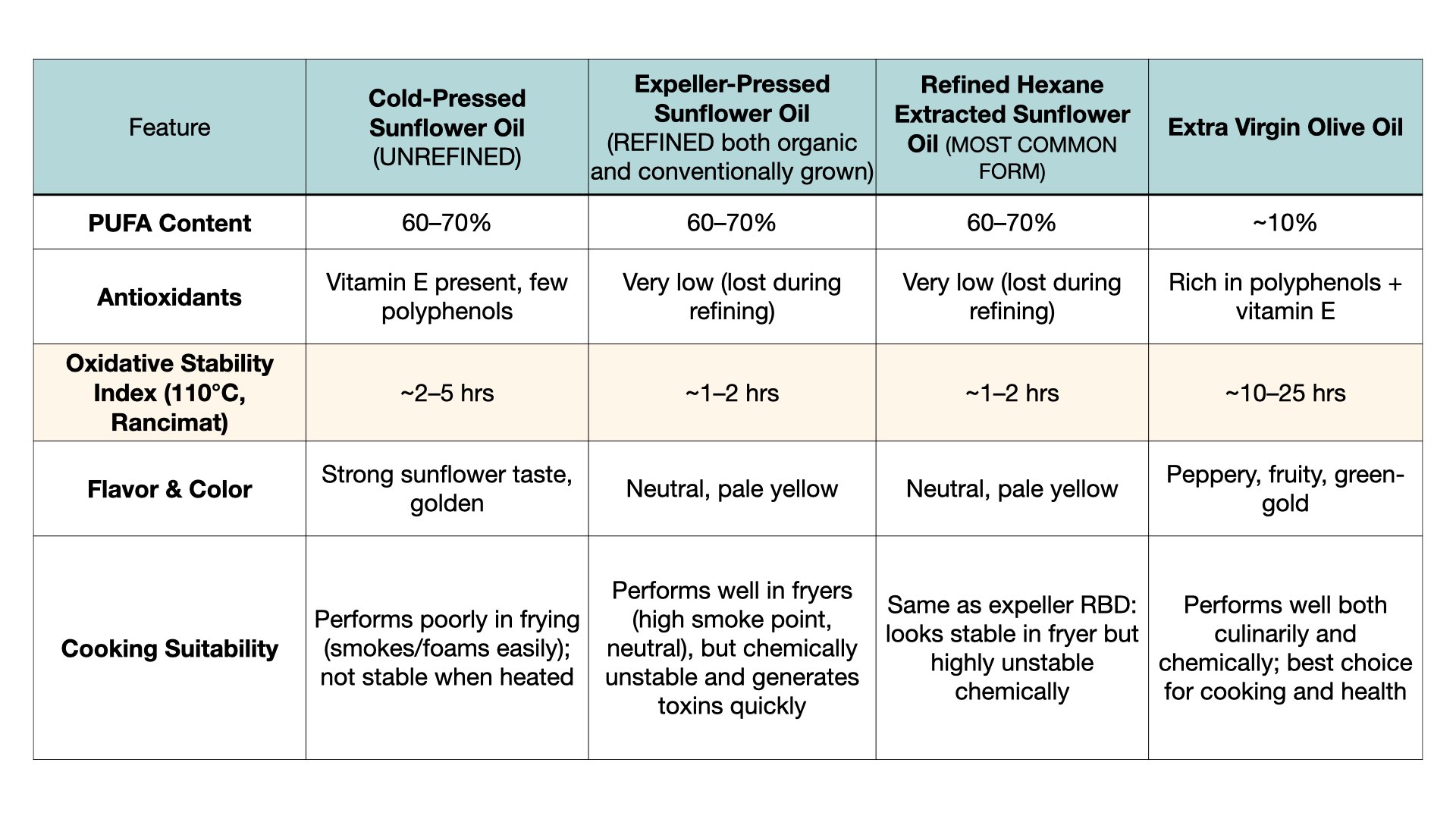
As you can see in the table, unrefined sunflower oil tests slightly more stable in lab measurements. This is due to the antioxidants that are still present. But those antioxidants can’t make up for the fact that the PUFA fatty acids oxidize so easily; they just don’t hold up to cooking.
Olive oil, on the other hand, is far more stable than the refined sunflower oils used in restaurants. As you can see, it performs 10x better on the rancimat test.
Importantly, beef tallow is even more stable than olive oil, with a Rancimat score between 20 and 40 hours. And it’s generally cheaper than olive oil. This is why you see restaurants starting to return to beef tallow. Tallow was actually the main deep-frying oil before the “experts” convinced everyone that tallow would clog our arteries. I remember when McDonald’s fries were fried in tallow.
I also remember a time when I went to McDonald’s after swallowing a ton of air while playing in a swimming pool, feeling nauseated, but I just had to finish those indescribably yummy fries, so I did. And then I threw everything up.
Wait, does that mean olive oil is not all that safe either?
Some folks assume that these Rancimat numbers translate directly to how many toxins develop during cooking and conclude that olive oil is not suitable for cooking at all. But in reality, it does not translate that way. The toxins don’t form gradually. They don’t form at all, and then they form in abundance. So go ahead and cook with olive oil, just be a little cautious, and don’t keep cooking after your food has already browned.
Think of the Rancimat test like a steep downhill drive. One car has new brakes (a stable oil), the other has worn-out brakes on the verge of failing (an unstable oil). The car with new brakes is safe to drive. The car with worn-out brakes is not. Because once those brakes do fail, the car speeds out of control, and danger comes quickly.
So a Rancimat value 10× higher doesn’t mean the oil forms exactly 1/10th the toxins. It means the oil can “hold back” oxidation far longer — giving you plenty of perfectly safe driving before things go off the rails.
Key Takeaways (Worst –> Best)
- Regular sunflower oil: Just as harmful as the other members of the hateful eight, nutrient-depleted, contaminated with toxins.
- Expeller-pressed sunflower oil: This only means no hexane was used. It’s still heated. Still refined and devoid of nutrients.
- Organic sunflower oil. This is basically the same as expeller pressed, the only difference being that it was also grown organically. But that’s not going to make much difference since the refining removes most of the pesticide
- Cold-pressed sunflower oil: Free of refining toxins but still high in unstable PUFA. Fine in moderation, but not for cooking.
The Bottom Line
The buzzwords don’t tell us the full story. “Organic sunflower oil”? Still refined. “Expeller-pressed sunflower oil”? Still refined. Only cold-pressed virgin sunflower oil escapes the toxic refining process—yet even that is fragile, PUFA-heavy, and not for cooking.
When you see sunflower oil on an ingredients label, assume it’s the industrial kind. That makes it no healthier than soy or canola.
For your kitchen, better choices are cold-pressed olive oil, coconut oil, butter, and other traditional seed oils and animal fats. If you want to experiment, small amounts of cold-pressed sunflower oil can add flavor to raw dishes—but I wouldn’t cook with it.
Sunflower oil may look sunny and natural, but in most cases, it’s just another seed oil dressed up with better marketing.
OTHER VIEWPOINTS ON WHY SEED OILS ARE BAD:
If you read what’s being written about seed oils for any length of time, you’re going to encounter people who believe they’re bad for an entirely different reason.
Some people argue that the problem with seed oils comes down to one molecule: linoleic acid. Our modern diet is too high in linoleic acid, they argue, which should represent just 1-2 percent of our daily calories. Given this belief, anything high in linoleic acid—sunflower seeds, sunflower oil, even many nuts and grains—should be avoided. Only foods high in saturated fat are considered safe. That means you can’t eat chicken, fish, or any kind of pork except “low PUFA pork.” You can’t even cook with olive oil.
There are two problems with this view.
One, is that it makes a lot of assumptions about what humans used to eat that don’t seem accurate. We have little evidence to support that 1-2% figure. We’re getting an average of 7-14% now (depending on who you believe) and the anti-linoleic acid folks say that’s the whole reason people are sicker today. But most people get most of that linoleic acid from seed oils, and the seed oils are what’s new to the human experience. Not linoleic acid.
Two, it misses the real issue: Processing makes the poison. Seed oils aren’t harmful because they contain linoleic acid. They’re harmful because industrial refining transforms them into pro-oxidative toxins that deplete our defenses and drive disease. This is a big topic, and if you want to understand it better, I’ve covered it thoroughly in my latest book, Dark Calories.


