Saffron Road’s seed oil-free certification aims to ‘level up’ frozen aisle
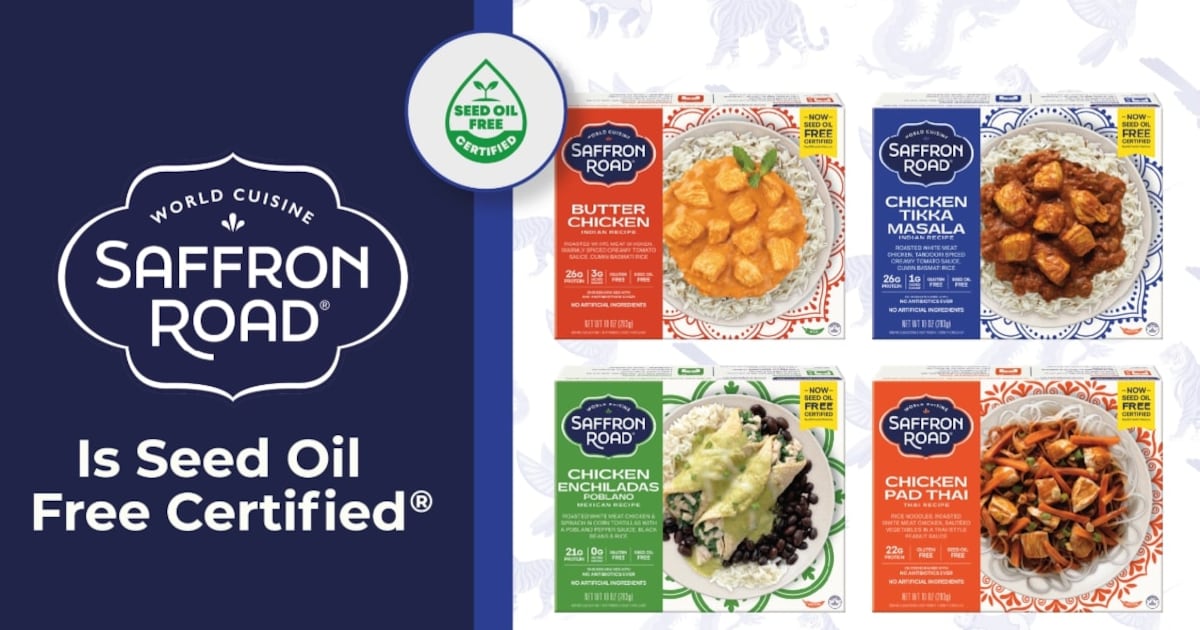
Saffron Road’s President Paul Turbeville says the certification – paired with higher protein levels and sustainable packaging – is part of a broader brand renovation designed to boost its presence in the frozen aisle and lead on the next major clean-label trend.
Saffron Road reformulates to remove seed oils from its frozen meals
Saffron Road, a Certified B Corp, made its frozen entrée line Seed Oil Free Certified, a first for the brand. The company worked with the Seed Oil Free Alliance to test all added oils and fats and confirm compliance with the group’s standards.
“We like to be ahead of the wave,” said Turbeville. “People are learning about seed oils and the potential risks of seed oils from all sorts of sources … and we wanted to lead and push the category in this direction.”
Turbeville said Saffron Road previously used oils such as sunflower oil in the past. “Even that, we felt like, we’re always looking for a way to do better and to up our game,” he said. “This was a step even further down that path for us.”
The frozen meals now use olive oil. Turbeville described it as “a multi-thousand-year history” ingredient that has “stood the test of time from a health and wellness standpoint.”
Saffron Road’s Seed Oil Free Certified frozen entrées include:
- Butter Chicken
- Cheese Enchiladas Al Chipotle
- Chicken & Cheese Enchiladas Al Chipotle
- Chicken and Potatoes
- Chicken Biryani
- Chicken Enchiladas Poblano
- Chicken Pad Thai
- Chicken Tikka Masala
- Chickpea Masala
- Coconut Curry Chicken
- Drunken Noodles with Chicken
- Lamb Saag
- Slow Roasted Adobo Garlic Chicken
- Vegetable Pad Thai
The reformulated entrees are available nationwide at Whole Foods, Kroger, Albertsons and other major retailers, according to the company.
Saffron Road’s reformulation comes amid rising scrutiny for seed oils despite experts saying that the stigma overlooks lipid research and nutritional science.
Certification process
The Seed Oil Free Certification required months of testing and verification.
“We launched the initiative in January, and we went into production sort of May–June,” Turbeville said.
Seed Oil Free Certified is “very serious about their standards. That included testing the oils that we’re using to make sure that they’re not contaminated with seed oil, switching practices in some of the oil supply chains,” he added.
Protein increases and packaging changes
The seed oil removal was part of a broader renovation. The brand increased the amount of protein in animal-based entrées, and it plans to introduce plant-fiber trays in early 2026 as a strategy to “level up the brand entirely,” Turbeville explained.
On products with chicken or lamb, the protein increase ranged from 50% and upwards of 100% per 20-26 grams per serving depending on the entrée, Turbeville said.
The combination of higher-protein meals and cleaner ingredients led to low double-digit price increases. Turbeville said consumers have generally accepted the change.
“A line that Adnan [Durrani, founder and CEO] often uses that I love is ‘We sell values for value,’” he said. “Our consumer has a higher willingness to pay, and they recognize that you get the quality that they’re after. It’s not going to be the least expensive thing on the shelf.”
Consumer feedback and category data
Turbeville said the renovation was informed by internal discussions, employee input and direct consumer feedback.
“I look at all of our complaints every week, and so that was a part of just kind of seeing like, hey, the consumer is asking for more protein,” he said.
He also noted that broader category data and trends – including interest from people using GLP-1 medications – shaped the renovation.
Turbeville said Saffron Road has received feedback from people using GLP-1 medications, who often eat smaller portions but want meals that are flavorful and protein-rich.
“People who are on GLP-1s tend to not be interested in cooking because they’re not that hungry, and so they’re also interested in portion control,” he said. “Flavor starts to be more important to them … they want to eat something that tastes really good.”
“Keeping the protein levels up is definitely front and center,” he added. “We’ve gotten praise from folks in the GLP-1 community.”
Don’t miss Food Navigator’s broadcast series on Weight Management
Join industry leaders and scientists on November 13 & 19 as we explore how the rise of GLP-1 weight-loss drugs is disrupting the food & beverage space – and uncover how functional foods, bioactive ingredients and next-gen formulations can reshape satiety, metabolism and brand opportunity.
Register today for free and claim your spot at the forefront of the “weight-management 2025” narrative.
Advice for other brands looking to reformulate
On reformulating for cleaner labels, Turbeville recommended starting with small, meaningful steps. He suggested focusing on the most processed ingredients, whether they be oils or dyes, and making incremental improvements.
“Just start wherever you are,” he said. “They may not be able to get to our standard right away – we’d love it if they did. But I think what’s the most meaningful, impactful one change that they could make to start out with.”
Marketing and consumer engagement
Saffron Road launched national advertising in August to communicate the reformulation and certification.
“That included our first national advertising campaign” which includes digital channels and seed oil influencers, Turbeville said.
“These are folks who often are probably skipping the frozen aisle entirely because there’s a lot of junk there, to be honest. And so we’re trying to engage the consumer, to bring them into a part of the store they may not be shopping,” he added.
Frozen category trends
Turbeville said interest in frozen foods is rising again post-pandemic, particularly for healthier, better-for-you options.
“I’ve been in natural foods since 2014 and I haven’t seen this much excitement in the category in a long time,” he said. “There’s actually a broad kind of natural food revival happening right now. People are looking at the American public health crisis … and food is a big part of that.”
He encouraged retailers to carry more better-for-you options, saying the assortment in the frozen aisle can influence which consumers visit it. “If you want to attract people who are more health-conscious, you’ve got to give them more options and entice them to walk down the aisle,” he said.