How belief in conspiracy theories could harm sustainability
Abstract
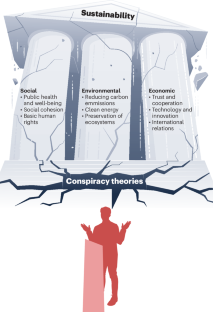
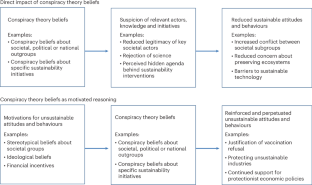
Previous research and theorizing have overwhelmingly focused on the psychological underpinnings of conspiracy beliefs. Here we examine what conspiracy beliefs imply for attitudes and behaviours relevant for the social, environmental and economic dimensions of sustainability. We propose that conspiracy beliefs mostly contribute negatively to sustainability, either by reducing sustainable attitudes and behaviours or by justifying (and thereby reinforcing) people’s existing unsustainable attitudes and behaviours. Specifically, conspiracy beliefs are mostly associated with reduced public health and well-being, weakened social cohesion and deteriorated basic human rights (social sustainability); with lower support for reducing carbon emissions, investing in clean energy sources and preserving delicate ecosystems (environmental sustainability); and with reduced trust and cooperation, diminished support for technological innovation and increased harm to the international relationships necessary for fair trade (economic sustainability). However, most studies supporting these relationships were conducted in western democratic societies, underscoring a need for more cross-cultural research on these issues.
This is a preview of subscription content, access via your institution
Access options
Access Nature and 54 other Nature Portfolio journals
Get Nature+, our best-value online-access subscription
$32.99 / 30 days
cancel any time
Subscribe to this journal
Receive 12 digital issues and online access to articles
$119.00 per year
only $9.92 per issue
Buy this article
- Purchase on SpringerLink
- Instant access to full article PDF
Prices may be subject to local taxes which are calculated during checkout
References
-
Casara, B. G. S., Suitner, C. & Jetten, J. The impact of economic inequality on conspiracy beliefs. J. Exp. Soc. Psychol. 98, 104245 (2022).
-
Hebel-Sela, S., Hameiri, B. & Halperin, E. The vicious cycle of violent intergroup conflicts and conspiracy theories. Curr. Opin. Psychol. 47, 101422 (2022).
-
Van Prooijen, J.-W. & Douglas, K. M. Conspiracy theories as part of history: the role of societal crisis situations. Mem. Stud. 10, 323–333 (2017).
-
Van Prooijen, J.-W. Group-oriented motivations underlying conspiracy theories. Group Process. Inter. 27, 1050–1067 (2024).
-
Zhao, Q., Van Prooijen, J.-W. & Spadaro, G. Coping capacity attenuates the effect of natural disaster risk on conspiracy beliefs. J. Environ. Psychol. 97, 102363 (2024).
-
Adam-Troian, J. et al. Investigating the links between cultural variables and belief in conspiracy theories: the key roles of collectivism and masculinity. Polit. Psychol. 42, 597–618 (2021).
-
Hornsey, M. J., Bierwiaczonek, K., Sassenberg, K. & Douglas, K. M. Individual, intergroup and nation-level influences on belief in conspiracy theories. Nat. Rev. Psychol. 2, 85–97 (2023).
-
Hornsey, M. J. et al. Multination data show that conspiracy beliefs are associated with the perception (and reality) of poor national economic performance. Eur. J. Soc. Psychol. 53, 78–89 (2023).
-
Mao, J.-Y., Zeng, Z.-X., Yang, S.-L., Guo, Y.-Y. & Van Prooijen, J.-W. Explaining the paradox of conspiracy theories and system-justifying beliefs from an intergroup perspective. Polit. Psychol. 45, 299–318 (2024).
-
Van Prooijen, J.-W. & Song, M. The cultural dimension of intergroup conspiracy theories. Br. J. Psychol. 112, 455–473 (2021).
-
Van Prooijen, J.-W. & Van Vugt, M. Conspiracy theories: evolved functions and psychological mechanisms. Perspect. Psychol. Sci. 13, 770–788 (2018).
-
Zeng, Z.-X. et al. How does economic inequality shape conspiracy theories? Empirical evidence from China. Br. J. Soc. Psychol. 63, 477–498 (2023).
-
Douglas, K. M. & Sutton, R. M. What are conspiracy theories? A definitional approach to their correlates, consequences, and communication. Annu. Rev. Psychol. 74, 271–298 (2023).
-
Van der Linden, S. Misinformation: susceptibility, spread, and interventions to immunize the public. Nat. Med. 28, 460–467 (2022).
-
Douglas, K. M. et al. Understanding conspiracy theories. Polit. Psychol. 40, 3–35 (2019).
-
Van Prooijen, J.-W. & Douglas, K. M. Belief in conspiracy theories: basic principles of an emerging research domain. Eur. J. Soc. Psychol. 48, 897–908 (2018).
-
Bowes, S. M., Costello, T. H. & Tasimi, A. The conspiratorial mind: a meta-analytic review of motivational and personological correlates. Psychol. Bull. 149, 259–293 (2023).
-
Jetten, J., Peters, K. & Casara, B. G. S. Economic inequality and conspiracy theories. Curr. Opin. Psychol. 47, 101358 (2022).
-
Barbier, E. B. The concept of sustainable economic development. Environ. Conserv. 14, 101–110 (1987).
-
Clark, W. C. Sustainability science: a room of its own. Proc. Natl Acad. Sci. USA 104, 1737–1738 (2007).
-
Rai, S. S., Rai, S. & Singh, N. K. Organizational resilience and social-economic sustainability: COVID-19 perspective. Environ. Dev. Sustain. 23, 12006–12023 (2021).
-
Purvis, B., Mao, Y. & Robinson, D. Three pillars of sustainability: in search of conceptual origins. Sustain. Sci. 14, 681–695 (2019).
-
Parlasca, M. C. & Qaim, M. Meat consumption and sustainability. Annu. Rev. Resour. Econ. 14, 17–41 (2022).
-
Ranjbari, M. et al. Three pillars of sustainability in the wake of COVID-19: a systematic review and future research agenda for sustainable development. J. Clean. Prod. 297, 126660 (2021).
-
Udry, J. & Barber, S. J. The illusory truth effect: a review of how repetition increases belief in misinformation. Curr. Opin. Psychol. 56, 101736 (2024).
-
Jolley, D. & Douglas, K. The social consequences of conspiracism: exposure to conspiracy theories decreases intentions to engage in politics and to reduce one’s carbon footprints. Br. J. Psychol. 105, 35–56 (2014).
-
Pummerer, L. et al. Conspiracy theories and their societal effects during the COVID-19 pandemic. Soc. Psychol. Pers. Sci. 13, 49–59 (2022).
-
Hornsey, M. J. & Fielding, K. S. Attitude roots and Jiu Jitsu persuasion: understanding and overcoming the motivated rejection of science. Am. Psychol. 72, 459–473 (2017).
-
Lewandowsky, S., Gignac, G. E. & Oberauer, K. The role of conspiracist ideation and worldviews in predicting rejection of science. PLoS ONE 8, e75637 (2013).
-
Lewandowsky, S. et al. When science becomes embroiled in conflict: recognizing the public’s need for debate while combating conspiracies and misinformation. Ann. Am. Acad. Political Soc. Sci. 700, 26–40 (2022).
-
Rutjens, B. T. & Veckalov, B. Conspiracy beliefs and science rejection. Curr. Opin. Psychol. 46, 101392 (2022).
-
Rutjens, B. T. & Hornsey, M. J. Chapter five—the psychology of science rejection. Adv. Exp. Soc. Psychol. 71, 243–280 (2025).
-
Miller, J. M., Saunders, K. L. & Farhart, C. E. Conspiracy endorsement as motivated reasoning: the moderating roles of political knowledge and trust. Am. J. Polit. Sci. 60, 824–844 (2016).
-
Uscinski, J., Enders, A. M., Klofstad, C. & Stoler, J. Cause and effect: on the antecedents and consequences of conspiracy theory beliefs. Curr. Opin. Psychol. 47, 101364 (2022).
-
Van Prooijen, J.-W. & Böhm, N. Do conspiracy theories shape or rationalize vaccination hesitancy over time. Soc. Psychol. Pers. Sci. 15, 421–429 (2024).
-
Cichocka, A., Marchlewska, M. & Biddlestone, M. Why do narcissists find conspiracy theories so appealing. Curr. Opin. Psychol. 47, 101386 (2022).
-
Hornsey, M. J. et al. To what extent are conspiracy theorists concerned for self versus others? A COVID-19 test case. Eur. J. Soc. Psychol. 51, 285–293 (2021).
-
Imhoff, R. & Lamberty, P. A bioweapon or a hoax? The link between distinct conspiracy beliefs about the coronavirus disease (COVID-19) outbreak and pandemic behavior. Soc. Psychol. Pers. Sci. 11, 1110–1118 (2020).
-
Zajenkowski, M., Górniak, J., Wojnarowski, K., Sobol, M. & Jonason, P. K. I need some answers, now!: Present time perspective is associated with holding conspiracy beliefs. Pers. Individ. Differ. 196, 111723 (2022).
-
Jolley, D. & Douglas, K. The effects of anti-vaccine conspiracy theories on vaccination intentions. PLoS ONE 9, e89177 (2014).
-
Loomba, S., de Figueiredo, A., Piatek, S. J., de Graaf, K. & Larson, H. J. Measuring the impact of COVID-19 vaccine misinformation on vaccination intent in the UK and USA. Nat. Hum. Behav. 5, 337–348 (2021).
-
Freeman, D. et al. COVID-19 vaccine hesitancy in the UK: the Oxford coronavirus explanations, attitudes, and narratives survey (Oceans) II. Psychol. Med. 52, 3127–3141 (2022).
-
Hornsey, M. J., Harris, E. A. & Fielding, K. S. The psychological roots of anti-vaccination attitudes: a 24-nation investigation. Health Psychol. 37, 307–315 (2018).
-
Grebe, E. & Nattrass, N. AIDS conspiracy beliefs and unsafe sex in Cape Town. AIDS Behav. 16, 761–773 (2012).
-
Lamberty, P. & Imhoff, R. Powerful pharma and its marginalized alternatives? Effects of individual differences in conspiracy mentality on attitudes toward medical approaches. Soc. Psychol. 49, 255–270 (2018).
-
Bierwiaczonek, K., Gundersen, A. B. & Kunst, J. R. The role of conspiracy beliefs for COVID-19 health responses: a meta-analysis. Curr. Opin. Psychol. 46, 101346 (2022).
-
Van Prooijen, J.-W., Etienne, T., Kutiyski, T. & Krouwel, A. P. M. Just a flu? Self-perceived infection mediates the link between conspiracy beliefs and COVID-19 health beliefs and behaviors. J. Health Psychol. 27, 1421–1431 (2022).
-
Bierwiaczonek, K., Kunst, J. R. & Pich, O. Belief in COVID-19 conspiracy theories reduces social distancing over time. Appl. Psychol. Health Wellbeing 12, 1270–1285 (2020).
-
Van Prooijen, J.-W. et al. A longitudinal analysis of conspiracy beliefs and COVID-19 health responses. Psychol. Med. 53, 5709–5716 (2023).
-
Van Prooijen, J.-W., Etienne, T., Kutiyski, T. & Krouwel, A. P. M. Conspiracy beliefs prospectively predict health behavior and well-being during a pandemic. Psychol. Med. 53, 2514–2521 (2023).
-
Bronstein, M. V., Kummerfeld, E., MacDonald, A. III & Vinogradov, S. Willingness to vaccinate against SARS-CoV-2: the role of reasoning biases and conspiracist ideation. Vaccine 40, 213–222 (2022).
-
Cao, S., Van Prooijen, J.-W. & Van Vugt, M. The motivations and reputational consequences of spreading conspiracy theories. Br. J. Soc. Psychol. 64, e12784 (2024).
-
Green, R., Toribio-Flórez, D., Douglas, K. M., Brunkow, J. W. & Sutton, R. M. Making an impression: the effects of sharing conspiracy theories. J. Exp. Soc. Psychol. 104, 104398 (2023).
-
Nera, K., Jetten, J., Biddlestone, M. & Klein, O. ‘Who wants to silence us?’ Perceived discrimination of conspiracy theory believers increases ‘conspiracy theorist’ identification when it comes from power holders—but not from the general public. Br. J. Soc. Psychol. 61, 1263–1285 (2022).
-
Lantian, A. et al. Stigmatized beliefs: conspiracy theories, anticipated negative evaluation of the self, and fear of social exclusion. Eur. J. Soc. Psychol. 48, 939–954 (2018).
-
Green, J., Druckman, J. N., Lazer, D., Ognyanova, K. & Perlis, R. H. Depressive symptoms and conspiracy beliefs. Appl. Cogn. Psych. 37, 332–359 (2023).
-
Acar, K. et al. Delusion proneness predicts COVID-19 vaccination behavior. Front. Psychiatry 15, 1450429 (2024).
-
Greenburgh, A. & Raihaini, N. J. Paranoia and conspiracy thinking. Curr. Opin. Psychol. 47, 101362 (2022).
-
Roels, S., Begeer, S., Scheeren, A. & Van Prooijen, J.-W.Conspiracy mentality in autistic and non-autistic individuals. Cogn. Neuropsychiatry 29, 228–241 (2024).
-
Leibovitz, T., Shamblaw, A. L., Rumas, R. & Best, M. W. COVID-19 conspiracy beliefs: relations with anxiety, quality of life, and schemas. Pers. Individ. Differ. 175, 110704 (2021).
-
Liekefett, L., Christ, O. & Becker, J. C. Can conspiracy beliefs be beneficial? Longitudinal linkages between conspiracy beliefs, anxiety, uncertainty aversion, and existential threat. Pers. Soc. Psychol. Bull. 49, 167–179 (2023).
-
Van Prooijen, J.-W. Injustice without evidence: the unique role of conspiracy theories in social justice research. Soc. Justice Res. 35, 88–106 (2022).
-
Abalakina-Paap, M., Stephan, W., Craig, T. & Gregory, W. L. Beliefs in conspiracies. Polit. Psychol. 20, 637–647 (1999).
-
Bilewicz, M., Witkowska, M., Pantazi, M., Gkinopoulos, T. & Klein, O. Traumatic rift: how conspiracy beliefs undermine cohesion after societal trauma? Eur. J. Psychol. 15, 82–93 (2019).
-
Golec de Zavala, A. & Cichocka, A. Collective narcissism and anti-semitism in Poland. Group Process. Inter. 15, 213–229 (2012).
-
Imhoff, R. & Bruder, M. Speaking (un-)truth to power: conspiracy mentality as a generalized political attitude. Eur. J. Personal. 28, 25–43 (2014).
-
Kofta, M., Soral, W. & Bilewicz, M. What breeds conspiracy antisemitism? The role of political uncontrollability and uncertainty in the belief in Jewish conspiracy. J. Pers. Soc. Psychol. 118, 900–918 (2020).
-
Jolley, D., Meleady, R. & Douglas, K. M. Exposure to conspiracy theories promotes prejudice which spreads across groups. Br. J. Psychol. 111, 17–35 (2020).
-
Nera, K., Wagner-Egger, P., Bertin, P., Douglas, K. M. & Klein, O. A power-challenging theory of society, or a conservative mindset? Upward and downward conspiracy theories as ideologically distinct beliefs. Eur. J. Soc. Psychol. 51, 740–757 (2021).
-
Poon, K.-T., Chan, R. S. W. & Lai, H.-S. Are rules made to be broken? Conspiracy exposure promotes aggressive behavior. Polit. Psychol. 45, 923–940 (2023).
-
Obaidi, M., Kunst, J., Ozer, S. & Kimel, S. Y. The “Great Replacement” conspiracy: how the perceived ousting of Whites can evoke violent extremism and Islamophobia. Group Process. Integr. 25, 1675–1695 (2022).
-
Edelson, J., Alduncin, A., Krewson, C., Sieja, J. A. & Uscinski, J. E. The effect of conspiratorial thinking and motivated reasoning on belief in election fraud. Polit. Res. Quart. 70, 933–946 (2017).
-
Wang, H. & Van Prooijen, J.-W. Stolen elections: how conspiracy beliefs during the 2020 American presidential elections changed over time. Appl. Cogn. Psych. 37, 277–289 (2023).
-
Krouwel, A., Kutiyski, Y., Van Prooijen, J.-W., Martinsson, J. & Markstedt, E. Does extreme political ideology predict conspiracy beliefs, economic evaluations and political trust? Evidence from Sweden. J. Soc. Political Psychol. 5, 435–462 (2017).
-
Kunst, J. R. et al. Leveraging artificial intelligence to identify the psychological factors associated with conspiracy theory beliefs online. Nat. Commun. 15, 7497 (2024).
-
Imhoff, R. et al. Conspiracy mentality and political orientation across 26 countries. Nat. Hum. Behav. 6, 392–403 (2022).
-
Van der Linden, S., Panagopoulos, C., Azevedo, F. & Jost, J. J. The paranoid style in American politics revisited: an ideological asymmetry in conspiratorial thinking. Polit. Psychol. 42, 23–51 (2021).
-
Van Prooijen, J.-W., Krouwel, A. P. M. & Pollet, T. Political extremism predicts belief in conspiracy theories. Soc. Psychol. Pers. Sci. 6, 570–578 (2015).
-
Smallpage, S. M., Enders, A. M. & Uscinski, J. E.The partisan contours of conspiracy theory beliefs. Res. Politics https://doi.org/10.1177/2053168017746554 (2017).
-
Bertin, P., Delouvée, S., McColl, K. & Van Prooijen, J.-W. Rage against the machine: investigating conspiracy theories about the video assistant referee on Twitter during the 2018 FIFA World Cup. Sports Manag. Rev. 26, 495–516 (2023).
-
Adam-Troian, J. et al. Of precarity and conspiracy: introducing a socio-functional model of conspiracy beliefs. Br. J. Soc. Psychol. 62, 136–159 (2023).
-
Van Prooijen, J.-W. Why education predicts decreased belief in conspiracy theories. Appl. Cogn. Psych. 31, 50–58 (2017).
-
Bilewicz, M. Conspiracy beliefs as an adaptation to historical trauma. Curr. Opin. Psychol. 47, 101359 (2022).
-
Crocker, J., Luhtanen, R., Broadnax, S. & Blaine, B. E. Belief in U.S. government conspiracies against Blacks among Black and White college students: powerlessness or system blame? Pers. Soc. Psychol. Bull. 25, 941–953 (1999).
-
Pantazi, M., Gkinopoulos, T., Witkowska, M., Klein, O. & Bilewicz, M. “Historia est magistra vitae”? The impact of historical victimhood on current conspiracy beliefs. Group Process. Integr. 25, 581–601 (2022).
-
Van Prooijen, J.-W., Staman, J. & Krouwel, A. P. M. Increased conspiracy beliefs among ethnic and Muslim minorities. Appl. Cogn. Psych. 32, 661–667 (2018).
-
Pantazi, M., Papaioannou, K. & Van Prooijen, J.-W. Power to the people: the hidden link between support for direct democracy and belief in conspiracy theories. Polit. Psychol. 43, 529–548 (2022).
-
Papaioannou, K., Pantazi, M. & Van Prooijen, J.-W. Is democracy under threat? Why belief in conspiracy theories predicts autocratic attitudes. Eur. J. Soc. Psychol. 53, 846–856 (2023).
-
Papaioannou, K., Pantazi, M. & Van Prooijen, J.-W. Rejection of the status quo: conspiracy theories and preference for alternative political systems. Br. J. Soc. Psychol. 63, 2077–2099 (2024).
-
Jolley, D., Douglas, K. M., Leite, A. C. & Schrader, T. Belief in conspiracy theories and intentions to engage in everyday crime. Br. J. Psychol. 58, 534–549 (2019).
-
Kerodal, A. G., Freilich, J. D. & Chermak, S. M. Commitment to extremist ideology: using factor analysis to move beyond binary measures of extremism. Stud. Confl. Terror. 39, 687–711 (2016).
-
Fiebig, V. & Koehler, D. Uncharted territory: towards an evidence-based criminology of sovereign citizens through a systematic literature review. Perspect. Terror. 16, 34–48 (2022).
-
Rathje, J.Driven by conspiracies: the justification of violence among “Reichsbürger” and other conspiracy-ideological sovereignists in contemporary Germany. Perspect. Terror. 16, 49–61 (2022).
-
Kruglanski, A. W., Molinario, E., Ellenberg, M. & Di Cicco, G. Terrorism and conspiracy theories: a view from the 3N model of radicalization. Curr. Opin. Psychol. 47, 101396 (2022).
-
Miller, M. K. The Social Science of QAnon: a New Social and Political Phenomenon (Cambridge Univ. Press, 2023).
-
Bartlett, J. & Miller, C. The Power Of Unreason: Conspiracy Theories, Extremism and Counter-Terrorism (Demos, 2010).
-
Imhoff, R., Dieterle, L. & Lamberty, P. Resolving the puzzle of conspiracy worldview and political activism: belief in secret plots decreases normative but increases nonnormative political engagement. Soc. Psychol. Pers. Sci. 12, 71–79 (2021).
-
Jolley, D. & Paterson, J. L. Pylons ablaze: examining the role of 5G COVID-19 conspiracy beliefs and support for violence. Br. J. Soc. Psychol. 59, 628–640 (2020).
-
Rottweiler, B. & Gill, P. Conspiracy beliefs and violent extremist intentions: the contingent effects of self-efficacy, self-control and law-related morality. Terror. Polit. Violence 34, 1485–1504 (2022).
-
Schrader, T., Jolley, D., Jolley, R. P. & Krahenbuhl, S. Upholding social hierarchies: social dominance orientation moderates the link between (intergroup) conspiracy exposure and violent extremism. Group Process. Integr. https://doi.org/10.1177/13684302241247985 (2024).
-
Šrol, J., Čavojová, V. & Ballová Mikušková, E. Finding someone to blame: the link between COVID-19 conspiracy beliefs, prejudice, support for violence, and other negative social outcomes. Front. Psychol. 12, e726076 (2022).
-
Douglas, K. M. & Sutton, R. M. Climate change: why the conspiracy theories are dangerous. Bull. At. Sci. 71, 98–106 (2015).
-
Tam, K.-P. & Chan, H.-W. Conspiracy theories and climate change: a systematic review. J. Environ. Psychol. 91, 102129 (2023).
-
Hornsey, M. J., Harris, E. A. & Fielding, K. S. Relationships among conspiratorial beliefs, conservatism and climate scepticism across nations. Nat. Clim. Change 8, 614–620 (2018).
-
Haltinner, K. & Sarathchandra, D. Predictors of pro-environmental beliefs, behaviors, and policy support among climate change skeptics. Soc. Curr. 9, 180–202 (2022).
-
Chan, H.-W., Tam, K.-P. & Hong, Y.-Y. Does belief in climate change conspiracy theories predict everyday life pro-environmental behaviors? Testing the longitudinal relationship in China and the U.S. J. Environ. Psychol. 87, 101980 (2023).
-
Van der Linden, S. The conspiracy-effect: exposure to conspiracy theories (about global warming) decreases pro-social behavior and science acceptance. Pers. Individ. Differ. 87, 171–173 (2015).
-
Biddlestone, M., Azevedo, F. & Van der Linden, S. Climate of conspiracy: a meta-analysis of the consequences of belief in conspiracy theories about climate change. Curr. Opin. Psychol. 46, 101390 (2022).
-
Bolsen, T., Palm, R. & Kingsland, J. T. Effects of conspiracy rhetoric on views about the consequences of climate change and support for direct carbon capture. Environ. Commun. 16, 209–224 (2022).
-
Lezak, S. B. & Thibodeau, P. H. Systems thinking and environmental concern. J. Environ. Psychol. 46, 143–153 (2016).
-
Haltinner, K., Sarathchandra, D. & Ptak, T. How believing that climate change is a conspiracy affects skeptics’ environmental attitudes. Environ. Sci. Policy Sustain. Dev. 63, 25–33 (2021).
-
Winter, K., Hornsey, M. J., Pummerer, L. & Sassenberg, K. Anticipating and defusing the role of conspiracy beliefs in shaping opposition to wind farms. Nat. Energy 7, 1200–1207 (2022).
-
Winter, K., Hornsey, M. J., Pummerer, L. & Sassenberg, K. Public agreement with misinformation about wind farms. Nat. Commun. 15, 8888 (2024).
-
Ruan, T. & Lv, Q. Public perception of electric vehicles on reddit over the past decade. Commun. Transp. Res. 2, 100070 (2022).
-
Marques, M. D., Kerr, J. R., Williams, M. N., Ling, M. & McLennan, J. Associations between conspiracism and the rejection of scientific innovations. Public Underst. Sci. 30, 854–867 (2021).
-
Dong, Y., Yang, X., Zhang, X. & Jiang, J. ‘They are conspiring against us’: how outgroup conspiracy theories stimulate environmental neglect in intergroup resource dilemmas. Br. J. Soc. Psychol. 63, 1856–1878 (2024).
-
Barbosa de Andrade Aragão, R., Bastos Lima, M. G., Burns, G. L., Ross, H. & Biggs, D. ‘Greenlash’ and reactionary stakeholders in environmental governance: an analysis of soy farmers against zero deforestation in Brazil. For. Policy Econ. 166, 103267 (2024).
-
Salles, D., de Medeiros, P. M., Santini, R. M. & Barros, C. E. The far-right smokescreen: environmental conspiracy and culture wars on Brazilian YouTube. Soc. Media Soc. https://doi.org/10.1177/20563051231196876 (2023).
-
Van Prooijen, J.-W., Spadaro, G. & Wang, H. Suspicion of institutions: how distrust and conspiracy theories deteriorate social relationships. Curr. Opin. Psychol. 43, 65–69 (2022).
-
Schyns, P. & Koop, C. Political distrust and social capital in Europe and the USA. Soc. Indic. Res. 96, 145–167 (2010).
-
Sønderskov, K. M. & Dinesen, P. T. Trusting the state, trusting each other? The effect of institutional trust on social trust. Polit. Behav. 38, 179–202 (2016).
-
Spadaro, G., Gangl, K., van Prooijen, J.-W., van Lange, P. A. M. & Mosso, C. O. Enhancing feelings of security: how institutional trust promotes interpersonal trust. PLoS ONE 15, e0237934 (2020).
-
Spadaro, G. et al. Corrupt third parties undermine trust and prosocial behavior between people. Nat. Hum. Behav. 7, 46–54 (2023).
-
Meuer, M. & Imhoff, R. Believing in hidden plots is associated with decreased behavioral trust: conspiracy beliefs as greater sensitivity to social threat or insensitivity towards its absence? J. Exp. Soc. Psychol. 93, 104081 (2021).
-
Schepisi, M. et al. Conspiracy mentality differently shapes interpersonal trust when money or digital privacy is at stake. J. Trust Res. 14, 78–95 (2023).
-
Fiagbenu, M. E. The stock market is rigged? Conspiracy beliefs and distrust predict lower stock market participation. Appl. Cogn. Psych. 36, 978–995 (2022).
-
Valero-Mora, P. M., Zacarés, J. J., Sánchez-García, M., Tormo-Lancero, M. T. & Faus, M. Conspiracy beliefs are related to the use of smartphones behind the wheel. Int. J. Environ. Res. Public Health 18, 7725 (2021).
-
Köbis, N., Van Prooijen, J.-W., Righetti, F. & Van Lange, P. A. M. Prospection in individual and interpersonal corruption dilemmas. Rev. Gen. Psychol. 20, 71–85 (2016).
-
Alper, S. There are higher levels of conspiracy beliefs in more corrupt countries. Eur. J. Soc. Psychol. 53, 503–517 (2023).
-
Douglas, K. M. & Sutton, R. M. Does it take one to know one? Endorsement of conspiracy theories is influenced by personal willingness to conspire. Br. J. Soc. Psychol. 50, 544–552 (2011).
-
Alper, S., Toribio-Flórez, D., Capraro, V. & Douglas, K. M. Stronger conspiracy beliefs are associated with a stronger tendency to act dishonestly and an overestimation of others’ dishonesty. Soc. Psychol. Pers. Sci. https://doi.org/10.1177/19485506241302878 (2024).
-
Fousiani, K., Xu, S. & Van Prooijen, J.-W. Leaders’ power construal influences malevolent creativity: the mediating role of organizational conspiracy beliefs. J. Occup. Organ. Psychol. 98, e70005 (2025).
-
Kim, Y. & Lim, H. D. Mitigating organizational conspiracy beliefs through strategic internal communication and employee–organization relationships (EOR) in the workplace. J. Public Relat. Res. 36, 361–387 (2024).
-
Van Prooijen, J.-W. & De Vries, R. E. Organizational conspiracy beliefs: implications for leadership styles and employee outcomes. J. Bus. Psychol. 31, 479–491 (2016).
-
Chen, Y. & Zhang, Z. Exploring public perceptions on alternative meat in China from social media data using transfer learning method. Food Qual. Prefer. 98, 104530 (2022).
-
Wilks, M., Phillips, C. J. V., Fielding, K. & Hornsey, M. J. Testing potential psychological predictors of attitudes towards cultured meat. Appetite 136, 137–145 (2019).
-
Trang, S., Kraemer, T., Trenz, M. & Weiger, W. H. Deeper down the rabbit hole: how technology conspiracy beliefs emerge and foster a conspiracy mindset. Inform. Syst. Res. https://doi.org/10.1287/isre.2022.0494 (2024).
-
Većkalov, B., van Stekelenburg, A., van Harreveld, F. & Rutjens, B. T. Who is skeptical about scientific innovation? Examining worldview predictors of artificial intelligence, nanotechnology, and human gene editing attitudes. Sci. Commun. 45, 337–366 (2023).
-
Marques, M. D., Kerr, J. R., Stukas, A. A. & McLennan, J. The effect of scientific conspiracy theories on scepticism towards biotechnologies. Public Underst. Sci. https://doi.org/10.1177/09636625241300896 (2024).
-
Lantian, A. & Rose, M. No evidence that belief in conspiracy theories is negatively related to attitudes toward transhumanism. Scand. J. Psychol. 65, 569–580 (2024).
-
Golec de Zavala, A., Dyduch-Hazar, K. & Lantos, D. Collective narcissism: political consequences of investing self-worth in the ingroup’s image. Polit. Psychol. 40, 37–74 (2019).
-
Golec de Zavala, A., Bierwiaczonek, K. & Ciesielski, P. An interpretation of meta-analytical evidence for the link between collective narcissism and conspiracy theories. Curr. Opin. Psychol. 47, 101360 (2022).
-
Sternisko, A., Cichocka, A., Cislak, A. & Van Bavel, J. J. National narcissism predicts the belief and dissemination of conspiracy theories during the COVID-19 pandemic: evidence from 56 countries. Pers. Soc. Psychol. Bull. 49, 48–65 (2023).
-
Erisen, C. et al. Psychological correlates of populist attitudes. Polit. Psychol. 42, 149–171 (2021).
-
Papaioannou, K., Pantazi, M. & Van Prooijen, J.-W. Unravelling the relationship between populism and belief in conspiracy theories: the role of cynicism, powerlessness, and zero-sum thinking. Br. J. Psychol. 114, 159–175 (2023).
-
Van Prooijen, J.-W. et al. Populist gullibility: conspiracy theories, news credibility, bullshit receptivity, and paranormal belief. Polit. Psychol. 43, 1061–1079 (2022).
-
Olmstead, K. S. in Conspiracy Theories and the People Who Believe Them (ed. Uscinski, J. E.) 285–297 (Oxford Univ. Press, 2019).
-
Nelson, C. E. Revolution and war: Saddam’s decision to invade Iran. Middle East J. 72, 246–266 (2018).
-
Pipes, D. Conspiracy: How the Paranoid Style Flourishes and Where It Comes From (Simon & Schusters, 1997).
-
Šrol, J. & Čavojová, V. Symbolic threat from the West, belief in pro-Kremlin conspiracy theories, and attribution of blame for the war in Ukraine: a two-wave longitudinal study. Polit. Psychol. 46, 85–103 (2025).
-
Mao, J., Van Prooijen, J.-W. & Van Lange, P. A. M. Conspiracy theories: groups, ideology, and status as three distinct bases for expressions in society. Curr. Dir. Psychol. Sci. https://doi.org/10.1177/09637214241280742 (2024).
-
Lewandowsky, S., Lloyd, E. A. & Brophy, S. When THUNCing Trumps thinking: what distant alternative worlds can tell us about the real world. Argumenta 3, 217–231 (2018).
-
Uscinski, J. et al. Have beliefs in conspiracy theories increased over time? PLoS ONE 17, e0270429 (2022).
Author information
Authors and Affiliations
Contributions
J.-W.v.P., J.S. and M.M. conceived of the article idea and performed the investigation. J.-W.v.P. and M.M. produced the figures. J.-W.v.P. prepared the original draft of the manuscript. J.S. and M.M. contributed to writing the manuscript and reviewed and edited the final version.
Corresponding author
Ethics declarations
Competing interests
The authors declare no competing interests.
Peer review
Peer review information
Nature Human Behaviour thanks Adam Enders and Kai Sassenberg for their contribution to the peer review of this work.
Additional information
Publisher’s note Springer Nature remains neutral with regard to jurisdictional claims in published maps and institutional affiliations.
Rights and permissions
Springer Nature or its licensor (e.g. a society or other partner) holds exclusive rights to this article under a publishing agreement with the author(s) or other rightsholder(s); author self-archiving of the accepted manuscript version of this article is solely governed by the terms of such publishing agreement and applicable law.
About this article
Cite this article
van Prooijen, JW., Šrol, J. & Maglić, M. How belief in conspiracy theories could harm sustainability.
Nat Hum Behav (2025). https://doi.org/10.1038/s41562-025-02243-0
-
Received: 01 December 2024
-
Accepted: 12 May 2025
-
Published: 23 June 2025
-
DOI: https://doi.org/10.1038/s41562-025-02243-0