Who Killed JFK? You wouldn’t even believe if i told you
JFK Assassination Conspiracy Theory #1: The Mafia Did It
The Mafia, particularly the Chicago Outfit, tends to factor into many conspiracy theories around the JFK assassination, either as the sole culprit or part of a larger conspiracy. Why would the Mafia have wanted to target John F. Kennedy? Maybe they were distraught about their casinos in Cuba being closed, or maybe JFK’s dad, Joseph Kennedy, had mob connections because he made his fortunes as a bootlegger. He didn’t.
JFK Assassination Conspiracy Theory #2: The Soviets Did It
Yes, Lee Harvey Oswald lived in the USSR for a while. But the USSR did not have John F. Kennedy killed.
This particular line of thinking has died down considerably in recent decades. That’s largely because, by now, if there was any evidence of Soviet involvement in the JFK assassination, we probably would have found it. The Soviet Union dissolved in 1991 (the same year Oliver Stone’s JFK was released), and amidst all that we learned from the KGB files that later emerged, from Nikita Khrushchev’s bioweapons facility Biopreparat to the secret D-6 underground network below Moscow, there hasn’t been a shred of evidence suggesting the USSR was behind the JFK assassination.
In fact, Kennedy was actively working to find peace and understanding between the two super powers. He kept up correspondence with Premier Khrushchev—much of which can be read on the State Department’s website—even setting up a direct telephone line to Moscow. The two leaders seemed to also like each other personally. Once, Krushchev even gifted the Kennedys a dog, who was appropriately named Pushinka.
However, we now know that there was actually a Soviet plot involving the Kennedy assassination. And if you’ve ever shared a JFK assassination conspiracy theory, you’re part of it.
In 1992, a KGB archivist named Vasili Mitrokhin defected to the United Kingdom, bringing with him a trove of official documents he’d absconded with across his 30-year career. Those documents revealed that the KGB had actually worked to spread misinformation that the CIA was behind the JFK assassination, going so far as to forge a letter from Lee Harvey Oswald to CIA officer E. Howard Hunt (best known today for his involvement in the Watergate burglary) to implicate him and the CIA in the assassination.
JFK Assassination Conspiracy Theory #3: The Cubans Did It
In terms of motive, both are there. For the anti-Castro Cubans, there was the matter of the disastrous 1961 Bay of Pigs invasion, a CIA-backed coup attempt Kennedy had largely inherited from the Eisenhower administration wherein the U.S. reneged on its commitment to the very insurgents it had helped train after their “covert” activities were made apparent to the world. Plus, newly uncovered documents have shown that the Chicago Mafia was involved in training some of these Cuban exiles.
Likewise, Fidel Castro certainly would have had reason to want to kill the head of the U.S. government. Why? Because the U.S. government literally would not stop trying to kill him.
The Church Committee, set up in 1975 to investigate the activities of the CIA, FBI, NSA, and IRS, “found concrete evidence of at least eight plots involving the CIA to assassinate Fidel Castro from 1960 to 1965.” In 2006, the former head of Cuban intelligence, Fabian Escalante, claimed that across 40 years, Castro had dodged 638 assassination attempts, 42 of which occurred during the JFK administration.
And of course, Lee Harvey Oswald founded a chapter of the Fair Play for Cuba Committee in New Orleans, which put him on the FBI’s radar.
But beyond potential motive, we have no evidence to suggest that anyone on either side of the Cuban conflict (other than the Castro-obsessed Oswald) played any part in the JFK assassination. And, in fact, right up until his death, JFK was actively working to rebuild the America’s relationship with Cuba that had been “ruptured” by the previous administration.
JFK Assassination Conspiracy Theory #4: A Secret Society Did It
In the late 1950s, two counterculture hipsters named Kerry Thornley and Greg Hill decided to create a satirical religion called Discordianism. And as every religion needs its central text, Thornley and Hill wrote the Principia Discordia, and printed their first edition in 1963 on the Xerox machine of Jim Garrison, the District Attorney of Orleans Parish, Louisiana.
In 1962, before writing the Principia Discordia, Thornley completed the manuscript for his novel The Idle Warriors, which was a comedic, fictionalized retelling of his time in the Marines. His main character, Johnny Shellburn, was based on a fellow Marine who swore he was a Communist and later defected to the Soviet Union: Lee Harvey Oswald.
Usually, writing a funny novel about an old Communist Marine connection, plus a fake religious text for a satirical cult, won’t get you in trouble. But when that Communist Marine you once knew kills the president of the United States, and you photocopied your cult manifesto on the machine belonging to the conspiracy-obsessed New Orleans District Attorney who is desperate to implicate people in the killing plot, that’s a different story. As Adam Gorightly’s 2014 Caught in the Crossfire conveys, Thornley spent so much time being falsely accused of being part of the JFK assassination conspiracy that he began believing he actually was an unwitting pawn in somebody else’s game.
JFK Assassination Conspiracy Theory #5: The U.S. Government Did It
To believe that the government was behind the JFK assassination is to rely on both the government’s lack of full transparency during the investigation and the revelations of other illegal and unethical activities that came to light throughout the 1960s. These specific conspiracy theories act as less of a solution to a murder, and more a portrait of the erosion of public trust that can occur in an absence of governmental accountability.
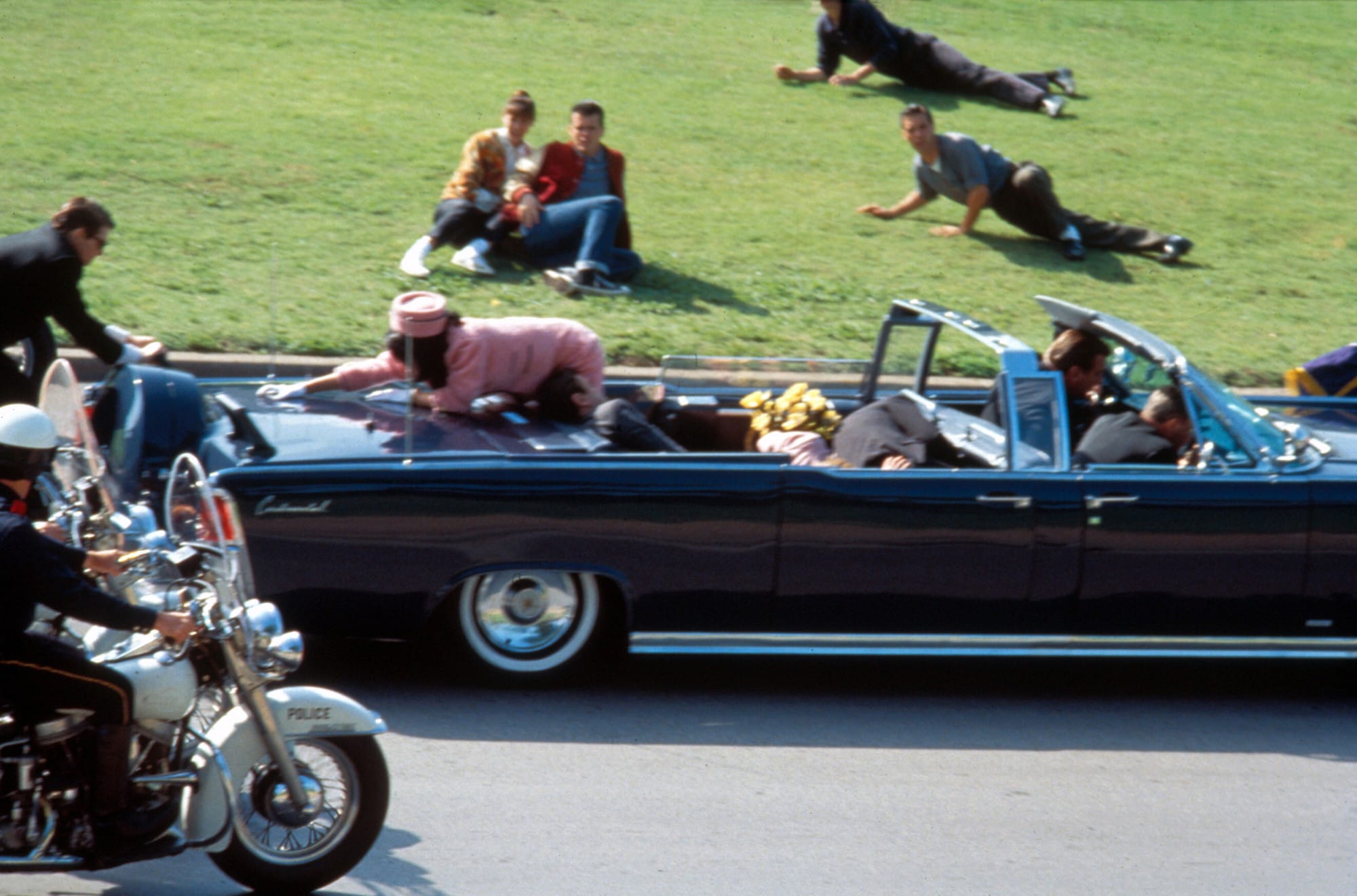
This theory proposes that while Lee Harvey Oswald did fire two shots from the sixth floor of the Texas Book Depository, the third shot—the one that killed the president—was actually fired by a Secret Service agent armed with an AR-15 in the car behind the President’s limo. As the theory goes, the Secret Service’s interference in the investigations was designed to cover up its own mistake. Fittingly, this fringe theory returns to circulation any time provable Secret Service malfeasance makes its way into the news, like the matter of the 6th Summit of the Americas in 2012, the revelation of deleted texts amidst the January 6, 2021 hearings, or the swirl of confusion around the July 2024 attempted assassination of President Donald Trump.
Bobby Kennedy knew first hand what the CIA was capable of, having been directly involved in the assassination plots against Fidel Castro. When Bobby reportedly asked the CIA if they killed his brother, the possibility that the agency had done it—no substantial evidence suggests that’s true—wasn’t the frightening part. Rather, the fact that the CIA had become unwieldy and unaccountable enough to even entertain the idea that it could have done it was more alarming.
JFK Assassination Conspiracy Theory #6: Oswald Did It, All Alone
Of course, the likely reality is that Lee Harvey Oswald acted alone in killing JFK. And Oswald wasn’t a patsy, nor a secret agent. He was just a sad man who thought he was destined for importance and lashed out at anyone he felt kept him from that. He clung to communism, to Cuba, to anything that made him feel a sense of purpose.
And on the day of November 22, 1963, Oswald decided his purpose was killing the president of the United States. Just as on April 10, 1963, Oswald decided his purpose was killing conservative politician General Edwin Walker, though the bullet Oswald fired from the same Carcano rifle he would later use at the Book Depository would narrowly miss its target. And just as another man looking for a sense of purpose, Jack Ruby, would take Oswald’s life with the pull of a trigger on November 24, 1963.
The decisions of two men led to more than 60 years worth of conspiracy theories, often posited by those who are convinced that they can finally solve a mystery whose actual solution simply can’t be accepted.
Because to accept that solution would mean to accept that nobody, not even the president of the United States, is as safe as the systems of government promise us that we are. It means accepting that a symbol of hope, and a new frontier, can be snuffed out by a man with an army surplus rifle that he bought for $20. And that his actions were not tied to any complex conspiracy. It was just a moment of chaos, where coincidences lined up to shatter the country. Many people would rather believe in a conspiracy theory, because in some way, that makes it feel like they’re in control. That there are rules to the game, that there is a system in place, and that we can all be safe if we do as we’re told.
Why Do We Still Believe JFK Assassination Conspiracy Theories?
Conspiracy theorists continue to venture down the JFK assassination rabbit hole in the hopes of finding something new. This mystery continues to haunt America 61 years later—and that’s something we predicted would happen 61 years ago. Here’s how Harrison E. Salisbury, assistant managing editor for The New York Times, described the situation in his introduction to the 1964 release of the Warren Report:
The legend of President Kennedy’s death began with the crack of the sniper’s rifle that took his life. It was born at about 12:30 P.M. on November 22, 1963, when the lethal bullet whined toward his body. It has steadily grown since that moment.
As an editor of The New York Times remarked when he read the bulletin announcing the President’s death at 1:35 P.M. that day: ‘The year 2000 will see men still arguing and writing about the President’s death.
Nothing that has happened since seems likely to invalidate that assessment. Not even the Warren Commission can be expected to stifle the Kennedy legend.
But this “legend” gives Lee Harvey Oswald the final word.
If anyone should have had the final word on the Kennedy presidency, it was President Kennedy himself. But JFK is the only president since Franklin Delano Roosevelt to not pen a presidential memoir—and the first since McKinley to have his legacy be defined not by his own pen but an assassin’s bullet.
To grapple with the way the assassination has come to define, for many, the entirety of the Kennedy legacy, we spoke with JFK Presidential Library and Museum Director Alan Price. Does he find it frustrating that so many people obsess over JFK’s assassination rather than his life?
“Perhaps it is not surprising that such a tragic event, which struck down such an inspirational leader, would be in the foreground of public curiosity,” Price says. “Intellectually and emotionally, it’s hard for people to make sense of it.”