Why Ditching Seed Oils Protects You Thousands of Times Better Than Going Glyphosate-Free | Dr. Cate
Table of Contents
The science is clear: The benefits of avoiding seed oils far outweigh the benefits of avoiding glyphosate. So why isn’t this common knowledge?
New information that challenges decades of nutritional dogma faces obstacles at every turn — sometimes even from people devoted to spreading the truth.
The Message They Cut From the Film
When Jeff Hays invited me to participate in his documentary Toxic Nation, I was eager. Here was a chance to reach millions with what I believe is the most important nutritional truth of our time.
During filming, I explained that the real toxin hiding in our modern diet isn’t the herbicides or food colorings or heavy metals. Don’t get me wrong, these things are bad, and it’s important to avoid them if possible. But the source of the most meaningful toxicity in our food supply is none of these things. It’s the toxic aldehydes in foods made with the Hateful Eight seed oils.

It helped. I feel great.
“It’s helped. I feel great.”
Kobe Bryant
NBA baskeball player

This has been life changing
“Let me tell you this has been life-changing. I have all of her books, in audible and ebooks! I have gotten rid of all the hateful 8 oils. I have trained my body to eat its own previously toxic body fat. Download that pod it’s a game changer!”
Megyn Kelly

Life changing
Deep Nutrition changed my life.
Jesse Watters
Fox News Primetime host
Saved my life
I would like to thank you for literally saving my life. Back in February, I had to be hospitalized while on vacation in Phoenix with an A1C of 11% and had to start taking 2 types of insulin and 2 other meds. I read the Fatburn Fix in April, and followed the program to a tee, and I’m down by 15 pounds, 6.8 A1C, and only one once weekly diabetes medicine. Prior to reading the book, it was almost impossible for me to lose weight as a diabetic.
Leontyne Tompkins
I feel free
For the last month, I have really been reading all labels on everything. I have completely remove those 8 oils you talk about. I must tell you, I feel great! I have more energy and I am now 197 lbs (have always been around 205 to 210lbs). I eat potatoes with real butter, grass fed steak, pasta with the right toppings. I eat everything! I seem to crave less sugar. I love it!
Robert Kirkendall
I feel so much better
I had terrible aches and pains everywhere in my body, my hands, shoulders and knees. I feel so much better and the way I feel is motivating me every day! Thank you
Mike Deb Wootan Burcin
Better than ever
I am an anesthesiologist in Orlando and a huge fan of both of your books! I have been incorporating your principles for the last 10 months and feel that my health is better than ever.
Marnie Robinson, MD
My allergies disappeared
The biggest difference for me (and a surprising one) is that my allergies have almost completely disappeared! This is a big deal for me, because I’ve had allergies most of my life and they have often affected what I do which is a teaching music in [a public school district]. In general, I feel much better and have more consistent energy throughout the day.
Erica Turrell
Heart Palpitations have Stopped
I’ve lost 20+ pounds (also fasting 16-24 hours daily) and haven’t had palpitations except for one occasion — I had a mini bag of Fritos for the first time in July. And, I feel better now on a daily basis than I ever did all through college.
Mike Wright
Deep Nutrition and Fatburn Fix reader

I’ve lost over 50 pounds
I’ve lost over 50 pounds. I’m 56 years old. Cutting processed food and unhealthy fats from my diet was one of the first things I did on my health recovery journey…I went cold turkey off the bad oils. Emptied my pantry into the trash and just started eating real food
Mitzi Wilkinson Champion
Knowledge I didn’t know I needed
Your Fatburn Fix book is amazing, my friend. Thank you! I’m an Functional Nutritional Therapy Practitioner and I know my stuff. This is the extra layer of knowledge I didn’t know I needed. Well done!
Jennifer Dillman
Fatburn Fix reader
Lost a solid 20 lbs and my bloodwork is great
I have lost a solid 20 lbs and my bloodwork (after 3 months of eating your way) was even better! I was metabolically healthy (per your book) before I read your book, but barely. Lowering my weight, sealed the deal! I have been talking about you and your book to anyone who will listen…Thank you for all you’ve done and what you continue to do! You are changing lives for the better!
Missy Cramer
FatBurn Fix reader
Lost 20 lbs I could never shed
I love your Fatburn Fix! Has helped me so so much! I have had the dreaded weight all my life – 20 or so pounds I could never shed. I have lost that now. I only eat 2 meals a day lunch and dinner with a glass of milk or cappuccino around 4 to hold me over. No snacking and not bad oils. It has been the key to unlocking my fatburn. I work out in the am and believe I am burning fat for energy not from food!
Lauren Smith
I feel great
My waist is four inches smaller. I feel great and many of the minor aches and pains that I had (knees and lower back) are gone. Also, my muscle tone is amazing, even though I have not increased my workout routine.
Richard Janelle
Completed Dr Cate’s online course

The go-to for strength and conditioning coaches
Whenever I advise my clients about eating to perform I go straight to what I have learned from Dr. Cate. Her book Deep Nutrition has become the go-to for strength and conditioning coaches across the country.
Kent Matthes
Major League Baseball Agent with WME Sports

Dismantles the lie
Dr. Cate dismantles the lie that seed oils are healthy, which may the biggest lie about nutrition and health because it’s so insidious.
Ken D Berry, MD
Author of Lies My Doctor Told Me

She knows the chemistry
Dr. Cate alerts us to the harms of seed oils and she’s convincing because she knows the chemistry better than anyone.
Dr. Drew Pinskey, MD
Globally recognized internal medicine and addiction medicine specialist, media personality, LoveLine Host, and New York Times bestselling author

No one is better at communicating nutritional truth
Dr. Cate has had the single greatest impact on how we talk to people about fueling for both performance or durability. While we all are a little unique, the foundational principles of human nutrition are immutable. If you are looking to create a more durable, resilient body, no one is better at communicating nutritional truth than Dr. Cate.
Dr. Kelly Starrett
Physiotherapist coach and New York Times and Wall Street Journal bestselling author

Highly recommend The Fatburn Fix
Dr. Shanahan has had a significant impact on my practice of medicine. I am known as a Low Carb Doctor, but I never really appreciated the negative effects of processed seed oils on the health of my patients. I highly recommend The Fatburn Fix to my patients and have a loaner copy in my waiting room. It is amazing how quickly blood sugars and overall health improves with cutting seed oils. It is not just about the carbs!
Dr. Brian Lenkzes, MD
CEO of LowCarbMD San Diego, co-host of Low Carb MD Podcast and host of Life’s Best Medicine Podcast

Respected in the sports world
Dr. Cate reordered my diet when I was with the L.A. Lakers, and the benefits, for me personally, were felt immediately and have served me to this day. I’ve come to take real food so seriously I started a small family farm. I know of no M.D./nutritionist more respected in the sports world than Dr. Cate Shanahan.
Chris Kaman
NBA Player

Brought seed oil issue front and center
Cate brought the seed oil issue front and center. Healthy fats matter. So much so that I created an entire product line to swap out bad fats with good.
Mark Sisson
Founding Father of the Primal/Paleo Movement

Optimal health starts with food
If you want to understand how optimal health starts with food, start with Dr. Cate. Her book Deep Nutrition leaves you with an appreciation of the profound relationship between our genes and the planet, inspiring us to be good shepherds of both.
Dallas Hartwig
Attribution author of The Whole 30

Helped me with endurance
Deep Nutrition really helped me with endurance. I started to feel better as a player. I was able to run more, I was able to be more active …and I just decided to keep going with it to this day.
Dwight Howard
NBA Player

Silver bullet for me
Dr Cate’s teachings helped me lose 60 pounds like it was nothing. It was like a silver bullet for me.
Paul Grewal, MD
Dr Grewal Internal Medicine, MD, author of Genius Foods

Radically improve your health…
Dr. Shanahan has provided a solid reference that deserves a place in the library of anyone who is seriously interested in nutrition. Her perspective on the vital role that healthy fat has in our diet is novel and, if implemented, can radically improve your health.
Dr. Joseph Mercola
Author of Fat for Fuel and Founder of Mercola.com

Pull up a chair…
I have based my work on the idea that getting the right kinds of healthy fats into your body and avoiding the worst fats is essential to optimal health. I’ve interviewed dozens of the world’s top experts about this, and I know of no one who speaks more eloquently on this topic than Dr Cate. If she’s talking fats, pull up a chair. Take notes.
Dave Asprey
Author of the Bulletproof Diet
The key to unlocking my fatburn
I love your Fatburn Fix! Has helped me so so much! I have had the dreaded weight all my life – 20 or so pounds I could never shed. I have lost that now. I only eat 2 meals a day lunch and dinner with a glass of milk or cappuccino around 4 to hold me over. No snacking and not bad oils. It has been the key to unlocking my fatburn.
Lauren Smith
Saved my life
I would like to thank you for literally saving my life. Back in February, I had to be hospitalized while on vacation in Phoenix with an A1C of 11% and had to start taking 2 types of insulin and 2 other meds. I read the Fatburn Fix in April, and followed the program to a tee, and I’m down by 15 pounds, 6.8 A1C, and only one once weekly diabetes medicine.
Leontyne Tompkins
> Tears of joy
I’m crying tears of joy and appreciation for all you’ve done for me and my health! Without Deep Nutrition and Fatburn Fix, I would literally still be in the vicious cycle I’d been fighting all my life! In a nutshell – I am no longer a compulsive overeating addict suffering under the crushing ‘thumb’ of all food and alcohol.
Penni Wicks
The movie was chock full of the world’s experts on what’s wrong with our food supply, and each and every one has something significant to share with the world. But I was worried that, taken together, our combined messages would be so overwhelming that people would feel hopeless and give up. So I wanted to tell folks that I understood that sentiment. I’ve witnessed patients nearly drive themselves crazy doing all the little things. Knowing that “seed oils are worse than glyphosate, artificial food colorings, and heavy metals combined,” as I said during our interview, really helps them focus. I hoped this message might be empowering.
But when the movie came out, that section was gone.
Jeff, the producer and director, told me, apologetically, that he felt compelled to remove it because there was no single white paper evidence I could point to in order to support the claim. That moment drove home how deeply misunderstood this issue is, even by people who want to tell the truth about food.
So I decided to write this article to share the evidence that didn’t make it into the film, and to show you why this difference matters far more than most people realize. (I’m also writing an academic paper that will make the point so that next time I can point to a white paper!)
Why This Matters to You
If you’re trying to get healthier, you probably want to know where to focus your food efforts. Should you spend extra on organic to avoid glyphosate? Or avoid seed oils? Which change will actually protect your health the most?
It’s easy to say this or that is bad for us. What’s hard — and this is the reason nobody else has done it, as far as I know — is to build a hierarchy of bad so people can tell what really matters most.
Without that hierarchy, everything sounds equally dangerous, and the result is paralysis. When you don’t know where to start, you might not start at all.
That’s why I’ve spent years sorting through the evidence — not to make another list of “bad” foods, but to show what’s worst, what’s secondary, and what’s minor.
And when it comes to choosing between glyphosate-free and seed-oil-free, the science is remarkably clear: Eliminating seed oils spares your cells from tens of thousands of times more toxic exposure than going glyphosate-free.
That’s because “seed oil–free” and “glyphosate-free” don’t address the same kind of threat. They target completely different categories of exposure, and one of them dwarfs the other by several orders of magnitude in real-world risk.
A Simple Way to Picture It
Imagine a 75,000-seat stadium.
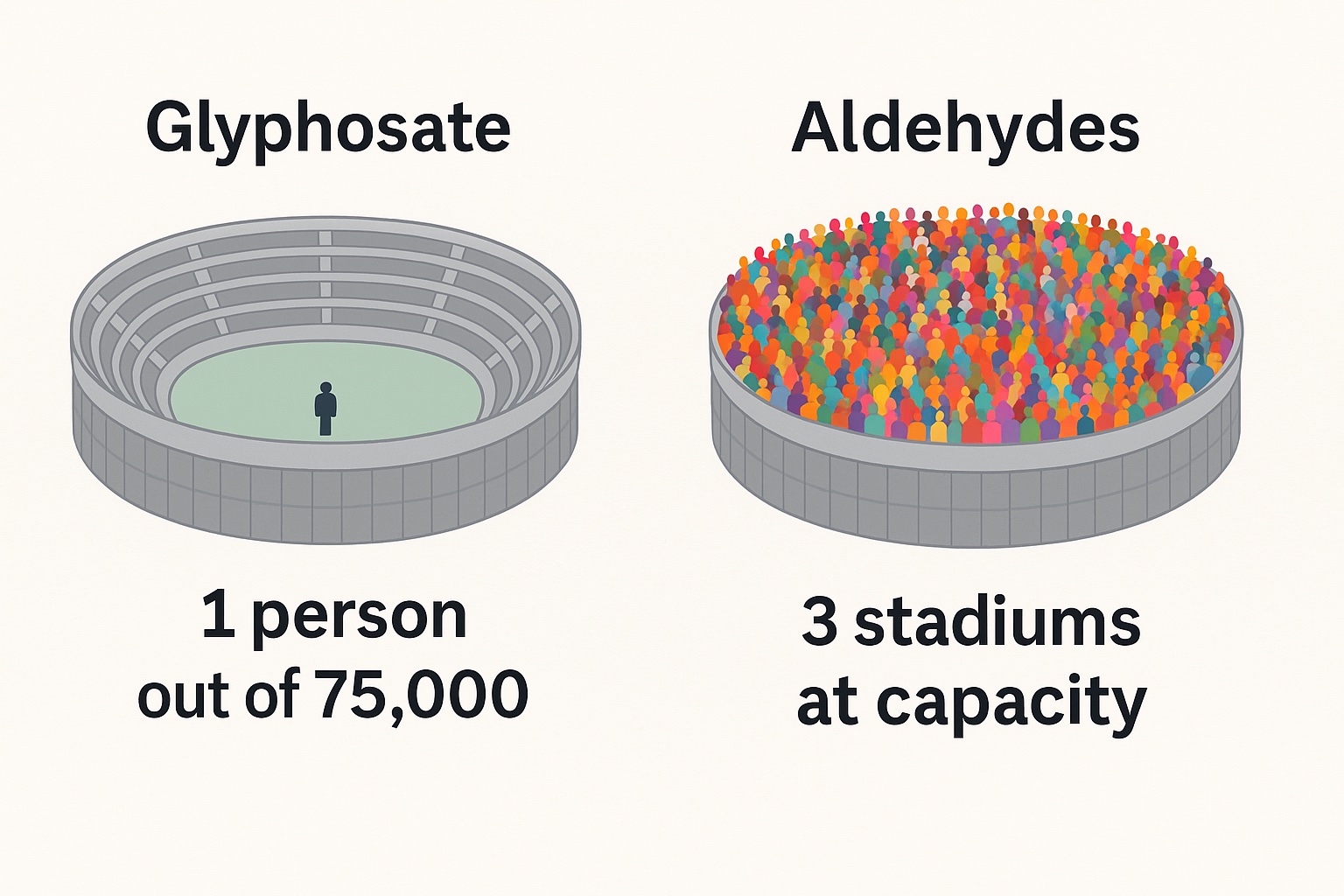
Glyphosate exposure from oatmeal is like one lonely fan sitting in that entire arena. The aldehydes that form when seed oils are heated (the compounds your cells actually have to neutralize every time you eat fried or processed foods) fill three whole stadiums, with people spilling out onto the field.
That’s not an exaggeration. It’s what the chemistry shows.
If we want to build a meaningful hierarchy of bad, that’s the kind of difference we’re looking for — not small variations in lab data, but orders of magnitude in real-world exposure.
This is where the concept of toxic potential comes in.
Both glyphosate and aldehydes have measurable toxicity in the lab. But what determines whether they can hurt you is how much you’re actually exposed to in daily life. And that’s where the comparison becomes staggering: the aldehydes from heated seed oils deliver exposures that are tens of thousands of times higher than anything you’d get from pesticide residues.
So if you’ve been wondering where to start on your “eat healthy food” journey, this is it.
Crunching The Numbers on Seed Oils Versus Glyphosate
If you’re the kind of person who likes to see the math, here it is.
When researchers analyze real-world foods, they measure exactly how much of each compound people are actually exposed to. And when you compare those measurements to the concentrations known to harm cells, the scale of difference between aldehydes and glyphosate jumps off the page.
Here’s how the comparison looks when we translate it into lab measurements:
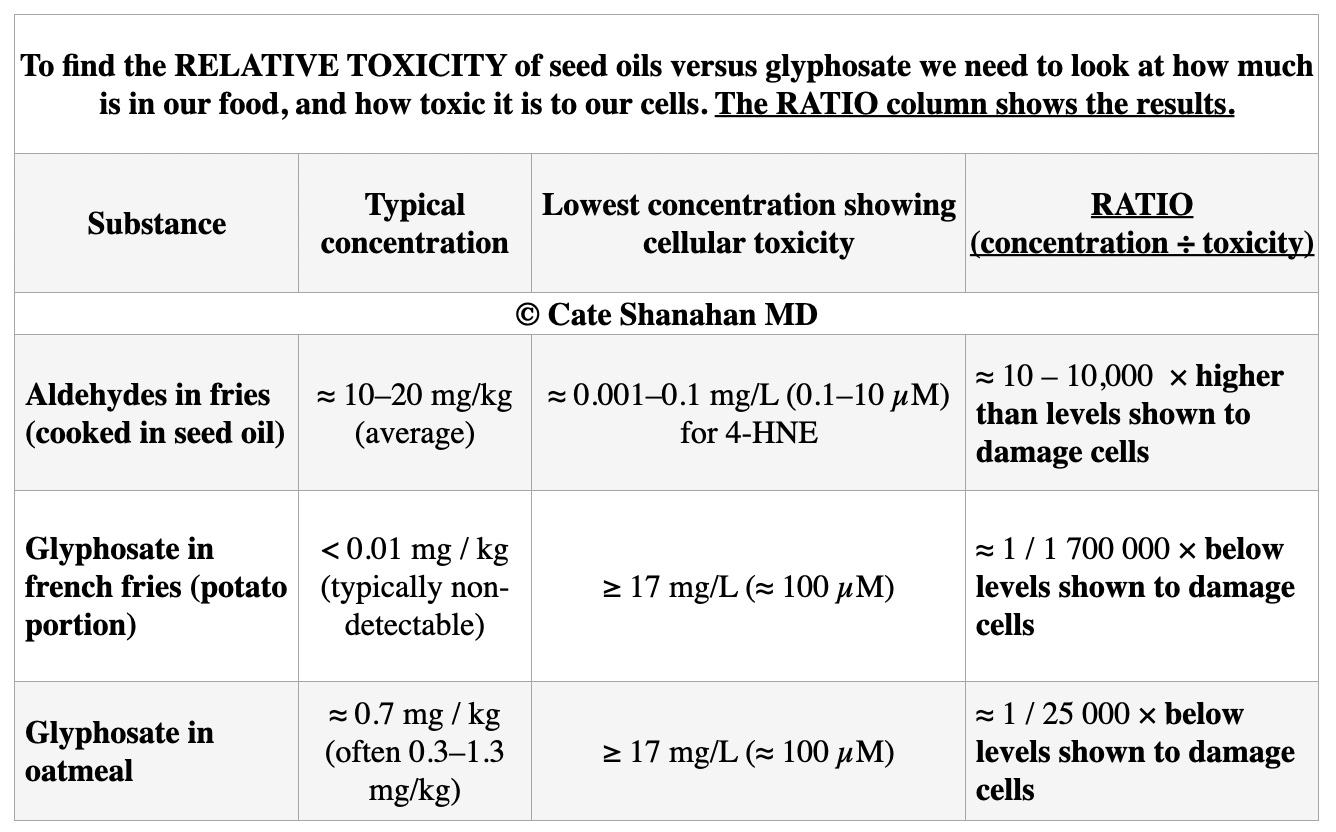
This table shows that, gram for gram, aldehydes are FAR more toxic than glyphosate, and their concentration in many common foods is also higher.
So while both substances have toxicity in principle, only the aldehydes routinely reach levels that matter inside the human body.
I used oatmeal as the example because it’s one of the foods with the highest concentration of glyphosate. Healthier foods like broccoli, cheese, and meats come out below the threshold of detection, meaning they may contain zero, or at least not enough for testing to measure.
The math is simple and empowering. Your choice of cooking oil can protect you thousands of times more than the “glyphosate-free” label ever will.
Why you might see higher numbers for glyphosate than what’s in the chart above.
If you search online for glyphosate levels in food, you’ll find claims that residues average 1–2 mg/kg or even reach 18 mg/kg. Those figures come not from finished foods, but rather from broad agricultural surveys that combine dozens of food categories, including some that humans don’t eat, like raw crop samples, even animal feeds. The processing steps often eliminate much of the glyphosate. Before we eat them, oats are washed, steamed, and stripped of their outer hulls — all steps that remove much of the residue. That’s why finished oatmeal typically measures around 0.7 mg/kg, not the multi-ppm levels reported in raw grain surveys.
That’s why the data for finished products, like oatmeal, tell a different story. Independent lab testing (including FDA and EWG studies) finds most finished oat products contain 0.3–1.3 mg/kg, with an average around 0.7 mg/kg. That’s roughly a thousand times lower than the doses used in lab experiments to produce cell damage. In other words, the scary-sounding numbers you might see online usually describe concentrated raw grains or animal feed, not the cooked oatmeal you eat for breakfast.
So why does the discourse around glyphosate sound scarier than that?
It’s usually not because people are trying to mislead anyone. More likely, they see two numbers — a low one from FDA/EFSA monitoring and a higher one from a broad residue survey — and, out of healthy skepticism (“maybe industry is lowballing it”), they lean toward the higher number. That’s human. But in this case, the gap isn’t about industry spin; it’s about which stage of the food was tested.
And here’s another key point to keep in mind:
Even if we take one of those higher, raw-grain numbers — say 18 mg/kg — and pretend your bowl of oatmeal actually had that much, your exposure would still be hundreds of times below the concentrations that harmed cells in lab studies.
A quick reality check:
- 18 mg/kg in oats
- Eat 100 g? That’s 1.8 mg total
- Spread through ~40 L of body water? 0.045 mg/L
- Lab toxicity shows up around 17 mg/L
- 0.045 ÷ 17? 1/375
Even using the “scary” number, you’re still ~300–400× below toxicity. That’s the opposite of what we see with seed-oil aldehydes, where real-world food levels shoot past cellular toxicity ranges.
So while the glyphosate conversation has been amplified, the aldehyde story has barely been told.
Why Medicine Overlooks Toxic Aldehydes
You’d think such a potent toxin would be headline news.
But the reason it’s not widely known is that these data live in a different scientific universe.
The world’s preeminent expert in seed oil aldehydes is Dr. Martin Grootveld. He’s been publishing on this subject for decades, trying to get the word out. So why do leading cardiologists and nutritionists seem not to know about this? Because in spite of Dr. Grootveld’s dominance in his field, at the end of the day, he is a lipid-chemistry expert, not a medical doctor. And he publishes his work in journals that doctors do not read. Meanwhile, glyphosate gets constant attention because it’s tracked by the EPA and discussed in environmental-health circles.
This asymmetry leaves both the public and the medical profession with a distorted picture: they worry about parts-per-billion of a weak herbicide but ignore milligrams-per-serving of highly reactive lipid oxidation products.
I think another part of the problem is that it’s hard to get our heads wrapped around the idea that organic foods can contain meaningful amounts of toxins.
Key Fact: Organic Does Not Mean Toxin-Free
Organic food labels are designed to protect us from intentionally added chemicals and soil contamination, not from the chemistry of food processing. The organic label tells you about how a food was grown and that no harmful chemicals were added intentionally, but it does not tell you about what happens when it’s cooked.
The Empowering Takeaway
What Truly Matters Most
Once you understand where the real danger lies, your choices become simpler—not harder.
You don’t need to memorize chemical names or buy foods emblazoned with every possible “free of” symbol. You just need to know which habits actually move the needle for your health. The single most powerful one is this:
Memorize the eight toxic seed oils and start cutting down your consumption.
That one decision will start to relieve your body of the chronic, meal-by-meal exposure to reactive molecules that damage cell membranes, mitochondrial enzymes, and DNA itself. Every packaged product containing refined seed oil adds to that invisible burden. Every home-made meal containing real-food fats instead gives your cells a break to recover.
Buying organic still has value. It protects ecosystems and keeps farm workers healthier. But if your goal is personal health, the first step isn’t going organic; it’s getting oxidation-savvy. Skip the seed oils, and you’ve already sidestepped 90% of modern food toxicity.
References for Toxicity Comparison Table
Esterbauer, H.; Schaur, R. J.; Zollner, H. (1991). “Chemistry and biochemistry of 4-hydroxynonenal, malonaldehyde and related aldehydes.” Free Radical Biology & Medicine, 11(1): 81-128.
Doorn, J. A.; Petersen, D. R. (2004). “Reactions of 4-hydroxynonenal with proteins and cellular targets.” Free Radical Biology & Medicine, 37(7): 937-945.
Minekura, H. et al. (2001). “4-Hydroxy-2-nonenal is a powerful endogenous inhibitor of NF-?B activation in endothelial cells.” Biochemical and Biophysical Research Communications, 285(4): 960-966.
Mesnage, R.,?et al. (2021). “Determination of glyphosate and AMPA in oat products for the certification of reference materials.” Food Chemistry, 365: 130454. (PMC) PMC
Environmental Working Group (EWG). (2018). “Breakfast With a Dose of Roundup? Glyphosate in popular oat-based foods.” EWG Food & You research. EWG+1
Environmental Working Group (EWG). (2019). “Glyphosate Contamination in Food Goes Far Beyond Oat Products.” EWG News & Insights. EWG
NDSU Extension. (2023). “Glyphosate on Potatoes.” North Dakota State University Extension Publication. ndsu.edu