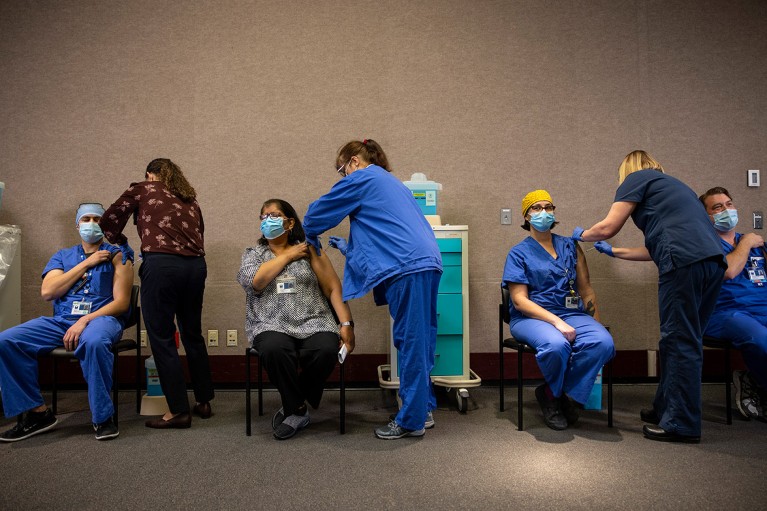
Almost 14 billion COVID-19 vaccines have been delivered since the first jab was officially rolled out on 8 December 2020.Credit: Paula Bronstein/Getty
On 8 December 2020, a 90-year-old British woman became the first person in the world to receive a Pfizer COVID-19 vaccine. Five years on, more than 13.64 billion doses of COVID-19 vaccines have been administered. Thanks to the rapid roll-out of these vaccines, the World Health Organization (WHO) declared that COVID-19 was no longer a public-health emergency in May 2023.
The global response to the COVID-19 pandemic was a turning point for public health — but the downstream effects haven’t all been positive, argues Kristen Panthagani, a physician at Yale New Haven Hospital in Connecticut. In March 2020, Panthagani started a newsletter called You Can Know Things, which originally focused on addressing rumours and myths about COVID-19 vaccines and public-health measures. It now explores how the miscommunication of science and health measures has damaged public trust in vaccines and scientific research.
Nature spoke with Panthagani about what public-health institutions can learn from the pandemic, and how they can rebuild trust in science.
Looking back at the past five years, what lessons have been learnt from the COVID-19 pandemic?
The pandemic was a steep learning curve. Nobody in our generation had ever encountered anything like that before and we must remember what we were dealing with at the time. It’s easy to beat ourselves up looking back, but it’s important that we look at what we can learn from that time and how we can do better going forwards.
Unfortunately, we’ve seen declining trust in childhood vaccines since the pandemic. The miscommunication and distrust over COVID-19 vaccines and mandates has influenced the uptake of other vaccines. The United States is now at risk of losing its elimination status for measles, and that is directly related to vaccine coverage. Once measles vaccination drops below 95%, we start to lose herd immunity. If that were to happen, I think it would be a clear sign of this declining trust in vaccines.
What happened during the pandemic that eroded people’s trust in vaccines?
Misinformation about vaccines has been circulating for decades, but the difference now is that it’s spreading more loudly and is becoming more mainstream. Public-health specialists and governments didn’t communicate well during the pandemic.
For example, in colloquial language, the word ‘immunity’ has this connotation of perfect protection — for example, with legal immunity, the idea is that you’re protected against prosecution. So many people thought that the COVID-19 vaccine would give them 100% immunity, but then some of their family members were hospitalized owing to COVID-19, or died, and now the message is that you need a booster every year. After a while, people say: “You told me this and I got something completely different.”
It would have gone a long way to tell people clearly, and early on, that the vaccines can be highly effective but are not perfect, and to acknowledge uncertainty in the data. There were scientists who were trying to do that, but it wasn’t the loud, predominant voices.
Enjoying our latest content?
Log in or create an account to continue
Access the most recent journalism from Nature’s award-winning team
Explore the latest features & opinion covering groundbreaking research