The Trump Staged Shooting Conspiracies Need to Stop | Opinion
A lone gunman stormed the annual White House Correspondents’ Dinner and was quickly detained after injuring a Secret Service agent. Almost immediately, people on both sides of the conspiracy spectrum claimed this was another staged assassination attempt orchestrated by President Donald Trump, this time to divert attention from embarrassing headlines tied to his failure to negotiate with Iran.
This same bipartisan conspiracy culture also believes Trump and his allies orchestrated the previous assassination attempt in Butler, Pennsylvania—an attack that killed a person in the crowd, seriously injured two others, and resulted in the immediate killing of the would-be assassin after Trump himself was struck in the ear.
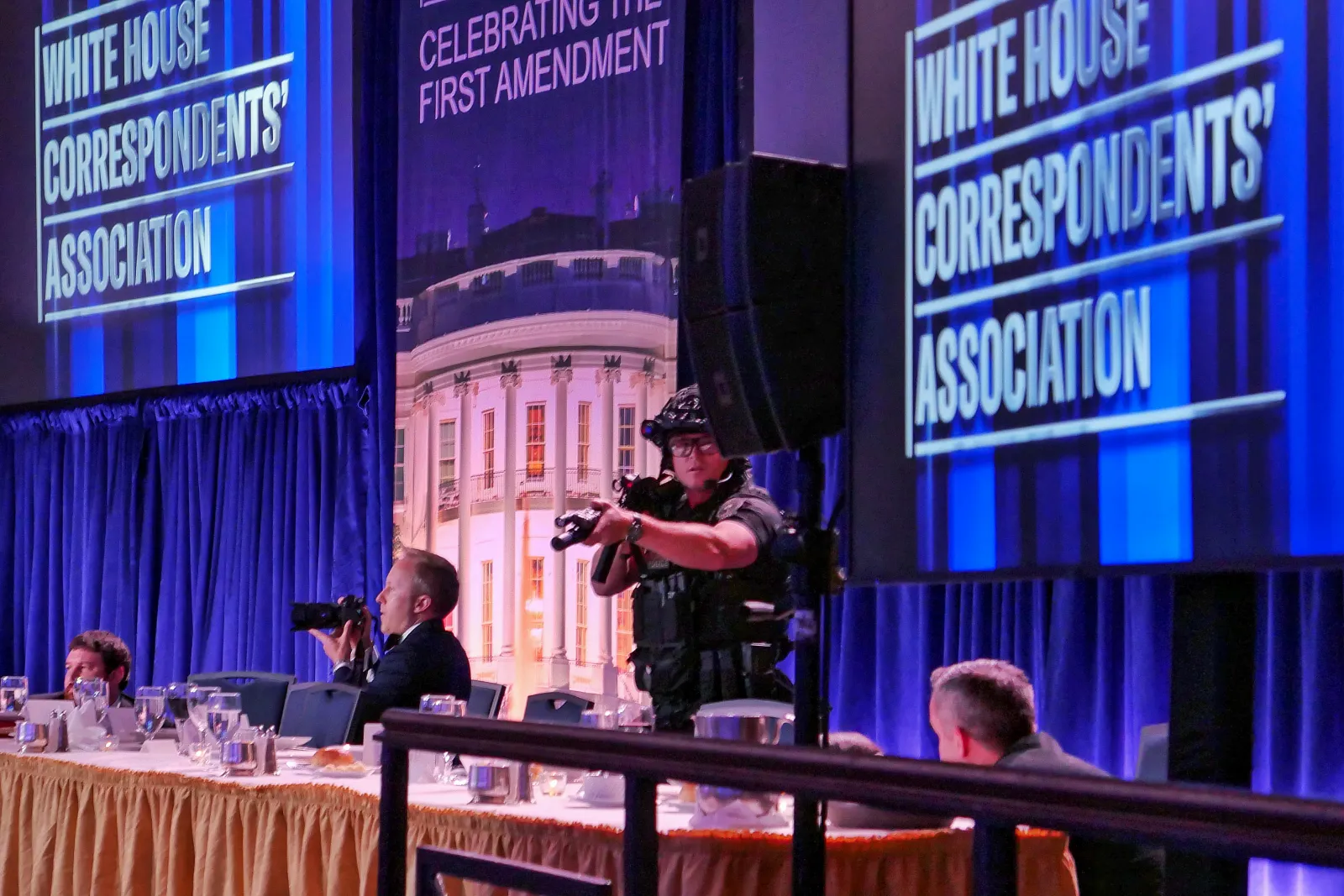
This is not fringe anymore. We all have friends and family who talk about this like it’s fact. It has become one of those rare issues that genuinely qualifies as a both-sides problem. People are jumping to conclusions based on headlines alone, not even trying to understand, but rushing to explain.
If you are one of those people, I would ask you to consider the logistics involved in staging a fake assassination attempt on a sitting president, even at the most basic level.
You are talking about coordinating a live attack in a crowded, uncontrolled environment with real bullets, real people, and zero margin for error. You are talking about Secret Service agents, local law enforcement, medical teams, witnesses, bystanders, and the media all somehow playing along—or being unknowingly folded into a plan where one unpredictable variable turns the situation into a bloodbath. And you think this White House, under Donald Trump, has the level of cunning required to pull that off not once, but twice, and then cover it up and keep it covered up?
At some point, the theory stops being about connecting dots and starts requiring you to believe in a level of precision, secrecy, and luck that simply does not exist in the real world.
Let’s assume, for a moment, that the gunman is a plant—an actor, whatever version makes it easier to believe the little movie playing in your head that you’ve mistaken for reality. He still has to move like a threat in front of agents trained to neutralize threats instantly. So now the theory depends on everyone in that chain getting it exactly right in a situation built on split-second decisions, or that the entire Secret Service would have to be in on it.
It doesn’t pass the out-loud test. There are simply too many variables. This was clearly a lone-wolf attack by someone who was not thinking clearly. Even if he saw himself as some kind of revolutionary, his cheese would have slid all the way off its cracker if he thought he could just run right past the Secret Service. That was a suicide mission that failed.
Believing these Trump assassination attempts are staged is bigger than politics. It is cultural brain rot. And I would suggest that if you are subscribing to these kinds of ideas without questioning your own thinking, there is not much difference between believing Trump stages shootings to manipulate headlines and what Alex Jones said about the Sandy Hook shooting, which ultimately led to massive legal consequences.
That didn’t start with Alex Jones declaring it was staged right out of the gate. It started with “what if?” There is nothing wrong with asking “what if.” We do it all the time. It is part of how we learn. The problem is that his “what if” turned into fact in his mind, and eventually in the minds of many of his followers. Now he faces more than a billion dollars in damages because he and his audience targeted and harassed the victims of an already unimaginable tragedy.
And then there’s Erika Kirk, who was at the Correspondents’ Dinner when shots rang out. She was seen visibly upset, leaving the venue in tears. Within hours, social media was full of people mocking her and laughing at her pain.
Look, I don’t care what your politics are. I’m not a fan of Erika Kirk. I wasn’t a fan of her husband either. But this is a woman who watched her husband get assassinated in front of the world. So when she finds herself in a moment of unexpected live gunfire and chaos, and she reacts like a human being, I fail to find the humor in that.
You don’t have to like her. You don’t have to agree with her politics. You don’t have to support anything she has ever said or done. But she does not deserve this kind of disgusting ridicule. There is something deeply broken in the way people respond to moments like this now, where real fear and real emotion are turned into content for clicks.
Shame on anyone who thinks that is acceptable human behavior.
Everyone has invasive and irrational thoughts. That is normal. Your brain throws out possibilities all the time, most of them wrong, some of them ridiculous. The problem is not the thought itself. It is what we do with those thoughts after we entertain them.
There is a line between thinking something and believing it, and a lot of people do not even realize when they have crossed over. I have been guilty of it myself over the years, but I am getting better at avoiding it, like a lot of us are as we do that thing called growing up. So, before you share something, before you decide something must be true, before you turn someone else’s vulnerable moment into content for your channel, just stop and ask yourself what you actually know and what you only feel. It is fine to talk about both, as long as you can tell the difference and explain the context like an adult.
Because if you cannot tell the difference anymore, you are not thinking.
It’s groupthink, and you’re feeding it with collective confirmation bias.
Jesse Edwards is Director of Radio and Podcasting at Newsweek and host of Newsweek Radio.
The views expressed in this article are the writer’s own.