Fact Check: Document Does NOT Show Hantavirus As A COVID-19 Vaccine Side Effect — It Lists Health Conditions To Report IF They Happen
Does a document show hantavirus as a side effect of COVID-19 vaccines? No, that’s not true: The document shows a government-required adverse event (AE) report prepared by pharmaceutical companies. It is not a list of side effects caused by the vaccine but a broad list of health conditions that researchers want to monitor closely during vaccine trials for safety.
The claim appeared in a post and image (archived here) by the @TheProjectUnity account on X on May 7, 2026. It read:
When you realise the new ‘Fear Virus’ being pushed by the media (Hantavirus) was also listed as an adverse side effect of the covid vaccines…
This is what the post looked like on X at the time of writing:
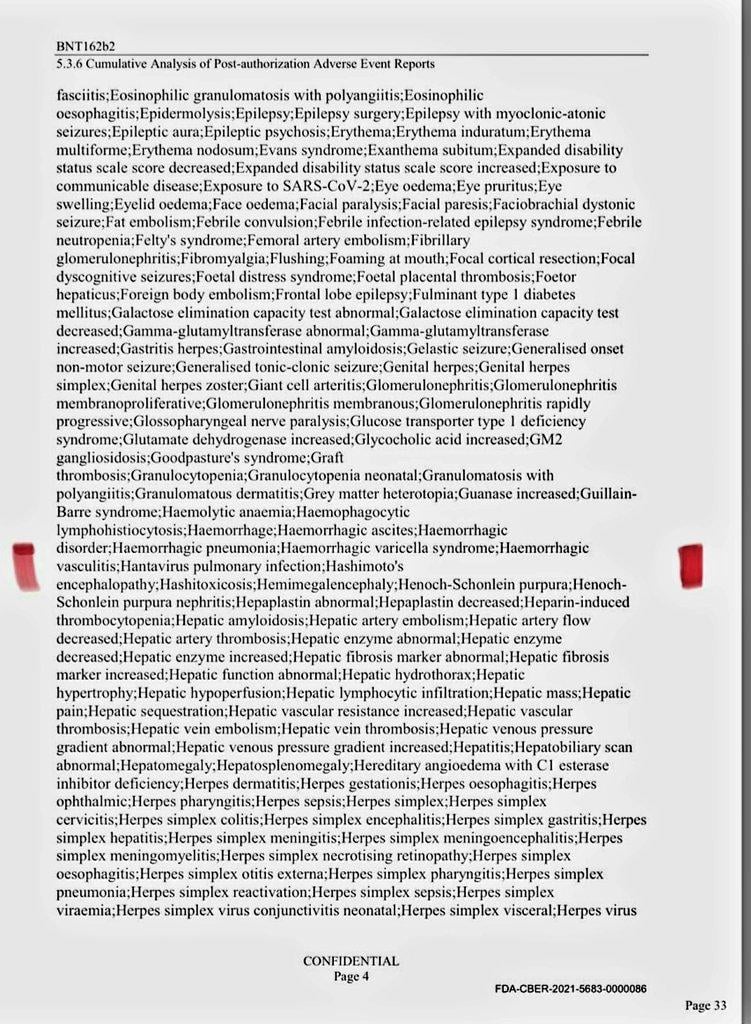
(Image source: post by @TheProjectUnity on X.)
Hantavirus is a rare but serious disease usually spread by rodents, especially through their droppings or urine. In early May 2026, health officials were investigating an outbreak (archived here) linked to a cruise ship, raising concerns after several passengers became ill.
The highlighted section shows ‘hantavirus pulmonary infection’ and comes from page 33 of a Pfizer document that was part of a Freedom of Information Act request by a group of more than 30 professors and scientists (archived here) from universities including Harvard, Yale, Brown, and UCLA. In their lawsuit (archived here) filed Sept. 16, 2021, the plaintiffs asked the FDA to share the data it relied upon in licensing Pfizer’s COVID vaccine.
The document, called 5.3.6 CUMULATIVE ANALYSIS OF POST-AUTHORIZATION ADVERSE EVENT REPORTS OF PF-07302048 (BNT162B2) RECEIVED THROUGH 28-FEB-2021 (archived here), was approved on April 30, 2021, according to the timestamp on the side of the PDF.
The page from the document is from a list of things called “adverse events of special interest” or AESIs, which are included in APPENDIX 1, starting on Page 30. A definition of the term is part of a U.S. Food and Drug Administration (FDA) document on the “Optimisation of Safety Data Collection” (archived here) for new drugs and medicines that are being licensed. This is how the FDA defines AESIs:
These adverse events may warrant collection of additional information across the entire study population to better characterise these events (e.g., particular laboratory parameters; vital signs; risk factors; concomitant therapies; and/or concomitant illnesses).
In plain terms, AESIs are health conditions that researchers want to monitor closely during a vaccine trial — not conditions caused by the vaccine.
At the time the Pfizer document was submitted, their vaccine was under emergency use authorization.
The AESI list was put together by the Brighton Collaboration (archived here), the European Medicines Agency ACCESS protocol (archived here), the U.S. Centers for Disease Control and Prevention (archived here), and the U.K. Medicines and Healthcare products Regulatory Agency (archived here).
Most of the numbers reported in the Pfizer document come from expert groups and regulatory authorities listed above, and the Vaccine Adverse Event Reporting System (VAERS) in the United States, which is run by the CDC and the FDA (archived here).
Lead Stories has debunked several claims about vaccine deaths that misuse VAERS.
Anyone with internet access can add a report to the VAERS list of reports. The public access link to it expressly warns against unwarranted conclusions based on VAERS material because the list only provides a tally of unverified notes about any health event people experience after they are vaccinated.
The list itself cannot be used to prove or quantify causation, since all it shows is a chronological correlation between vaccination and a health event, not a causal link. It is the equivalent of a police precinct’s incident blotter of reports that may serve as a starting point for police work, not an endpoint.