Worst “Science” EVER: This New Covid “Vaccine” Study is Totally Meaningless
Headlines are praising a new study which claims that the Covid “vaccine” reduces the risk of “Covid-related” heart attacks and strokes by 40%:
A new study finds the vaccine was linked with nearly 40 percent lower risk of events linked to covid-19 like heart attack and stroke
This is a moral lie in the great tradition of “damned lies and statistics”.
Beyond the headline, the ugly reality is this “study’ is meaningless dross. A collection of numbers with no real-life application, which contains ZERO unvaccinated people, ignores vaccine harms and shows precisely ZERO alleged benefit at all to people under 75.
And that’s just the start. In addition:
The sample was flawed
The control group non-existent
The definitions insane,
And the ‘diagnostic test’ unfit for purpose.
But that hasn’t stopped it being met with predictable frothing excitement from the pro-vaccine shills in all corners, either because that’s what they’re paid for, or because they don’t bother actually reading past the headline.
Let’s get into some details.
1. No control group
Firstly, we need to tackle the word “study”. People see the word “study”, and that it was published in the Journal of the American Medical Association (JAMA), and will be led to believe these are doctors doing science.
That’s not the case, they’re just statisticians doing statistics. It’s a data review, nothing more.
They collated medical records and sorted them by some variables to look for trends. It’s not really science, it’s just maths.
And since the data they collected was all based on military veterans getting vaccinated, it presents us with the biggest flaw in the study: The total absence of a control group.
The paper has been pitched by mainstream science writers and vaccine shills on social media as a case of “vaccinated vs unvaccinated”, but that’s just NOT TRUE.
There’s not a single unvaccinated person in the sample. None. Literally zero.
The two groups studied are “flu shot” and “flu shot + 2025 Covid booster”.
So every single person got at least one vaccine.
But it gets worse – in fact, over 91% of participants had the original Covid booster in 2021.
The table below actually lists eight other vaccines as well, including RSV and pneumococcal vaccines, all taken by between 70% and 10% of the sample:
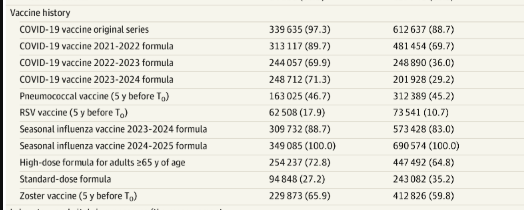
So, every person in both study groups had at least one vaccine. The vast, vast majority had at least two and some potentially had as many as TEN.
This study isn’t comparing unvaccinated vs vaccinated at all, it’s comparing people who got the flu shot, the 2025 booster and maybe eight other vaccines, with people who “only” got the flu shot and maybe eight other vaccines.
Right there, they have rendered their data meaningless.
There’s also this curious disclaimer in the “strengths and limitations” section…
We assumed no interaction between COVID-19 and influenza vaccines.
…now why would they assume that?
And why not add that they also assumed no interaction between the RSV vaccine and the original Covid vaccine from 2021.
And assumed no interaction between the 2024 flu shot and the zoster vaccine, and the 2022 Covid booster and the pneumococcal vaccines.
Or any and all of the thousands of potential combinations of one or more vaccines that may or may not interact in ways they assumed they didn’t.
You get the point.
2. Ridiculous definitions
Having established the sample and design of the study is pure nonsense; let’s move on to their hypothesis.
The authors claim to be testing whether or not the 2024-25 Covid “vaccine” formulation protects against “COVID-19–associated major adverse cardiovascular event” (MACE).
So what is a “COVID-19–associated major adverse cardiovascular event”?
The primary analysis included a composite COVID-19–associated MACE outcome consisting of 4 individual outcomes: (1) COVID-19–associated cardiovascular death; (2) COVID-19–associated myocardial infarction; (3) COVID-19–associated stroke; and (4) COVID-19–associated hospitalization for heart failure.
So, a “major adverse cardiovascular event” is a heart attack, stroke, heart failure or death resulting from same.
But how are they “associated” with Covid19?
Well…
COVID-19–associated cardiovascular death was defined as death within 30 days after a laboratory-confirmed SARS-CoV-2 infection and accompanied by a diagnosis code for MACE within the preceding 30 days.
A “Covid-associated cardiac death” is dying of a heart attack or stroke within 30 days of testing positive for Covid.
This will be resoundingly familiar to any veteran Covid sceptics. During the “pandemic”, a “Covid death” was a “death from any cause within 30 days of a positive test”. This is taken straight from that playbook.
Which is pretty damning, obviously, but it gets worse. Much, much worse [emphasis added]:
COVID-19–associated myocardial infarction and COVID-19–associated stroke were defined as an emergency department or urgent care encounter within 24 hours before or after a laboratory-confirmed SARS-CoV-2 infection or an inpatient admission 2 days before through 30 days after a laboratory-confirmed SARS-CoV-2 infection, with a corresponding diagnosis code for myocardial infarction or stroke. COVID-19–associated hospitalization for heart failure was defined as a hospitalization with either a primary diagnosis code for heart failure or an admission diagnosis field documented as heart failure, occurring from 2 days before through 30 days after a laboratory-confirmed SARS-CoV-2 infection
Did you spot the magic word?
A “Covid-associated” cardiovascular event is any heart attack or stroke resulting in hospitalization, in which the patient tests positive for Covid 30 days before OR 2 days AFTER the event.
In other words, they included people who didn’t test positive for Covid19 until after they were in hospital.
Now, even if you chose to live in the fantasy-reality where “Covid” actually exists, this is remedially bad science because it throws out the linear nature of causation.
Theoretically, according to this methodology, you could be feeling perfectly well, have a heart attack, be in hospital, catch “Covid” from another patient, and suddenly your heart attack is “Covid-associated” .
Even on their own flawed terms this is anti-rational.
Let’s remember that in the created world these “scientists” occupy, “nosocomial” (hospital-acquired) Covid19 makes up anything between 18% and 56% of all cases. Meaning – again, by their own logic – anybody, or indeed everybody, who tests positive after entering a hospital may have been infected while in hospital.
It really shouldn’t need to be said – but if you don’t know something was there before the heart attack, you can’t possibly say it caused the heart attack.
That’s basic cause-and-effect, and this paper chooses to ignore it.
This is, of course, the reason they opt for the weasel-word “associated”. Not “caused”, not “induced” but only “associated”.
But all becomes doubly meaningless when we add reality back in, because of course there is nothing to “associate” those cardiac events with the thing called “Covid” except a positive test – and we all know (or should know) what that means.
3. PCR tests. Again.
In the past six years, we have talked about PCR tests a LOT. Dozens of articles, probably hundreds of thousands of words. We know how they work, or rather how they don’t.
I have written about how creative application of tests that don’t work can create a pandemic out of almost thin air.
Anything that relies on PCR tests as reliable data is fatally flawed from its inception.
But let’s put a pin in that, and again pretend to live in the world where Covid exists and PCR tests are somehow useful at detecting it.
A large percentage – anything from 40 to 80 per cent – of so-called “Covid cases” are defined as “asymptomatic”. Meaning the only evidence for the presence of the virus is a positive test. But of course PCR tests can, and very often do, produce false positive results – and this is not a fringe conspiracy theorist idea, it’s broadly accepted mainstream “truth” by the type of establishment people running this study.
So, do they claim it’s possible, in any way, to differentiate between a false positive test and an asymptomatic case?
No. Not at all. They are essentially two different descriptors for the same exact thing – a positive test without symptoms.
Nowhere in this paper do they claim their alleged ‘positive cases’ were symptomatic; they only describe them as “laboratory confirmed”. Which means even by their own flawed and delusional rationale, all their positive cases could be false positives.
Does the paper attempt to account for this?
Of course it doesn’t.
But there’s more. Eg – nowhere is it noted how many times, or by whom, or at what cycle threshold these patients were tested.
Nor do they say which group was tested more or which group had a higher percentage of positive tests.
Does the paper attempt to account for this variable?
Of course it doesn’t.
What about negative tests? Eg – did the people with non-COVID-associated cardiovascular events test negative? Or were they just never tested?
Do you think they tell us?
Of course they don’t.
And what if, after they test positive and before their cardiac event, they test negative? Or what if they tested negative multiple times? Are those cases discounted?
Do you think they tell us?
Of course they don’t.
In fact, the study never mentions any such thing happening, which – with a sample of over a million people – seems very, very unlikely.
Misrepresenting Results
So we’ve established that the sample was flawed, the control group non-existent, the definitions insane, and the diagnostic test unfit for purpose.
What about the results?
Well, the graph they most heavily feature – and the one doing the rounds on social media and in the papers – is this one…
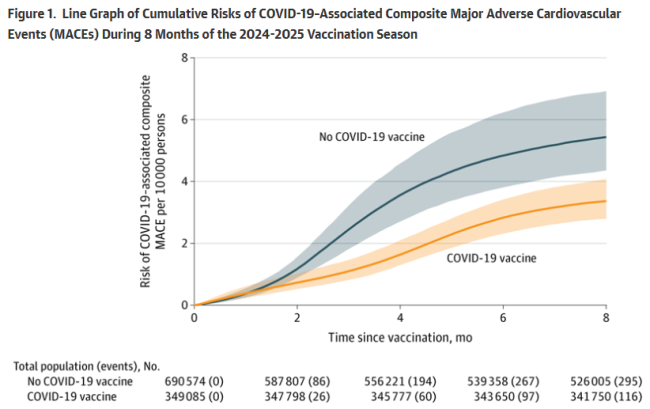
…and it is, in multiple ways, quite simply a lie.
Let’s start with the labels: “Covid19 vaccine” vs “no Covid19 vaccine”.
That’s a lie.
We know at least 89%, and potentially 100%, of the “no Covid19 vaccine” group got at least one Covid vaccine.
We know at least 58%, and potentially 100%, of the “no Covid19 vaccine” group got at least two Covid vaccines.
We know some of the “no Covid19 vaccine” group got as many as FOUR Covid vaccines.
Labelling them “no Covid19 vaccine” is dishonest. We can assume to some extent cynically done to help make their chart go viral on social media and own the anti-vaxxers.
Then there’s the pretty crucial matter of ages.
We know they split their group into three age sets (under 65, 65-75, and over 75), so why not plot three separate lines to show the results for each separate set?
Well, because then their graph would look a LOT less impressive, since as they admit…
Vaccine effectiveness for COVID-19–associated MACE was statistically significant only in individuals older than 75 years…No statistically significant vaccine effectiveness for COVID-19–associated MACE was observed among those younger than 65 years or aged 65 to 75 years.
One more time, for those at the back:
No statistically significant vaccine effectiveness for COVID-19–associated MACE was observed among those younger than 65 years or aged 65 to 75 years.
So, even on their own flawed, insane and deeply dishonest terms – when it comes to preventing “Covid-associated” cardiovascular events, the 2025 vaccine is 100% useless for those under 75.
5. Gaps in Data
To put it nicely, the study seems to have gone for a breadth- not-depth approach to data, hoping that a big sample with big numbers makes it look exhaustive, but there’s a shockingly small amount of detail in their data.
They have a sample of ~1 million people, but the total number of alleged “Covid-associated major adverse cardiovascular events” (MACEs) is only 411.
That’s a relatively tiny data pool that would benefit by some simple examination.
For example, it would be the easiest thing in the world to graph those 411 incidents by age, and report which group (vaxxed vs “unvaxxed”) was experiencing incidents at a younger average age.
Or, since we know they assumed an “association” between “covid” and these MACEs based solely on a PCR test administered anything from 30 days before to two days after the MACE, they could tell us when each of these tests was administered, and how many were done after the fact.
They could have split the 411 by vaccine status – across all the 10 potential vaccines – to look for patterns there.
Or they could have split them by Moderna vs Pfizer (instead of chucking them all together, as they admit to doing).
They could have graphed the 411 by comorbidities. Or gender. Or race. Or homelessness.
All of this would enable them to look for trends.
For example, maybe the “vaccinated” group experience a lower overall rate of MACEs, but the people who experienced them were all younger and had no previous history of heart problems – or vice versa.
This is all potentially interesting data, no?
But no – they don’t bother with any of this – or with any analysis that might have real-world meaning. Instead, they just tell you the basic percentages of these things in each massive group, without ever actually trying to apply them to the results.
Since we know they have this data, and it certainly wouldn’t be hard to have examined it for all these potential patterns, we must conclude either that the authors were too lazy, too incompetent, or found the results didn’t fit their desired conclusion.
Either way, we’re left with a wide but very shallow data pool that tells us nothing of any value at all. It’s just a mass of numbers with no application.
5. Absolute Risk vs Relative Risk
This is an old story in scientific literature, but absolute risk reduction vs relative risk reduction is a very important difference.
Early coverage of the paper, from places like the Washington Post boasted “40% reduction in heart attacks, strokes and heart failure”:
The coronavirus vaccine reduced the risk of major cardiovascular events linked to covid-19 — strokes, heart attacks, and hospitalization from heart disease — by about 40 percent, according to new research. https://t.co/cQjvi8EMpX
— The Washington Post (@washingtonpost) June 16, 2026
But that is a highly misleading -if not invidious – use of relative risk reduction.
When we look at the actual figures, we find the “unvaccinated” group experienced ~5 incidents per 10,000 people, and the “vaccinated” group ~3.
3 is 60% of 5.
So, sure that is a 40% reduction.
But let’s take those numbers and turn them into an absolute risk. First, by dispensing with the “per 10,000 people” unit adopted by the paper and returning to normal percentages.
“Unvaccinated” MACE risk: 0.056%
“Vaccinated” MACE risk: 0.034%
So the absolute risk reduction is only 0.022%.
Wouldn’t make such a great propagandist headline though would it.
6. Didn’t account for “vaccine adverse events”
Right at the end of the “strengths and limitations” section of the paper, the authors include this line:
We did not examine vaccine adverse events.
Which is a massive asterisk, don’t you think?
The focus of the paper is comparative risk, but how can you assess that correctly when you disregard one risk avenue?
You can’t test the efficacy of setting your hair on fire as a treatment for head lice, and then disregard serious burns from your risk-reward analysis.
7. improper sampling?
This one gets a question mark because it’s only a potential problem, rather than an obvious, terminally defeating problem – like everything else we’ve been discussing..
The issue is that the study claims the Covid vaccine also reduces the risk of non-“covid related” heart attacks and strokes.
[vaccine] effectiveness extends to broader outcomes (all-cause MACE, hospitalization, and death)
Yes, it turns out the so-called “unvaccinated” group had a greater risk of all-cause cardiovascular events.
The authors have a theory to explain this, they suggest – of course – it’s due to undetected Covid19 infections:
likely reflecting the hidden burden of undetected SARS-CoV-2 and associated complications that are reduced by COVID-19 vaccination.
Hmmm…had the authors of this car crash of a study already forgotten at this point that at least 92% – and potentially 100% – of their subjects had received at least one “covid vaccination”?
Oh, and incidentally, this conclusion of theirs renders the whole study even more meaningless, as they have just admitted they cannot reliably assess, on any terms, who actually has “Covid” and who doesn’t.
It also implies something else – flawed, potentially biased sampling.
If one of your statistically weighted, supposedly equally healthy groups experiences a greater frequency of adverse outcomes – disregarding the tested variable – that suggests the groups were not equally healthy, doesn’t it?
Maybe if they had bothered to do some of the analysis we discuss above involving graphing the different age sets etc – they may have been able to uncover some underlying factors skewing their sample?
But that probably was not what they were being paid to do.
Conclusion
I annoyed a lot of bots on twitter by calling this the worst “scientific paper” I have ever read, but I stand by it.
Granted, “worst science” has become a VERY competitive category, but when you stack up these flaws, I can’t see any way it doesn’t at least get on the podium.
- It lacks a control sample
- It had every participant take between 1 and 10 different vaccines
- It assumed no interaction between these vaccines
- It misrepresents its results
- It doesn’t account for vaccine harms
- It relies on unreliable tests
- It has potentially biased sampling
- Oh, and it throws out linear causation
Just one of those should be grounds for disregarding the paper entirely. Somehow contriving to achieve all of them in only a couple of thousand words is a feat of either corruption or incompetence that deserves to be studied by experts.
The study is so meaningless it doesn’t even produce the results it is trying so hard to produce.
I mean, I suppose, perhaps, maybe it is sort of theoretically possible that when they hurriedly created the latest “Covid vaccines” they also accidentally invented some kind of anti-heart attack miracle cure which works by some as yet unexplained biological mechanism.
…but is it not rather more likely that the authors of this appallingly unprofessional, self-contradictory and anti-scientific “study” – either by conscious or unconscious bias, or some factor unaccounted for or overlooked – contrived to find a statistical effect where none in fact exists?
But sure, if you’re over 75 and choose to ignore all the evidence for vaccine adverse effects (as the study itself chooses to do), and you like the look of those odds – then go grab yourself some vintage ’25 toxic sludge.
And make sure you – or your next of kin – let us know how it turns out.
Thanks for reading…
You can help us keep doing what we do. Every little helps and is hugely appreciated.
For other ways to donate, including direct-transfer bank details click HERE.