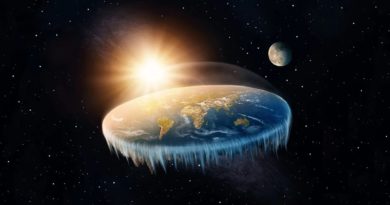
Bedford Level Experiment – Flat-Earthers in the Fens
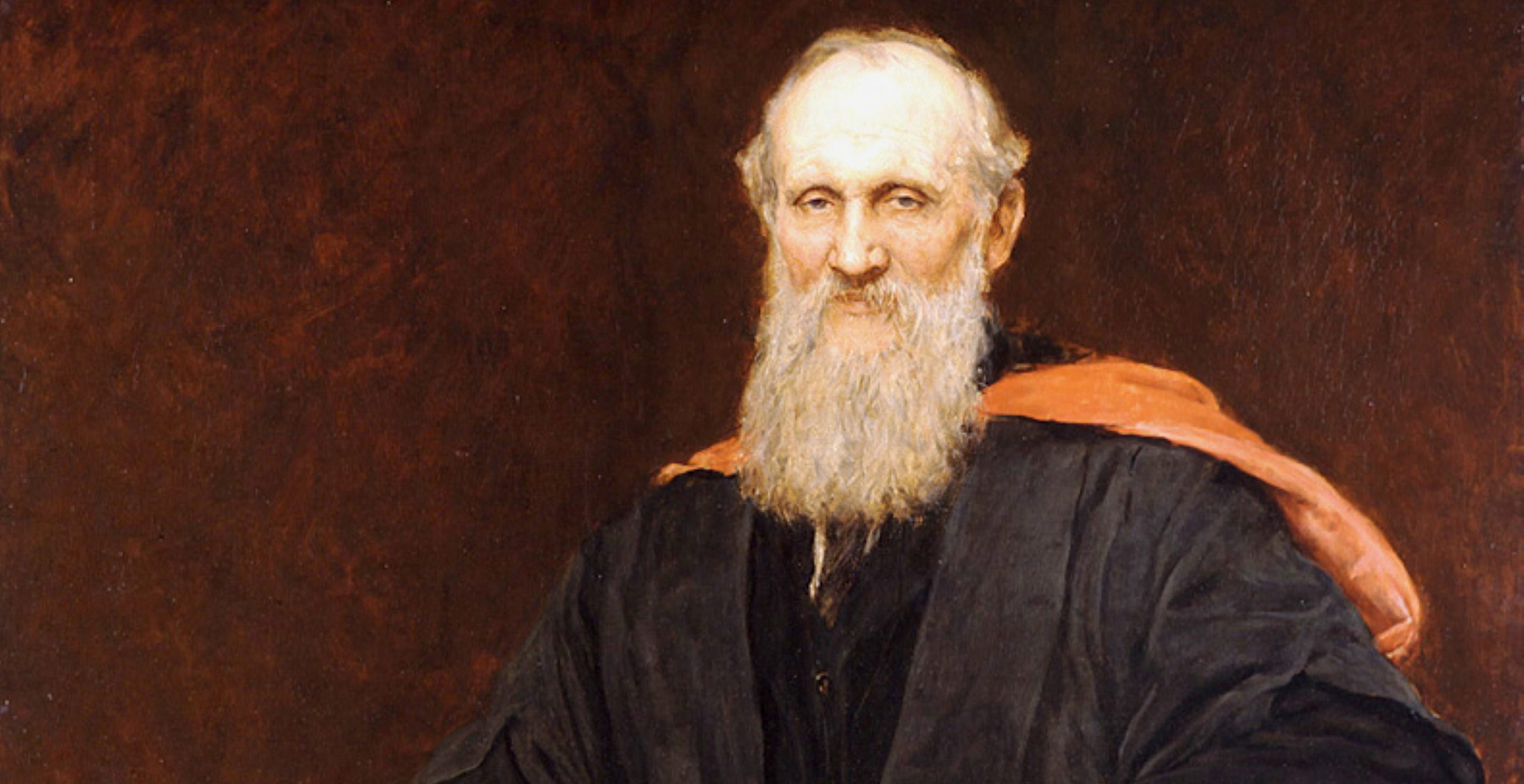
In January 1870, the naturalist Alfred Russell Wallace, who had recently published a book recounting his 8-year-long expedition to Southeast Asia (where he had independently come up with Evolution By Natural Selection, forcing Darwin to rush to publish On the Origin of Species), was reading the journal Scientific Opinion. In the letters section, he came across a strange letter, whose writer was willing to bet any scientist £500 that they couldn’t prove the Earth was round.
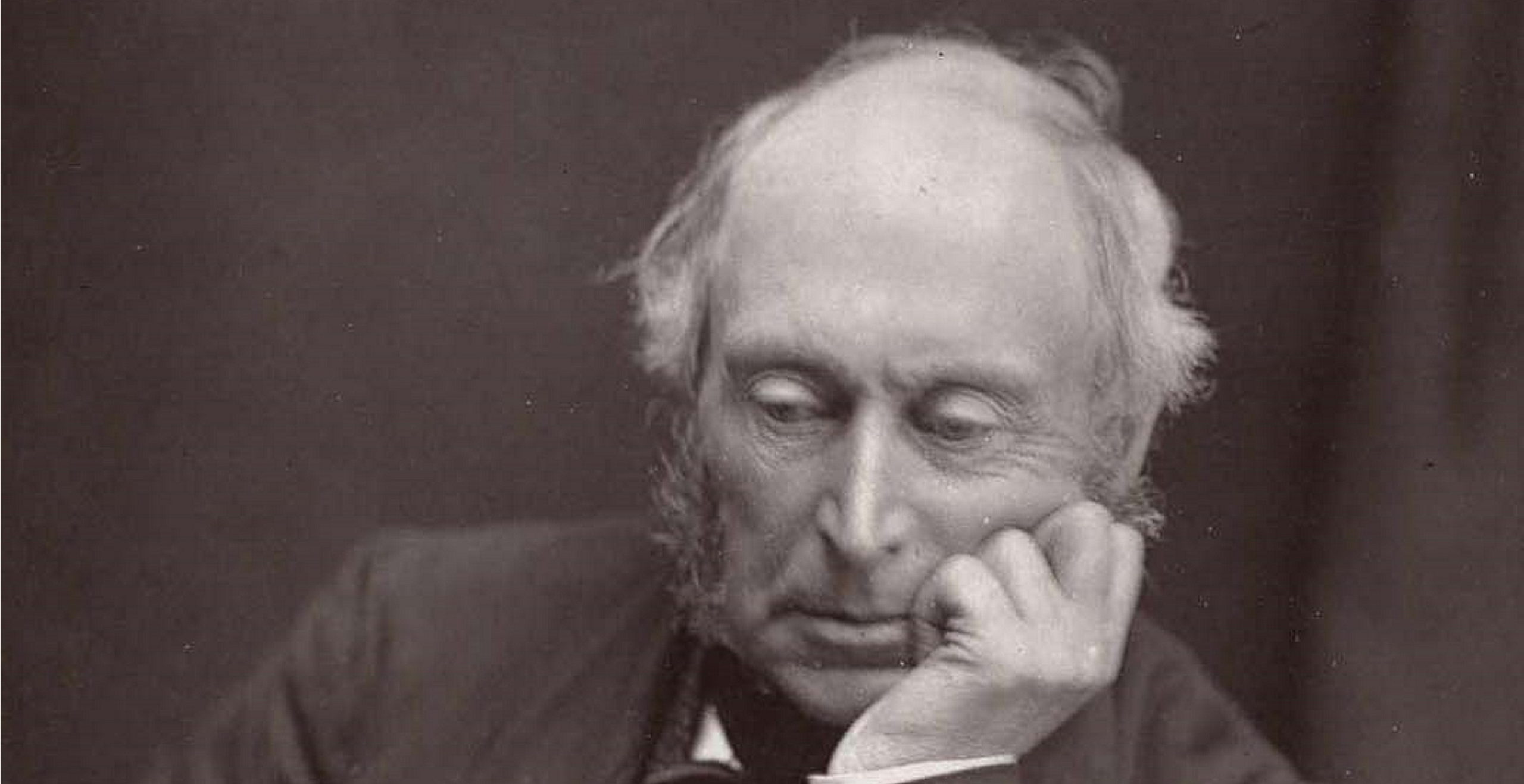
Thirty years earlier, Samuel Rowbotham had been a member of a short-lived utopian commune in the notoriously flat Fens of East Anglia, beside the Old Bedford River, an artificial drainage channel that runs completely straight for 6 miles. Rowbotham claimed to be able to see much further along this straight, flat canal than the curvature of the earth would allow and this convinced him, beyond any doubt, of the flatness of Earth (something that, contrary to later myths, virtually no educated Westerners had believed since Classical Antiquity).
Rowbotham, expelled from the commune, began giving lectures around the country, outlining a detailed Flat-Earth cosmology grounded in an extremely literal interpretation of the Bible.
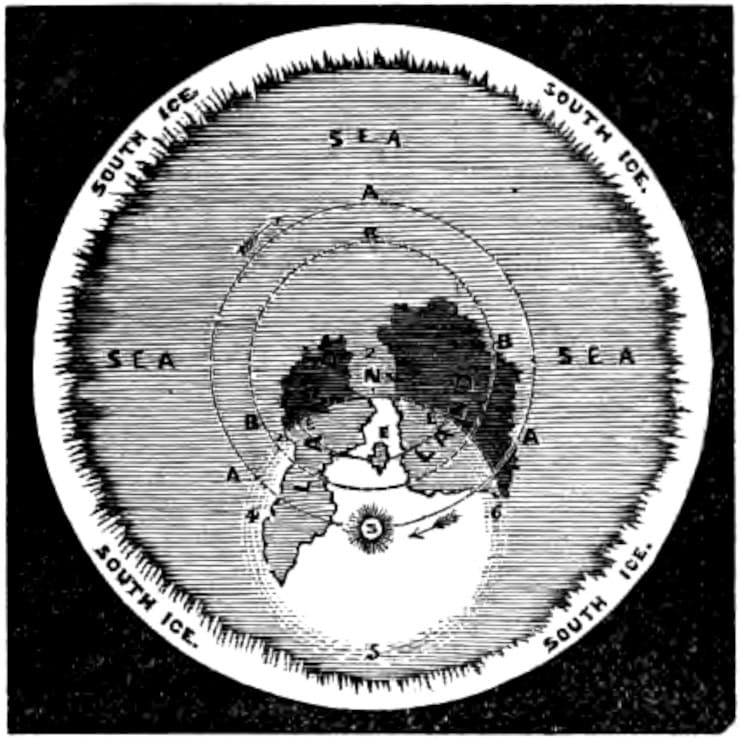
He published a series of pamphlets detailing his beliefs (and his claim that various dietary measures, including avoiding wheat bread, would enable readers to live ‘for an extraordinary period’), and one of these fell into the hands of John Hampden, another Biblical Literalist, who was almost immediately converted, and published his own flat-earth pamphlet within a year.
And that year Hampden issued his challenge in Scientific Opinion.
Wallace had a couple of reasons for accepting. First off, £500 was a lot in 1869, equivalent to about £50,000 nowadays. And also, perhaps surprisingly, for a man known today as a champion of Science during the controversy over Darwin’s Origin, Wallace was a Spiritualist.
He regularly hosted séances, where his sister’s lodger engaged in antics including levitating tables and producing flowers out of nowhere. Wallace’s reputation as a man of science was suffering as a result, and a high-profile debunking of a pseudoscientific belief might help to recover it.
On March 1st, 1870, Hampden and Wallace travelled to the Old Bedford Bridge near Downham Market, on the same Fenland watercourse where a young Samuel Rowbotham had made his measurements.
They would place five posts along the 6 miles between the Old Bedford Bridge and Welney Bridge, with markers exactly 6 feet above the water. They would line a telescope up with the first and last markers. On a flat earth, the markers would all appear lined up, but on a globe the markers in the middle would appear above the line of sight between the markers at each end.
Each participant had appointed a referee to adjudicate the results. Wallace had John Walsh, the editor of the hunting magazine The Field, and Hampden had William Carpenter, another flat-earther inspired by Rowbotham and, like Wallace, a spiritualist. Carpenter seems to have thought Wallace’s unconventional beliefs actually made him a potential Flat-Earth convert.
They paced out the distances along the riverbank, getting the posts in exactly the right places. And then the next day, when they’d finally managed to position the telescope correctly on a floating barge…
…they couldn’t tell anything. Only two of the five markers were visible, and it turned out the others were at entirely the wrong heights, including one that had fallen over and a local had re-erected without considering the necessary precision.
After quite a lot of arguing, the two parties agreed on a more straightforward experiment, with less that could go wrong. They would look from the Old Bedford Bridge, 13-and-a-half feet above the water, towards a marker at the same height on Welney Bridge. There would be a post midway, with another marker at 13-and-a-half feet. On a globe, the middle marker would appear above the line of sight, while on a flat earth both markers would be in line.
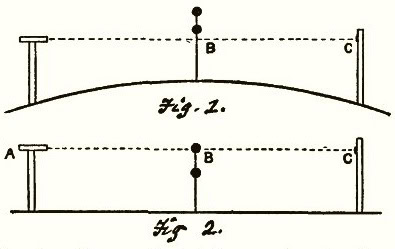
A diagram of Wallace’s experiment, looking between two bridges (A and C), with a marker (B) midway. Fig. 1 and Fig. 2 show the expected globe-earth and flat-earth views respectively. Source: A.R. Wallace. My Life (public domain).
The next day, they actually did the experiment. Looking through the original telescope, the middle marker was indeed above the line of sight.
The flat-earthers looked through their own telescope, with a crosshair that Wallace insisted was unnecessary, and, to quote Wallace’s autobiography, ‘literally jumped for joy’ – despite their result actually proving a globe. Their sketches show that the three markers – the telescope crosshair, the middle marker, and the marker on the bridge – appeared in a vertical line, roughly evenly-spaced. The spacing should be slightly unequal, but the sketches weren’t precise enough to tell whether it was. On a flat earth, all three should have been at the same height.
They returned to London without agreeing on a result.
Walsh published a write-up in The Field, and all three other participants wrote in, making their points. Hampden published a pamphlet with his version of events, claiming Wallace’s experiment demonstrated nothing (and that the diagrams in The Field were falsified), and continuing the bizarre claim that his experiment, with the telescope crosshair, proved him right. Samuel Rowbotham said he should have been involved, and that if they’d repeated his experiments, the flat-earthers would have been vindicated.
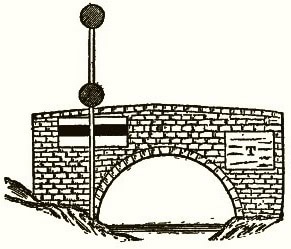
Another diagram of Wallace’s experiment, showing the marker on the post (the higher marker is the important one) appearing above the marker on Welney Bridge. Source: A.R. Wallace. My Life (public domain).
Wallace won the bet, but Hampden sued to get his stake back. The court ruled that the agreement wasn’t legally binding, so Wallace got nothing.
Hampden also wrote letters. He wrote to Wallace, Walsh, Wallace’s wife, Wallace’s cook, the Astronomer Royal, the President of the Royal Society, the editors of the Encyclopaedia Britannica, and basically anyone with any connection to Wallace, calling Wallace ‘thief’, ‘swindler’, ‘convicted felon’, ‘degraded blackleg’, etc. He spent several months in prison for threats and libel, and once showed up at Wallace’s house. The last time Wallace’s autobiography mentions him is 1885, 15 years after the wager.
Should Wallace have accepted the wager? I don’t have a definite answer. His scientific reputation suffered for it – most of his peers thought a respectable scientist shouldn’t do things like that, and he shouldn’t have given Hampden any publicity at all. Materially, he gained nothing from winning and lost a lot in legal costs (and endured 15 years of harassment). I suspect Wallace thought he had a chance of persuading Hampden. I can imagine Wallace (a spiritualist, who probably sympathised with someone rejecting scientific orthodoxy) thinking Hampden was a genuine free-thinker, who was mistaken about this particular thing.
But I’ll say in Wallace’s defence that, while Hampden wasn’t convinced, there might have been people who’d been to Rowbotham’s lectures, and read Hampden and Carpenter’s pamphlets, and were on the fence, who were convinced by reading about Hampden’s failure.
Joe Bath hosts the podcast Science: A Peculiar History, covering unusual stories from the History of Science. You can find a miniseries on the Flat-Earth movement in Victorian England here: scienceapeculiarhistory.co.uk/series-1.html, and most places you can get podcasts.
Published: 23rd March 2026