NASA's Changing Stance on UFOs: Full Timeline
NASA‘s relationship with UFOs has evolved alongside broader changes in public and government interest in unexplained sightings. Newsweek spoke with experts about how the public’s and scientific community’s views have evolved over time.
As new UFO—now commonly referred to as unidentified anomalous phenomena (UAPs)—reports, official investigations and congressional hearings have brought the topic back into the spotlight, the agency has increasingly emphasized a scientific approach to studying the phenomenon.
Former NASA official and UAP study team member Michael Gold recently argued that the topic was not always viewed through the same lens.
Newsweek reached out to NASA and the Department of War’s All-domain Anomaly Resolution Office, which is leading the government response to UAP, by email for comment.
UFOs in the 1940s and 50s
Reports of unexplained aerial phenomena received serious attention in the 1940s and 1950s before becoming increasingly stigmatized in later decades, making researchers and witnesses reluctant to discuss them publicly, Gold said in an interview with NewsNation’s Reality Check.
“It is true that in the 40s and 50s, people took this phenomenon seriously and were able to talk about it without fear. But this changed later, especially when academia joined the government in dismissing UAP reports and mocking and punishing people who spoke out about them,” Kanishkan Sathasivam, a politics, policy and international relations professor at Salem State University, told Newsweek. “Back then, it was precisely the government and academia that were among the most trusted institutions in the country. So, many people were willing to go with what those institutions said on anything.”
The modern UFO era began in 1947 following pilot Kenneth Arnold’s widely reported sighting of nine fast-moving objects near Mount Rainier and the subsequent Roswell incident.
Project Sign: First Formal Investigation into UFOs
In response to a growing number of reports, the U.S. Air Force launched Project Sign in 1948, its first formal investigation into UFOs. Project Sign approached the phenomenon with relative openness, examining whether some sightings could represent advanced technology beyond known human capabilities.
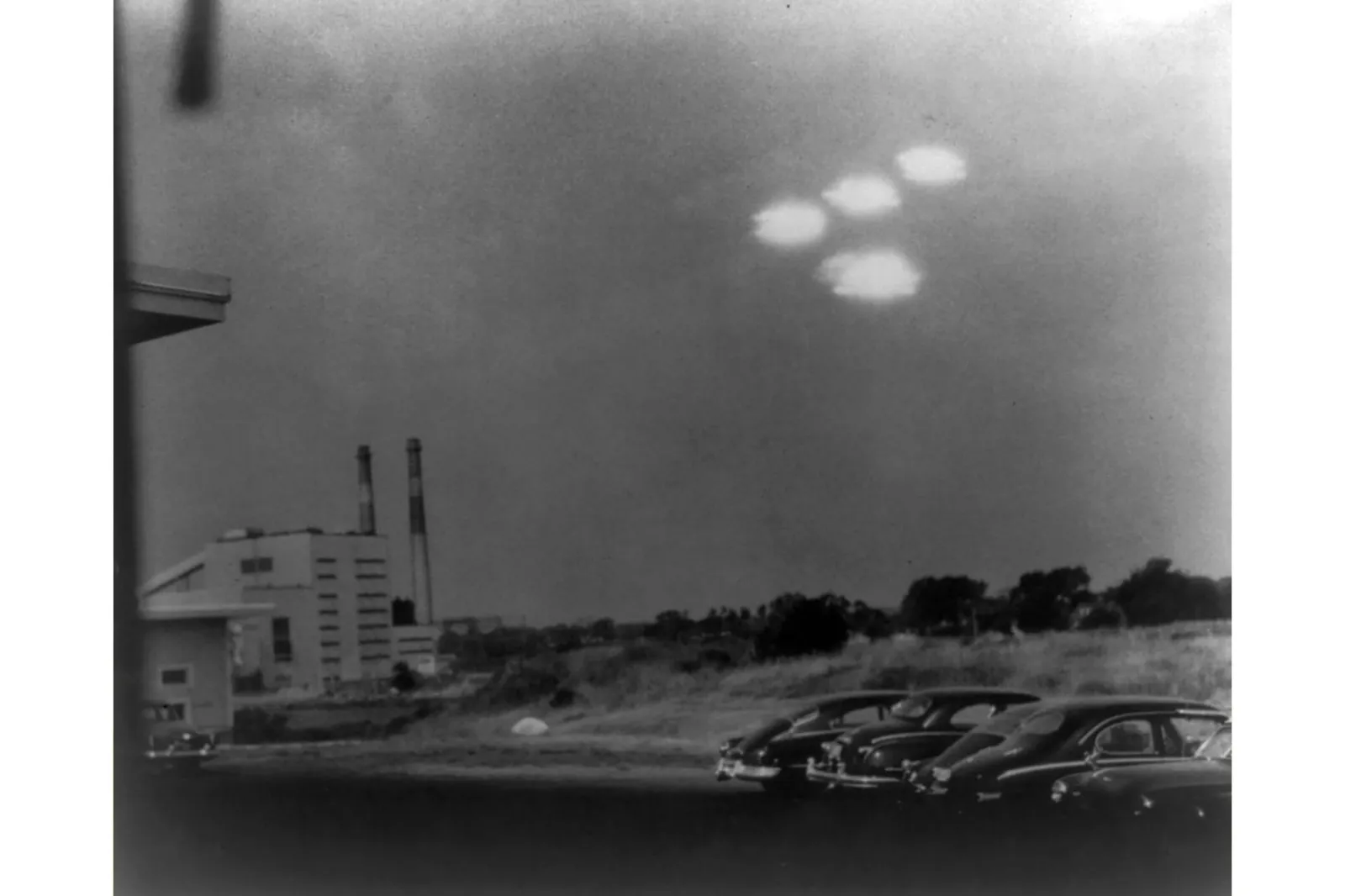
One of the most famous UFO photographs of the 1950s was taken by 21-year-old Coast Guard photographer Shell R. Alpert at the Coast Guard Air Station in Salem. Alpert photographed four bright objects in a V-formation hovering above nearby power plant smokestacks after noticing them outside his photo lab window (see photo above). The case was ultimately listed as unexplained. The photograph became known as one of the earliest and most widely circulated daylight UFO images.
In the Reality Check interview, Gold said that while there was “no mockery” surrounding UFO reports in the 1940s and early 1950s, that attitude later shifted.
1960s: UFO Shift Begins
Over the following decades, many reported UAP sightings received conventional explanations.
Astronauts Frank Borman and Jim Lovell reported seeing a “bogey” outside the Gemini 7 in December 1965 and described numerous bright particles moving nearby.
Buzz Aldrin reported seeing an unusual object during the Apollo 11 mission in July of 1969, but has said he doesn’t think it was an alien spacecraft.
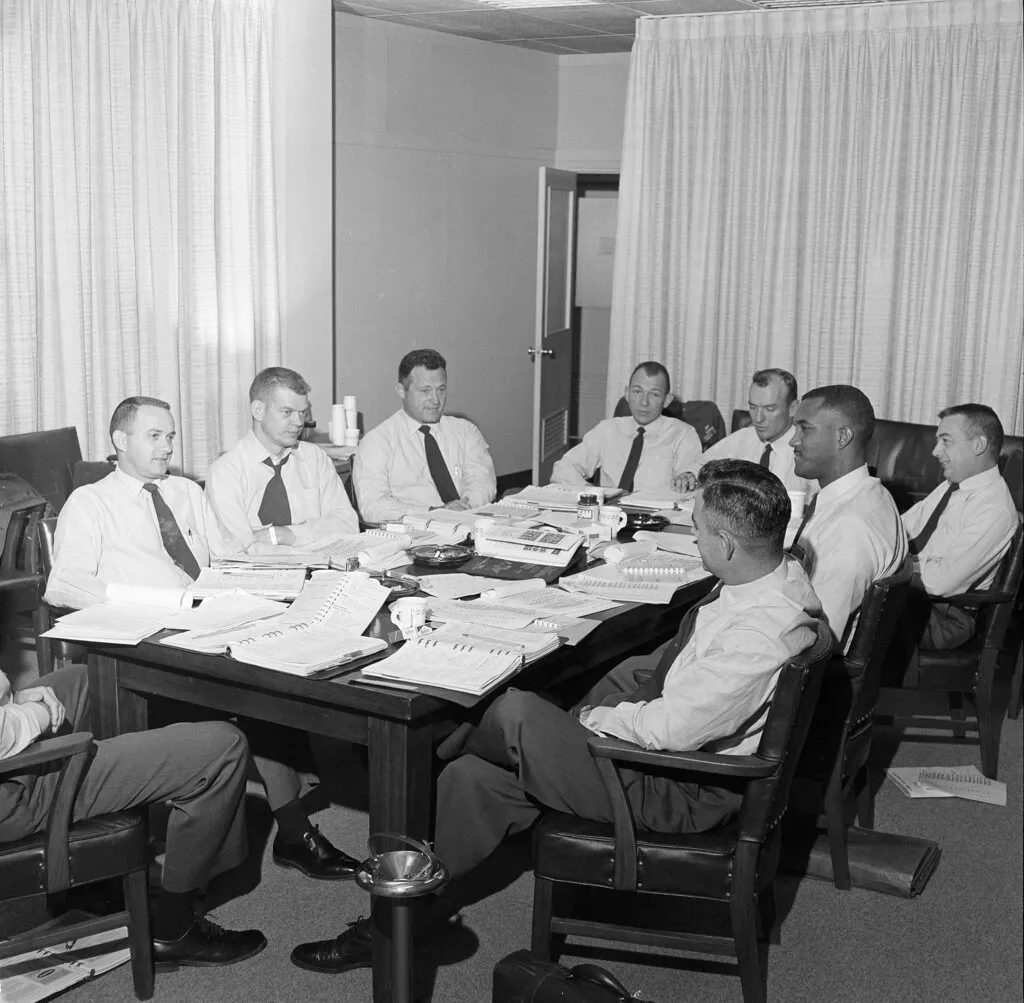
By the end of the decade, Project Blue Book (which had replaced Project Sign and became the government’s longest-running UFO investigation) was winding down. In 1969, following the University of Colorado’s Condon Report, the Air Force concluded that continued UFO investigations were unlikely to produce significant scientific results.
Over the next few decades, reported UFO encounters were scrutinized, but reports of unusual lights, flashes and apparent objects near spacecraft were commonly traced to ice crystals, insulation fragments, discarded hardware, orbital debris or reflections of sunlight.
1990s: Renewed Public Interest (Thanks to Video)
The Space Shuttle era produced some of the most famous NASA-related UFO controversies.
During the 1991 STS-48 mission, cameras recorded luminous objects apparently changing direction near Discovery, while NASA attributed the phenomenon to debris and thruster activity.
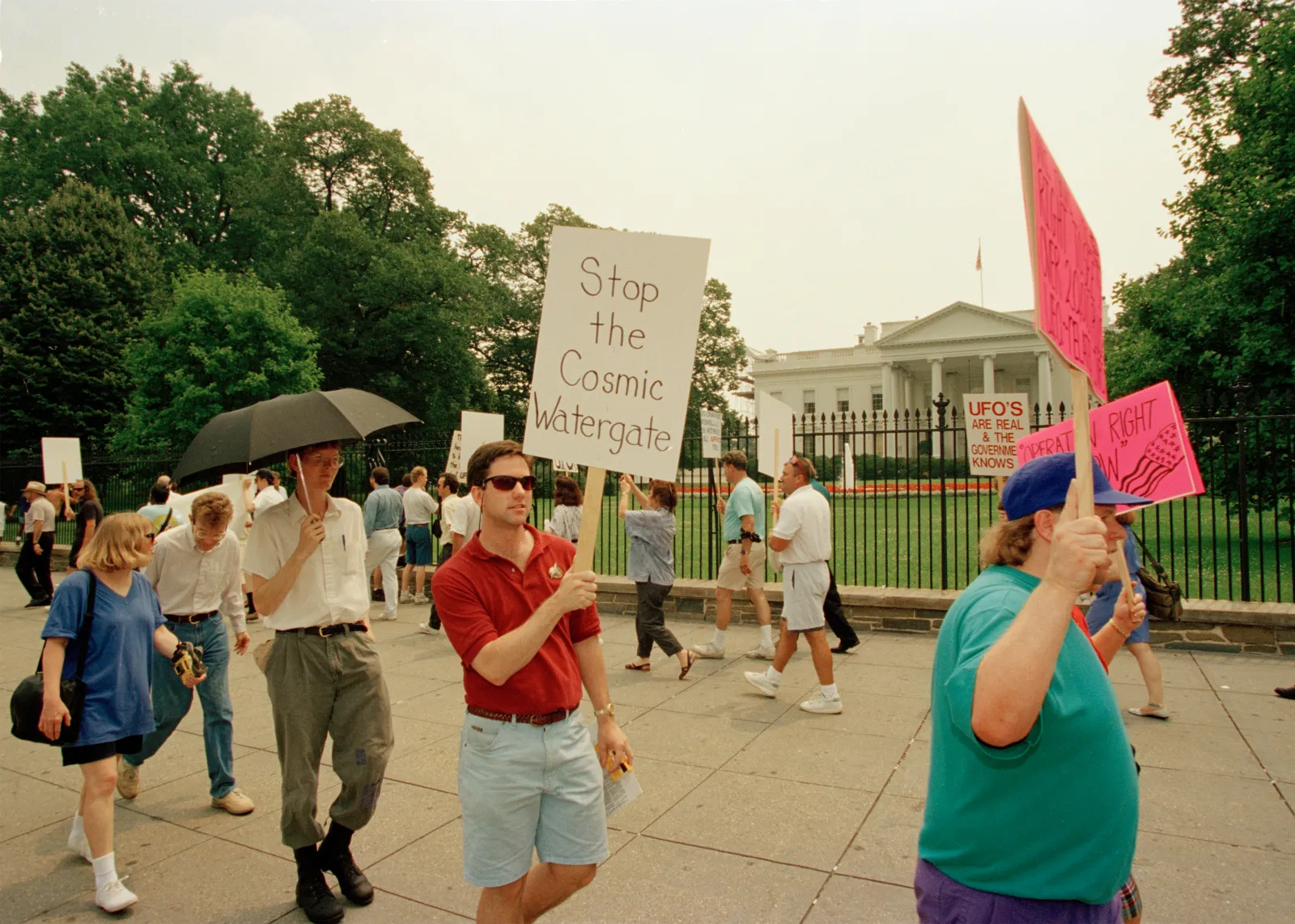
In 1996, Columbia’s STS-75 “Tether Incident” showed dozens of bright objects near a broken satellite tether, prompting claims of extraterrestrial craft. NASA and outside experts instead cited ice particles, debris and optical effects.
These cases helped keep UFO interest alive during a period when most astronaut sightings were being explained through conventional spaceflight phenomena.
UFOs Over the Past Decade
In recent years, however, government investigations, military disclosures and scientific reviews have helped bring the issue back into the mainstream. NASA’s changing role reflects that broader shift, from a period when the subject was often marginalized to one in which officials increasingly frame UAPs as a legitimate topic for data collection and scientific inquiry.
NASA’s later decision to study unexplained aerial phenomena emerged amid a broader shift within the U.S. national security establishment that gained momentum in 2017. The publication of Navy infrared cockpit videos and reporting that revealed the Pentagon’s Advanced Aerospace Threat Identification Program (AATIP) renewed public and congressional interest in the issue.
In the years that followed, lawmakers increased oversight, required intelligence assessments and regular reporting on UAPs, and established new mechanisms for investigating reports. Against that backdrop, NASA launched its own independent study in 2022, reflecting a wider government effort to examine unexplained aerial phenomena more systematically.
In 2023, the agency released the independent UAP study, appointed a director of UAP research, and said it would apply its scientific expertise and observational capabilities to better understand anomalous reports while conducting the work “transparently for the benefit of humanity,” then-administrator Bill Nelson said.
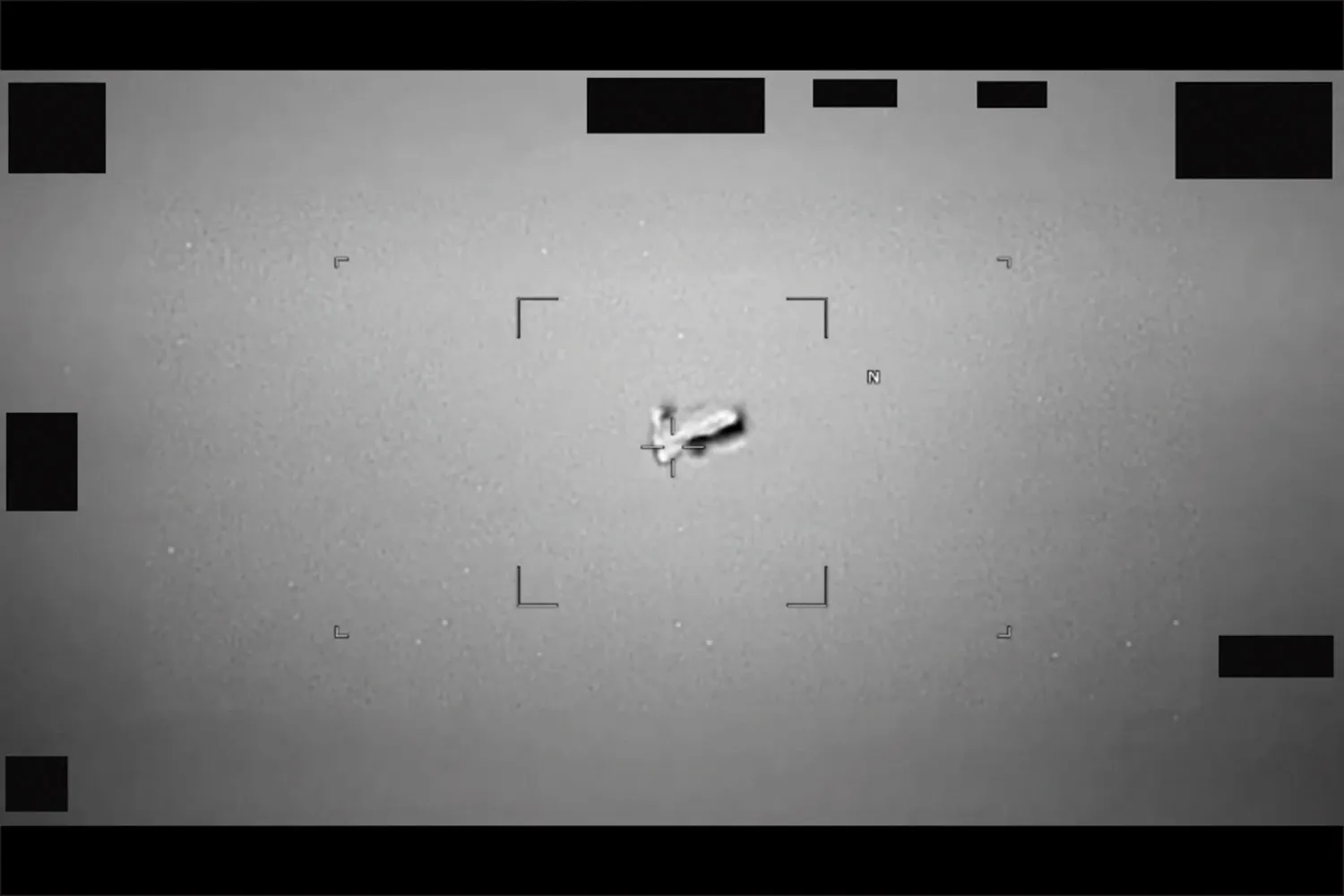
In the last few years, the situation has evolved further. On May 8, 2026, the first tranche of UFO files was released under the Trump Administration, followed by subsequent releases later in May and June.
Now, decades-old reports, as well as more recent ones, are receiving renewed attention. However, the public stance on UAPs—and the federal response to them—has also shifted.
“The public largely no longer trusts what the government has to say, and even academia has significantly lost the public’s trust,” Sathasivam told Newsweek. “So, the stigma is eroding, as is people’s fear of speaking out. Furthermore, the government itself has apparently come to the conclusion that they are hurt more than helped by continuing to perpetuate denials and cover-ups.”
That shift has coincided with the emergence of organizations dedicated to promoting greater transparency around UAP reports and government records. One such group is the Disclosure Foundation, a nonprofit advocacy organization focused on increasing public access to information about UAPs.
“Congress has mandated that NASA transfer its UAP records to the National Archives, and to date, very little of that work has actually been done,” Jordan Flowers, executive director of the Disclosure Foundation, told Newsweek. “That’s why the Disclosure Foundation has established an independent review team to help facilitate it — led by former members of NASA’s own UAP Independent Study Team alongside a panel of scientists committed to getting to the bottom of this. We now have a high degree of confidence that these records exist. And we’re not surprised that with presidential will now firmly behind transparency, NASA has gotten on board. The law has required this for some time. What’s changed is the political will to actually follow through.”
Furthermore, advances in technology, including smartphones, social media and the internet, have made photos, videos and firsthand accounts of alleged UAP sightings far more accessible to the public than they were in the 20th century.
“So now, I think the government’s thinking is to manage and control the narrative rather than to outright deny it and attack people for it,” Sathasivam said.
However, Sathasivam said he does not believe NASA played a role in any broader effort within the government to shape public perceptions of UFOs.
“NASA, however, is not now and never has been a part of this government cabal. So yes, I don’t believe NASA was ever a part of the cover-up. But, as a government agency with significant overlap with academia, it got the message loud and clear that it was supposed to join in mocking UAP claimants.”
What Happens Next
The next phase of the U.S. government’s UFO, or unidentified anomalous phenomena (UAP), disclosure effort could focus on additional releases of declassified records, continued investigations by the Pentagon’s All-domain Anomaly Resolution Office (AARO), and ongoing pressure from members of Congress seeking greater transparency and whistleblower testimony.
Contact Newsweek editors on this story: Samantha Beech and Gray R. Thomas