A cancer vaccine milestone, a vaccine injury center, and what a flu shot study actually found: The State of US Vaccine Policy
Welcome to our biweekly series in partnership with CIDRAP at the University of Minnesota.
With flu season off to an early start, a lot of people are deciding about their flu shot right now, and, unfortunately, a Cleveland Clinic preprint study is being taken out of context to convince them the vaccine doesn’t work. This edition closes with a breakdown of what the researchers actually found, why the number being shared comes from an outdated version of the study, and what the data can (and can’t) tell us.
First, we’ll catch you up on the past two weeks in vaccine policy, including promising results for a personalized melanoma vaccine, a rebuke of Health and Human Services (HHS) Secretary Robert F. Kennedy Jr. from the National Institutes of Health (NIH) hospital’s own board, and a federal vaccine committee that still can’t make recommendations. So, what happened, and should this study change how you think about your flu shot? Let’s discuss…
The PDF version of today’s update is here. Read past installments here and today’s update on the Unbiased Science Substack here.
The State of U.S. Vaccine Policy, in Brief
The past two weeks brought one encouraging result for cancer vaccines and several more signs that the federal agencies we rely on for vaccine decisions are stretched thin.
1. Merck and Moderna report positive results for a personalized melanoma vaccine
On October 22, Merck and Moderna reported that their personalized mRNA vaccine for melanoma, given alongside the immunotherapy drug pembrolizumab (Keytruda), cut the risk of recurrence within two years by 42% compared with pembrolizumab plus placebo in a trial of 1,137 patients. The companies haven’t yet shown that the vaccine extends overall survival, though Merck plans to seek approval as soon as possible. If approved, it would be the first personalized mRNA vaccine used to treat cancer. The vaccine is built from markers (neoantigens) unique to each patient’s own tumor and teaches the immune system to recognize the cancer if it comes back. Similar vaccines are being tested in pancreatic, kidney, bladder, and lung cancers and in glioblastoma, though most results outside melanoma come from small early-stage studies, and recent randomized trials in colon and head and neck cancers didn’t reduce recurrence.
2. The NIH opens a vaccine injury center, and its hospital board objects
Earlier this month, Kennedy held an unannounced ribbon-cutting at the NIH Clinical Center for a new clinic to study vaccine injuries, along with a roundtable featuring patients who said vaccines harmed them. The hospital’s oversight board responded by voting unanimously to support a statement from its chair, Jack Leslie, accusing Kennedy of undermining trust in science and politicizing the hospital’s work. Leslie said that serious vaccine injuries are rare but real and deserve rigorous study, but that the “Vaccine Injured” signs at the event suggest a predetermined conclusion, which would leave patients with findings no one trusts. Clinical Center CEO Dr. Jonathan Green said the clinic builds on existing NIH vaccine safety research and will undergo standard scientific and ethical review. Days after the launch, two NIH leaders said the center will also study long-term symptoms after infections, including long COVID, since many people had both the vaccine and the infection and it can be hard to tell which caused their symptoms.
3. The CDC declines a request to validate a higher-volume measles test
In May, public health officials in California and Washington asked the Centers for Disease Control and Prevention (CDC) to validate a high-throughput measles test that can process 500 samples in eight hours. The agency took two months to respond and then declined, citing “other competing priorities,” according to a letter the West Coast Health Alliance sent last week to new CDC director Dr. Erica Schwartz. Most public health labs bought high-throughput machines during the pandemic but need a CDC-endorsed test to use them for measles, and results currently take two to five business days, depending on staffing. With more than 4,500 measles cases reported so far this year, the states urged the CDC to develop and share protocols so labs are ready for large outbreaks. Experts told The New York Times the agency may not have the capacity to take on this work, given that its workforce has shrunk by about 30% since the start of President Donald Trump’s second term.
4. CDC deputy director Jennifer Shuford resigns after 4 months
Dr. Jennifer Shuford, the CDC’s deputy director and chief medical officer, will leave the agency on November 12 after four months in the role. Shuford previously served as Texas health commissioner and was widely respected for her handling of the state’s measles outbreak last year. In a CDC statement, she said she was leaving to spend more time with her family. Her exit comes as the agency faces criticism over its measles response, including a dispute over its refusal to acknowledge several measles-related deaths reported by the Pennsylvania Department of Health. Capt. Satish Pillai will serve as acting deputy director while the agency searches for a replacement.
5. Insurers balk at paying for newborns’ RSV protection in the hospital
Many newborns are leaving the hospital without respiratory syncytial virus (RSV) protection, because most commercial insurers will not reimburse hospitals for giving the monoclonal antibody immunization, which costs about $500 per dose. Hospitals typically negotiate bundled payments for delivery and newborn care, and insurers argue that not every infant needs it, since some mothers were vaccinated during pregnancy and some babies are born outside RSV season. Families can get the shot for free at a pediatrician’s office, but according to Dr. Michelle Fiscus, CEO of the Association of Immunization Managers, some infants aren’t seen within the recommended first seven days of life. Only about 40% of eligible pregnant people received the maternal RSV vaccine, according to the American Academy of Pediatrics (AAP), and many babies whose mothers weren’t vaccinated never got the antibody, either. If you’re expecting this season, ask your hospital ahead of time whether it gives the antibody before discharge.
6. ACIP limbo leaves the new mRNA flu vaccine without required insurance coverage
A court order halted Kennedy’s overhaul of ACIP (the CDC’s vaccine advisory committee), but he has not appointed new members, leaving the committee unable to issue recommendations as new vaccines reach the market. One example is Moderna’s mRNA flu vaccine, approved by the Food and Drug Administration (FDA) in August for adults 50 and older. Without an ACIP recommendation, insurers are not required to cover it, and some patients are paying out of pocket. In states that allow only pharmacists to give ACIP-recommended vaccines, it may not be available at the pharmacy at all. Insurers don’t have to cover a newly recommended vaccine until the plan year that starts a full year after the recommendation, so a recommendation made after this December would push required coverage to January 2029 at the earliest for most plans. The federal government has appealed the ruling, and AHIP, the insurance industry’s trade group, has pledged that its member insurers will keep covering all vaccines recommended as of September 2025.
Hot off the press! The CDC is now taking nominations for new ACIP members through December 31, so a reconstituted committee is unlikely to be voting before next year. The committee can have up to 19 members, and the notice calls for a balanced range of scientific, clinical, and public health expertise (including at least one person who brings consumer or community perspectives), citing HHS policy that membership be balanced in the points of view represented. Anyone can apply or be nominated, and the HHS secretary makes the final picks.
Can the Flu Shot Raise Your Risk of Flu? Another Look at a Cleveland Clinic Study
This Cleveland Clinic preprint study (meaning it hasn’t been peer-reviewed) first went viral when it was posted in April 2025 (we covered it then), and it’s circulating again this fall. Researchers followed 53,402 Cleveland Clinic employees for 33 weeks, starting October 1, 2024. Cleveland Clinic requires staff to get a flu shot or an approved medical or religious exemption, and 82% of employees (43,920 people) were vaccinated by the end of this study. A flu case was defined as a positive PCR (polymerase chain reaction) test performed within the Cleveland Clinic system, and 1,130 employees (2.1%) had tested positive throughout the season.
The study is now in its fourth version, and the main analysis has changed. Posts sharing it usually say the flu shot raised employees’ risk of flu by 27%. That number comes from the first version, which gave one estimate for the whole season (a hazard ratio of 1.27). The latest version splits the season by how much flu was circulating and reports three estimates, 0.70 (95% confidence interval 0.42 to 1.15) in low-activity weeks, 1.20 (0.86 to 1.67) in medium-activity weeks, and 1.33 (1.07 to 1.64) in high-activity weeks.
Two quick translations. A hazard ratio compares how quickly new cases pile up in two groups, so it isn’t the share of people who got sick. A hazard ratio of 1.33 doesn’t mean 33 in 100 people got the flu, and only about two in 100 employees tested positive over the entire study. Vaccination status also switched on seven days after someone’s shot, so “vaccinated” describes an employee on a given day, and the same person can contribute time to both groups.
Five Reasons We Aren’t Worried About this Study
Observational studies can tell us a lot, but only when they compare groups that are alike (apples to apples).
1. It’s not surprising that ‘most cases were in vaccinated people’
The authors say they were prompted by clinicians noticing that many vaccinated people were getting flu, including whole families. That intuition runs into a base rate problem. When most people are vaccinated, most cases will occur in vaccinated people, even if the vaccine works. In this study, roughly three of every four person-days were spent in the vaccinated state (8.9 million vaccinated days versus 2.9 million unvaccinated days). The table below shows how that plays out with example numbers.
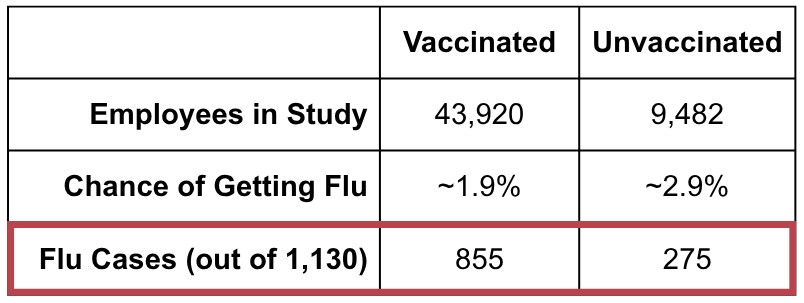
This is an example calculation rather than exact study results from the paper. We kept the study’s total of 1,130 cases and assumed the vaccine cuts risk by 33% (based on an end-of-season estimate against outpatient flu for the 2024-25 season), with both groups otherwise equally likely to get flu. We also treated everyone as vaccinated all season, which simplifies what happened.
In this example, every vaccinated employee is a third less likely to get flu than an unvaccinated one, and yet about three of every four cases still land in vaccinated people, simply because there are more than four times as many of them. Counting cases tells you very little until you know how many people were in each group, so what matters is the rate in each group, and whether the groups were comparable to begin with.
2. The unvaccinated group was mostly people with exemptions, who likely differ from their coworkers
About 9,500 employees (~18%) hadn’t received the flu vaccine by the end of the season, likely mostly people with approved exemptions. People with exemptions may differ from the rest of the workforce in ways that affect their flu risk, such as how much patient contact they have, whether they’ve had flu recently, or how likely they are to get tested when sick.

Unmeasured differences can make the vaccine look harmful. In the causal diagram, the arrows show the flow of information from one variable to another. For example, exposure to flu and infection history can both influence who ends up receiving the vaccine and who gets the flu, so comparing those two groups mixes the effect of the vaccine with those underlying differences.
Diagram by Unbiased Science.
Some of these differences could raise flu risk and others could lower it, but the authors adjusted for only four factors, which were age, sex, whether someone was a bedside nurse, and primary work location.
Hindsight’s 20/20: The authors could have collected more information on flu exposure and diagnosis history, household contacts, flu shots in prior seasons, chronic conditions, and job role, then compared people within the same unit and role. They could also add a negative control, such as positive tests for RSV or another respiratory virus the flu shot wouldn’t affect. If vaccinated employees also had extra RSV cases, something other than the flu shot is likely driving the difference.
3. Vaccinated employees were tested more, so more of their flu got caught
Flu was counted only when a PCR test was done within the Cleveland Clinic system, and the decision to test was left to the treating clinician. The authors noted that vaccinated employees were tested more often than unvaccinated employees on most days, especially during the peak of flu season. They argued the extra tests reflect extra infections, since the share of tests coming back positive wasn’t significantly different between groups at the peak. However, if vaccinated employees are more likely to get tested for a mild illness, those extra tests could catch mild infections that would have gone unrecorded in an unvaccinated coworker, and positivity would still look the same.
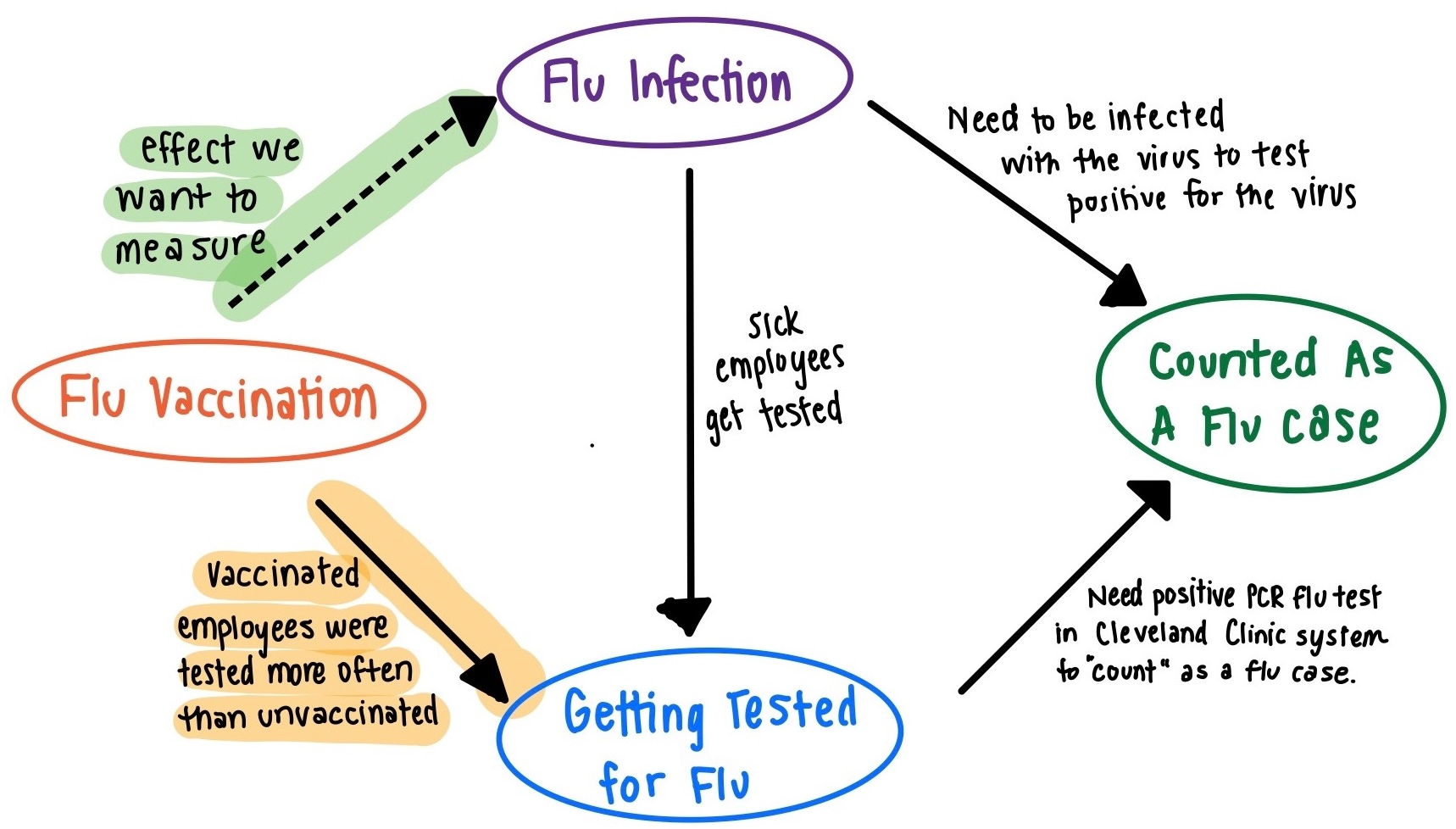
More testing among vaccinated individuals can look like more flu.
Diagram by Unbiased Science.
Hindsight’s 20/20: The authors could instead use a test-negative design, which is how the CDC’s vaccine effectiveness studies work. This design looks only at people tested for the same reason (like a respiratory illness) and compares vaccination rates between those who test positive and those who test negative, which helps reduce differences in who seeks care. Another option is testing everyone on a regular schedule, or testing anyone with certain symptoms under a standard protocol, so vaccinated and unvaccinated employees are tested equally often.
4. The study counted only positive tests, which misses the flu shot’s biggest benefit
The study measured only whether someone had a positive flu test. It wasn’t designed (or large enough) to look at flu hospitalizations or deaths, and it didn’t account for how sick infected people got. The flu shot’s biggest benefit is protection against severe illness, hospitalization, and death, so a positive test alone doesn’t capture what the vaccine does best. The data also come from a single health system in a single season, among a mostly working-age, mostly female workforce (average age 42, 75% women), so the findings don’t apply to children, older adults, pregnant women, or others at higher risk of severe flu, who benefit most from the vaccine.
Hindsight’s 20/20: Data on sick leave, emergency department visits, hospital admissions, and symptom duration would let researchers sort flu by severity beyond a single yes/no test. Results could also be reported separately by employee age and job type.
5. The higher-risk result comes from one slice of one flu season
In the fourth version of the paper, researchers split the flu season into low-, medium-, and high-activity weeks, and only the high-activity weeks showed a higher rate of flu among vaccinated employees.
- The unvaccinated group isn’t the same across the season. Most employees got their shots in the fall before flu took off, so early in the season the “unvaccinated” group included nearly everyone. By the peak, it was much smaller and made up mostly of people with exemptions, so each slice compares vaccinated employees against a very different reference group.
- Waning and rising flu activity are tangled together. By the busy weeks, most vaccinated employees had gotten their shot a couple of months or more earlier, and protection fades over the months after a shot. Because time since vaccination grew as flu climbed toward its peak, the analysis can’t cleanly separate “the vaccine doesn’t work when flu is common” from “protection fades with time.”
- The slicing was a choice made after the fact. The authors changed the main analysis in this version, and the cutoffs for low, medium, and high activity look like analyst decisions rather than a pre-specified plan. When an analysis is reworked after the data are in and one of three subgroups crosses the significance line, that result deserves a lot more caution than a pre-planned one.
Posts claiming the flu shot raises your risk by 27% leave all of this out. They also skip that the authors revised that first analysis themselves and wrote that the pattern could reflect an unrecognized factor and that the flu vaccine is an important public health tool.
Flu vaccines aren’t perfect, and how well they prevent infection varies from season to season. They do the most good by lowering the risk of hospitalization and death, even in years when they’re less effective at preventing infection.
With flu activity already rising earlier than usual, now is a good time to get vaccinated if you haven’t yet. If you have questions about your flu shot, talk with your clinician, or try our free tool to understand your own flu risk based on a few basic questions.
If you work in a clinic, pharmacy, or other community space, we created free, printable flyers with a QR code that leads to the flu risk tool so folks can access it while they are waiting.
Stay Curious,
Unbiased Science