Alien Probes Might Be Hiding in Plain Sight, Says Scientist
Alien probes could be hiding among us in plain sight as we search for them in the wrong places.
This is the theory of professor Alex Ellery of Carleton University who argues that if self-replicating alien probes have reached our solar system they may not be in the form of flying saucers or flashing lights but camouflaged as rocks from asteroids, lunar debris or comets.
“I believe that extraterrestrial intelligence (in AI form) could be concealed under the lunar surface, in effect, ‘hibernating.’ They may periodically surface to observe our planet and its biological evolution. As that evolution becomes more interesting, their awakening periods may become more frequent but our species evolved very rapidly to become tool-using over the last 2 million years or so,” Ellery told Newsweek.
Self-replicating spacecraft or probes are often referred to as von Neumann probes, having been introduced as a concept by mathematician and physicist John von Neumann in the 1940s. The idea is that these are machines capable of mining resources, replicating and spreading through the galaxy over millions of years.
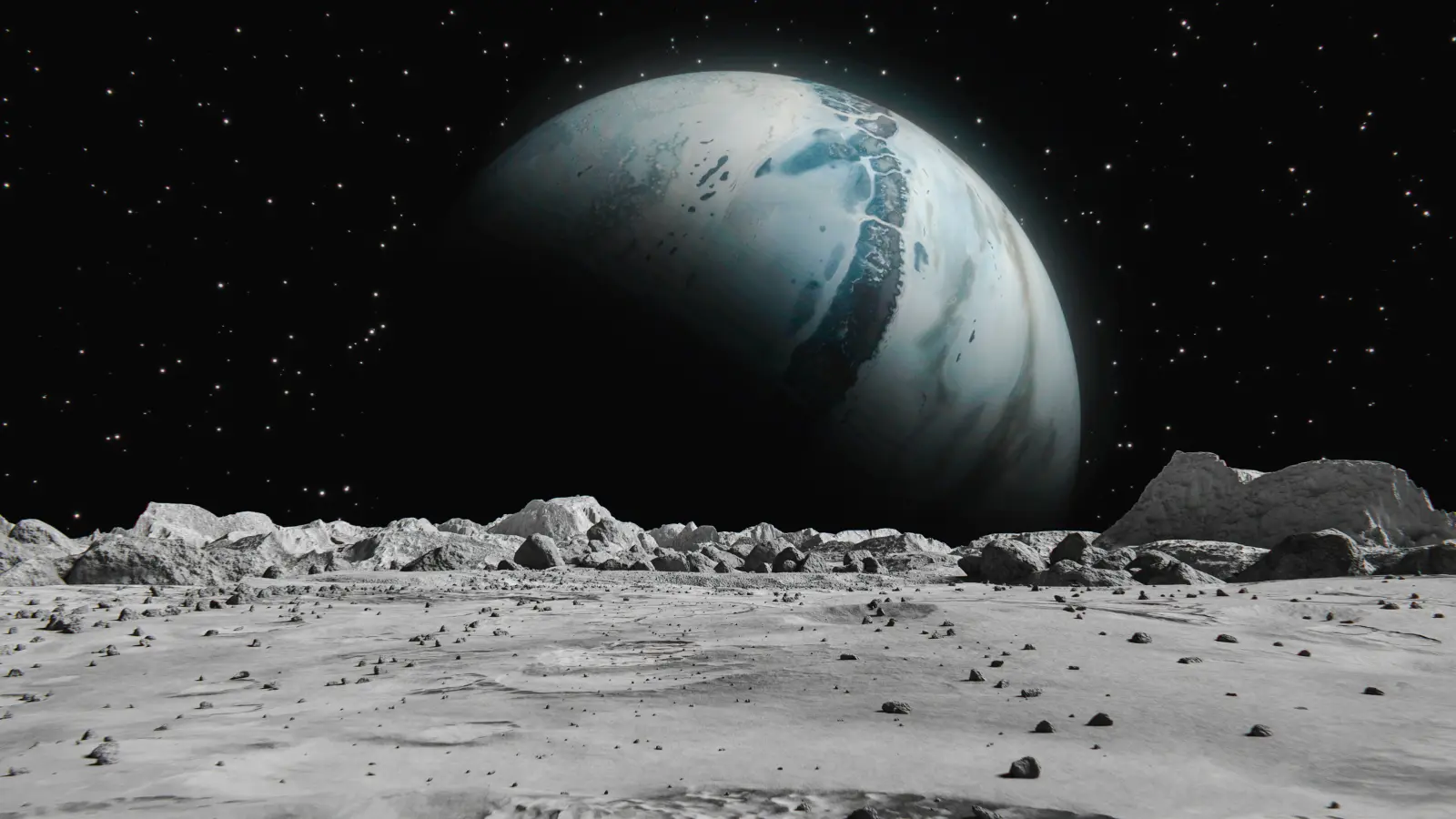
However, instead of searching for radio and artificial signals in the skies, Ellery suggests we should divert our attention closer to home, looking for evidence of technological activity such as unusual isotope ratios or magnetic anomalies on the moon and other nearby planets and celestial objects.
“The solar system is huge and mostly unexplored,” Ellery said in a statement. “There could be probes everywhere—in craters on the moon, or lurking in the asteroid belt and kuiper belt [both regions in the solar system].”
He explained further to Newsweek that he favors the moon as it is “a rich source of easily-obtained aluminum,” a “highly multifunctional material” and possesses a “small gravity field which renders manufacturing operations easier than on asteroids.”
In his preprint paper—meaning it has not yet been formally peer-reviewed but builds on previous research—Ellery highlighted the importance of determining “what to look for and where” as our solar system exploration “consolidates into commercial industrialization.”
“After considering asteroid resources, we suggest that evidence of asteroidal processing will be difficult to discern from natural processes given the constraints imposed by self-replication. We further determine that the moon is an ideal base of manufacturing operations,” he said.
Ellery suggested it is possible to build nuclear reactors on the moon using materials found there, which could leave chemical signs of past reactor activity.
“We further suggest that in anticipatory economic trade for resources, a self-replicating probe may have left artefacts buried with asteroidal resources on the moon. Such gifts would be detectable and accessible only once a threshold of technological sophistication has been achieved [to find and understand them]. An obvious gift in trade for the resources utilised would be a universal constructor,” he added.
Ellery acknowledged the argument that, given the limits of our exploration of our vast solar system, it’s unsurprising we haven’t yet discovered evidence of alien robotic probes, especially due to their typically small sizes.
“We have presented potential locations for targeted searches and admitted that technosignatures could be larger but hidden, though there may be widespread isotopic evidence of artificial nuclear power generation,” he said.
“Our search for such technosignatures will be side-effects of our own efforts to industrialize lunar and asteroid resources. The anomalous Chicxulub crater [one of the largest and best preserved craters on Earth] had been discovered by petroleum geologists decades before its significance was revealed by Alvarez et al.
“For the moon and asteroids, we are forearmed. The quicker we get to it, the quicker we may discover the answer to one of the most important scientific and philosophical questions of our time.”
Do you have a tip on a science story that Newsweek should be covering? Do you have a question about alien probes? Let us know via science@newsweek.com.
References
Ellery, A. (2025). Technosignatures of self-replicating probes in the solar system. arXiv preprint arXiv:2510.00082. https://arxiv.org/abs/2510.00082
Ellery, A. (2022). Self-replicating probes are imminent – Implications for SETI. International Journal of Astrobiology, 21(4), 212–242. https://doi.org/10.1017/S1473550422000234