The Eternal Carousel of Power: Why Pareto’s Elite Theory Outlasts Marxist Utopia and Echoes Nietzschean Recurrence

History is often taught as a grand march toward a final destination. Whether that destination is envisioned as a classless paradise, the universal triumph of liberal democracy, or the inevitable victory of reason over superstition, modern thought has been captivated by the idea of linear progress. This belief assumes that history possesses an underlying direction that humanity is gradually advancing toward a permanent resolution of its political and social contradictions. Such narratives offer reassurance by suggesting that today’s struggles are merely temporary obstacles on the road to a better future.
Yet the historical record presents a far less comforting picture. Civilizations rise only to fall, empires collapse and are replaced by new empires, revolutions overthrow ruling classes only to produce new ruling classes, and ideals of equality repeatedly give way to fresh systems of hierarchy. Far from progressing along a straight line, history appears to move in recurring patterns. The names change, the institutions evolve, and the technologies become more sophisticated, but the fundamental dynamics of power remain remarkably consistent. The ambitions, rivalries, and inequalities that characterized ancient kingdoms continue to shape modern nation-states.
Few thinkers captured this cyclical reality more clearly than the Italian sociologist and economist Vilfredo Pareto. Rejecting the optimistic philosophies of progress that dominated the nineteenth century, Pareto argued that every society is inevitably governed by an elite. More importantly, no elite remains permanently in power. Over time, ruling classes lose the qualities that enabled their ascent; they become complacent, decadent, or detached from the populations they govern. Eventually they are displaced by a new elite possessing greater energy, organizational ability, or ruthlessness. This process, which Pareto termed the “circulation of elites,” is not an anomaly but a permanent feature of political life. Revolutions do not abolish hierarchy; they merely replace one hierarchy with another.
Image: Friedrich Nietzsche (Public Domain)
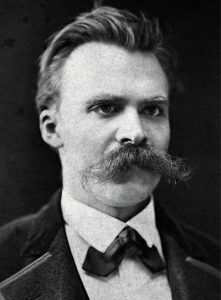
Pareto’s theory bears a striking philosophical resemblance to Friedrich Nietzsche’s concept of eternal recurrence. While Nietzsche introduced eternal recurrence primarily as a metaphysical and existential challenge, i.e., the idea that one should live as though every moment would repeat infinitely, it also expresses a profound skepticism toward narratives of ultimate historical redemption. Human existence is not a journey toward a final destination but a continual process of repetition, struggle, creation, and decline. Likewise, Pareto’s sociology denies the possibility of a definitive political end state. The drama of history is not progressive but cyclical, with each generation reenacting familiar contests for power under new ideological banners.
This perspective stands in direct opposition to the philosophy of Karl Marx. Marx regarded history as a dialectical process driven by class conflict that would culminate in the abolition of classes themselves. Capitalism, in his view, contained the seeds of its own destruction, and the dictatorship of the proletariat would ultimately give way to a communist society free from exploitation and domination. History, for Marx, had both direction and destination. Once the contradictions of class society were resolved, the cyclical conflicts that had defined previous epochs would come to an end.
Pareto found this vision fundamentally unrealistic. He argued that the desire for equality cannot eliminate differences in talent, ambition, intelligence, organization, or leadership. Even movements founded on egalitarian ideals inevitably generate new elites who monopolize authority in the name of the people. Every revolution that claims to liberate humanity merely initiates another cycle of elite replacement. From the aristocracies of antiquity to revolutionary France, from the Bolsheviks to modern political and corporate establishments, the pattern remains unmistakable: power changes hands, but it is never dissolved.
Seen through this lens, history resembles less a staircase ascending toward perfection than a wheel turning endlessly through recurring phases of ascent, consolidation, decay, and replacement. The costumes, slogans, and technologies evolve, but the underlying structure of political life endures. Pareto’s circulation of elites provides a sociological explanation for this phenomenon, while Nietzsche’s eternal recurrence offers its philosophical counterpart. Together, they challenge the modern faith in irreversible progress and invite us to see civilization not as a story with an ending, but as an enduring cycle that has repeated itself since the dawn of recorded history and, perhaps, always will.
The Metaphysical Loop: Pareto’s Circulation and Nietzsche’s Eternal Recurrence
Image: Vilfredo Pareto (Public Domain)

At first glance, Vilfredo Pareto, the detached sociologist armed with statistics and economic analysis, appears to inhabit an entirely different intellectual universe from Friedrich Nietzsche, the iconoclastic philosopher who wrote in aphorisms, parables, and poetic invective. Pareto sought scientific regularities in political behavior, while Nietzsche sought to overturn the moral foundations of Western civilization. One approached society as an empirical observer; the other approached existence as a psychologist and cultural critic. Yet beneath these stylistic and disciplinary differences lies a remarkably similar vision of history. Both thinkers reject the comforting illusion that humanity is progressing toward a final state of justice, equality, or rational perfection. Instead, they present existence as fundamentally cyclical in a world wherein the same patterns recur beneath ever-changing appearances.
Nietzsche’s doctrine of eternal recurrence (die ewige Wiederkunft) is among the most provocative ideas in modern philosophy. Introduced most famously in The Gay Science and elaborated in Thus Spoke Zarathustra, the concept asks the individual to imagine that every moment of life reflected in every triumph, every failure, every joy, every humiliation must be lived again and again for all eternity. Whether interpreted as a literal cosmological claim or, more commonly, as an existential thought experiment, eternal recurrence serves as the ultimate test of one’s affirmation of life. Could one embrace existence so completely that one would willingly relive it infinitely? Nietzsche’s challenge is directed not merely at individual psychology but at humanity’s deep longing for escape through religion, utopian politics, or faith in historical progress. Eternal recurrence denies the existence of a final redemption. There is no ultimate conclusion in which suffering is permanently abolished or history finally resolves its contradictions. Existence is repetition.
Although Pareto never advanced a metaphysical theory comparable to Nietzsche’s, his sociology arrives at a remarkably similar conclusion through entirely different means. Rather than contemplating the recurrence of the cosmos, Pareto examined the recurrence of political power. His famous theory of the circulation of elites proposes that every society, regardless of its constitutional form or ideological commitments, is inevitably governed by a minority. Democracy, monarchy, aristocracy, dictatorship are variations in institutional form, not exceptions to the underlying principle. The masses never truly govern themselves; they are always organized, directed, and led by an elite.
More importantly, Pareto argued that no ruling elite remains permanently dominant. Political stability contains within itself the seeds of political decay. Every elite eventually loses the qualities that enabled its rise. Success breeds complacency; prosperity encourages corruption; institutions become rigid; confidence turns into arrogance. As the governing class becomes increasingly detached from social realities, it gradually loses its capacity to command obedience or inspire loyalty. A rival elite emerges from outside the existing establishment, possessing the energy, ambition, and organizational ability that the old rulers have squandered. History, therefore, is not a story of institutional permanence but of perpetual replacement.
To explain these recurring transformations, Pareto distinguished between two ideal psychological types that characterize ruling classes: the “Foxes” and the “Lions.”
The Foxes govern through flexibility, negotiation, calculation, and manipulation. They excel at diplomacy, commerce, finance, coalition-building, and intellectual innovation. Foxes rely less on coercion than on persuasion and institutional sophistication. They flourish during periods of economic expansion and social complexity, where adaptability is more valuable than brute force. Yet these same qualities gradually become liabilities. Excessive compromise weakens authority; cleverness gives way to cynicism; political maneuvering substitutes for decisive leadership. Fox-dominated societies often become bureaucratically intricate but strategically fragile.
The Lions, by contrast, rule through strength, conviction, discipline, and the willingness to employ force. They represent courage, loyalty, martial virtue, and uncompromising authority. When institutions become paralyzed by excessive negotiation or moral uncertainty, Lions restore order through decisive action. Their legitimacy rests not upon persuasion but upon the capacity to command obedience and impose stability. Yet they too carry the seeds of their eventual decline. Rigidity replaces adaptability. Dogmatism replaces creativity. An elite built on force alone eventually loses the flexibility required to respond to changing social and economic realities.
History thus oscillates between these two governing styles in a rhythm that appears almost mechanical. Foxes construct sophisticated political orders but gradually undermine their own authority through excessive compromise and decadence. Lions overthrow the weakened establishment, restoring stability through force and conviction. Yet once securely established, the Lions inevitably confront the practical necessities of governance. Maintaining power requires diplomacy, administration, financial management, and political compromise. The Lions gradually acquire the very characteristics of the Foxes they displaced. Their descendants become increasingly cautious, institutionalized, and self-serving until another generation of vigorous Lions emerges to begin the cycle anew.
This recurring transformation constitutes what might be called the political analogue of Nietzsche’s eternal recurrence. Pareto does not argue that identical historical events literally repeat themselves. Rather, he contends that the underlying structure of political life remains astonishingly constant. Revolutions proclaim new ideals, constitutions promise new beginnings, and ideologies declare the birth of unprecedented societies. Yet beneath these changing narratives, the fundamental drama remains the same: elites rise, consolidate power, decay, and are replaced by new elites who eventually follow the identical trajectory.
This perspective directly challenges the dominant philosophy of modernity, which assumes that history possesses an inherent direction. Since the Enlightenment, Western political thought has often interpreted revolutions and social reforms as irreversible steps toward greater freedom and equality. Pareto dismantles this optimism. Political change is real, but it is rarely cumulative. Instead of ascending toward perfection, societies revolve through recurring phases whose structural logic remains fundamentally unchanged. The French Revolution overthrew an aristocracy only to produce a new political elite. Revolutionary Russia destroyed the Tsarist nobility only to create the nomenklatura. Anti-colonial movements frequently replaced imperial administrators with indigenous ruling classes. The rhetoric differs; the circulation remains.
This is where Pareto’s sociology intersects most deeply with Nietzsche’s philosophy. Nietzsche regarded the human longing for an ultimate historical destination as a manifestation of metaphysical wishful thinking, i.e., a secularized version of religious salvation. Pareto similarly rejects the belief that politics can abolish domination itself. Both deny that history culminates in a final condition beyond struggle. Conflict is not an unfortunate stage awaiting resolution but an enduring feature of human existence. Every victory contains the conditions of future decline. Every new order carries within itself the seeds of its replacement.
The significance of this parallel is not that Pareto simply translated Nietzsche into political science. Their intellectual projects remain distinct. Nietzsche’s eternal recurrence is ultimately concerned with the existential affirmation of life, while Pareto’s circulation of elites is an empirical theory of political dynamics. Nevertheless, both converge upon a common insight: human beings repeatedly mistake novelty for transformation. New constitutions, new slogans, new technologies, and new ideologies create the appearance of historical rupture, while the deeper structures governing ambition, hierarchy, conflict, and power remain astonishingly constant.
Viewed through this combined lens, history resembles neither a staircase ascending toward utopia nor a road leading to the “end of history.” It is better imagined as a great wheel, endlessly turning through familiar patterns of ascent, consolidation, decline, and renewal. Each generation believes itself to inhabit an unprecedented age. Each proclaims the arrival of a fundamentally new political order. Yet beneath the changing symbols and institutions, the same human drama unfolds once more. The names of the rulers change. The banners change. The technologies change. But the circulation of elites continues, and history turns again.
The Triumph of Realism: Pareto vs. Marx’s Teleological Illusion
Image: Karl Marx (Public Domain)

The contrast between Vilfredo Pareto’s cyclical realism and Karl Marx’s linear conception of history illustrates one of the most fundamental divisions in modern political thought. Both thinkers recognized that conflict is the engine of historical change, and both rejected the notion that political institutions exist primarily to serve the common good. Yet beyond this shared skepticism, their philosophies diverge radically. Marx believed that conflict possesses a direction and ultimately a conclusion. Pareto believed that conflict is permanent, while only its participants change. For Marx, history is a journey toward emancipation; for Pareto, it is an endless succession of ruling minorities. It is this difference that gives Pareto’s sociology its enduring explanatory power.
Marx’s theory of historical materialism is built upon a profoundly teleological understanding of history. According to Marx, every society contains internal economic contradictions that eventually generate revolutionary change. Human civilization progresses through successive modes of production, each characterized by a dominant class and an exploited class. Ancient slavery gives way to feudalism; feudalism yields to capitalism; capitalism, in turn, creates the industrial proletariat whose revolutionary consciousness ultimately destroys the bourgeois order. The culmination of this dialectical process is communism, a classless society in which private ownership of the means of production has been abolished, exploitation has disappeared, and the state itself gradually becomes unnecessary. Once class antagonisms cease, history, understood as the history of class struggle, effectively reaches its conclusion.
This vision is both revolutionary and profoundly optimistic. Marx transforms history into a narrative of redemption. The suffering of previous generations is not meaningless but serves as the necessary precondition for humanity’s eventual liberation. Capitalism, despite its injustices, is portrayed as an indispensable stage in the maturation of productive forces that will ultimately make universal abundance possible. History, therefore, possesses both direction and purpose. The future is not merely different from the past; it is fundamentally better.
Pareto rejected this entire framework. He denied neither revolution nor social transformation, but he challenged the assumption that these transformations could permanently eliminate hierarchy itself. In his view, Marx confused the replacement of one ruling class with the abolition of ruling classes altogether. Political domination, Pareto argued, is not an accidental feature of particular economic systems but a structural characteristic of every organized society. Wherever human beings cooperate on a large scale, decisions must be made, institutions must be administered, resources must be allocated, and coercive authority must ultimately reside somewhere. These necessities inevitably produce a governing minority.
Consequently, the notion of a permanently classless society appears, from a Paretian perspective, less as a sociological possibility than as a psychological aspiration. Human beings differ in ambition, competence, organizational ability, charisma, and willingness to exercise authority. These differences naturally generate leadership structures that gradually solidify into political elites. Even movements founded upon the language of equality require organizers, strategists, administrators, military leaders, and ideological guardians. The revolutionary promise of abolishing hierarchy therefore contains an internal contradiction: the very act of organizing a revolution necessitates the creation of an elite capable of directing it.
The political history of the twentieth century provides numerous examples that Pareto’s theory appears well equipped to explain. The Russian Revolution did not culminate in the disappearance of political authority but in its concentration within the Bolshevik Party. The hereditary aristocracy and capitalist class were indeed displaced, yet the promised rule of the proletariat never materialized in the direct democratic sense envisioned by many revolutionaries. Instead, a new governing stratum emerged, composed of party officials, military leaders, state planners, and bureaucratic administrators. Over time this political elite developed its own privileges, institutional interests, and mechanisms of self-preservation. The nomenklatura functioned less as the disappearance of elite rule than as its transformation into a new form.
Pareto would have regarded this outcome not as a betrayal of Marxism but as the predictable consequence of political organization itself. The revolutionary “Lions,” whose strength lay in discipline, ideological conviction, and decisive action, successfully overthrew the old order through force and centralized leadership. Yet governing an industrial society required far more than revolutionary zeal. Administration demanded negotiation, bureaucratic expertise, economic planning, propaganda, and political compromise. In learning these arts, the Lions gradually acquired the characteristics of the Foxes they had displaced. The revolutionary elite became an established elite, and the circulation of elites resumed its familiar course.
Nor is this dynamic unique to communist revolutions. Similar patterns can be observed across radically different civilizations and political systems. The Roman Republic witnessed the gradual replacement of an old aristocratic elite by ambitious military commanders who eventually consolidated imperial authority. Dynastic China repeatedly experienced cycles in which vigorous founding rulers established stable governments that later succumbed to bureaucratic stagnation, corruption, and internal decay before being replaced by new dynasties. The French Revolution destroyed the Bourbon monarchy only to pass through successive governing elites before culminating in the rule of Napoleon. Even constitutional democracies experience recurring turnover among political, bureaucratic, economic, and cultural elites without fundamentally eliminating elite governance itself.
These examples do not necessarily invalidate every aspect of Marx’s thought. His analysis of capitalism’s capacity to generate inequality, concentrate wealth, and produce recurring class tensions continues to inform economics, sociology, and political theory. Likewise, his emphasis on material interests remains an important corrective to purely idealistic explanations of history. Yet Marx’s expectation that class conflict would culminate in the permanent abolition of hierarchy has found little confirmation in the historical experience of states that sought to realize his vision. The disappearance of one elite has consistently been followed by the emergence of another.
Pareto’s model derives much of its strength from its refusal to promise a final destination. Rather than constructing a philosophy of inevitable progress, he offers a descriptive account of recurring political dynamics. His theory does not require that societies improve or deteriorate over time; it merely predicts that ruling elites will gradually lose the qualities that secured their dominance and will eventually be replaced by more vigorous competitors. Because this process is rooted in recurring features of human psychology and political organization rather than in any particular economic system, it appears with remarkable consistency across civilizations separated by geography, culture, religion, and historical epoch.
From the Pharaohs of ancient Egypt to the Roman Republic, from imperial China to medieval kingdoms, from revolutionary states to modern liberal democracies, history repeatedly exhibits the same structural pattern. A relatively small governing minority organizes political life, accumulates privileges, grows increasingly insulated from the wider population, and eventually confronts an organized counter-elite capable of exploiting its weaknesses. The institutions change. The ideologies change. The languages of legitimacy evolve from divine right to popular sovereignty, from nationalism to socialism or democracy. Yet the underlying mechanism of elite succession remains strikingly familiar.
In this sense, Marx arguably mistook one recurring mechanism of political change for the culmination of history itself. Class conflict is undoubtedly a powerful force, but for Pareto it is not the road out of hierarchy; it is one of the principal mechanisms through which one elite replaces another. Revolution does not end the circulation of elites but accelerates it. What appears to be the birth of an entirely new political order is often, upon closer examination, another turn of history’s enduring wheel.
Conclusion: Accepting the Carousel
Karl Marx offered humanity something far more than an economic theory; he offered a secular doctrine of redemption. In the wake of the Enlightenment’s declining religious certainties, Marx transformed history itself into a vehicle of salvation. The suffering of workers, the inequalities of capitalism, and the conflicts between classes were not merely unfortunate realities but necessary stages in humanity’s march toward emancipation. Like many grand narratives of progress, Marxism promised that history possessed both meaning and destination. The sacrifices of the present would ultimately culminate in a society beyond domination, exploitation, and political coercion, i.e., a classless world in which the state itself would gradually disappear because its historical purpose had been fulfilled.
The enduring appeal of this vision is easy to understand. It offers hope that injustice is temporary, that history bends toward liberation, and that the contradictions defining political life can eventually be overcome. It assures us that conflict is transitional rather than permanent and that human civilization is ascending toward an ultimate reconciliation. For generations of revolutionaries, intellectuals, and reformers, this promise provided not only a political program but also a profound source of moral purpose.
Yet the historical record has repeatedly complicated this expectation. Revolutions have transformed societies, redistributed power, and reshaped economic institutions, but they have rarely abolished hierarchy itself. Instead, old ruling classes have consistently given way to new ones. States that proclaimed the end of domination often produced new administrative elites, new bureaucracies, and new systems of political authority. The vocabulary of legitimacy changed from monarchy to democracy, from aristocracy to socialism, but the fundamental phenomenon of elite rule endured. The destination promised by teleological theories of history has remained perpetually beyond reach.
Pareto begins where such hopes end. His sociology strips politics of its redemptive mythology and invites us to confront power as a permanent feature of collective life rather than as a temporary defect awaiting correction. The circulation of elites does not celebrate inequality or justify domination; instead, it presents hierarchy as a recurring consequence of human organization. Every society, regardless of its ideals, generates leaders, administrators, organizers, and institutions of command. Over time these elites lose the qualities that secured their authority, becoming increasingly detached, complacent, or self-serving. They are then displaced by ambitious rivals who promise renewal but gradually follow the same trajectory. Political history thus appears less as a narrative of progress than as a recurring process of renewal and decline.
This is where Pareto’s realism converges most deeply with Nietzsche’s philosophy. Nietzsche challenged humanity to abandon the comforting illusion that existence culminates in a final redemption. The doctrine of eternal recurrence compels us to imagine that life, with all its triumphs and tragedies, must be lived again without end. The challenge is not to escape the cycle but to affirm it by embracing existence without appealing to some ultimate resolution beyond it.
Viewed alongside Pareto, this philosophical insight acquires a political dimension. If elite circulation is an enduring characteristic of organized societies, then the search for a final political order free from power struggles may itself be misguided. The contest for authority is not a historical accident but one of the defining conditions of civilization. Every generation inherits institutions created by its predecessors, challenges them, replaces them, and unknowingly prepares the conditions for future replacement. Political life does not culminate in permanence because the very forces that produce order also generate the conditions for its transformation.
This perspective requires a profound shift in how history is understood. Civilization is not an ever-rising staircase leading humanity toward perfection. Nor is it a straight road culminating in the “end of history.” It is better imagined as a great carousel or perhaps an immense wheel whose motion is continuous rather than progressive. The riders change, the decorations are repainted, and the music evolves with each era, but the underlying movement remains remarkably constant. Kingdoms become republics; republics become empires; empires fragment into nations; revolutions overturn regimes only to establish new governing classes. Technology advances at breathtaking speed, yet the political psychology of ambition, leadership, rivalry, and institutional decay displays a remarkable continuity across centuries.
To accept this cyclical vision is not necessarily to embrace political fatalism. Pareto’s theory does not imply that all governments are equally competent, that reforms are meaningless, or that justice is unattainable in relative terms. Societies can become freer, wealthier, more stable, or more humane. Institutions matter, and political choices have real consequences for the quality of human life. What Pareto denies is the possibility of abolishing the structural realities of power itself. The struggle over who governs, how they govern, and why they eventually lose legitimacy remains an enduring feature of political existence.
In this respect, Pareto and Nietzsche offer not a counsel of despair but an invitation to intellectual honesty. Both reject narratives that promise an ultimate escape from the recurring conditions of human existence. Both encourage us to look beyond the rhetoric of novelty and recognize the enduring patterns beneath historical change. They remind us that every age imagines itself unprecedented, while unknowingly reenacting dramas as old as civilization itself.
By synthesizing Pareto’s sociology with Nietzsche’s philosophy, we arrive at a vision of history that is at once more sobering and, paradoxically, more liberating. It abandons the expectation that politics will one day solve the permanent tensions of human society and instead encourages a clearer understanding of their recurring nature. The struggle for power is not an unfortunate interruption in humanity’s journey toward perfection; it is one of the defining rhythms through which civilization continually recreates itself. History, then, is neither a march toward utopia nor a descent into chaos. It is a perpetual return characterized by a cycle of ascent, dominance, decay, and renewal whose patterns endure even as the faces of power endlessly change.
*
Prof. Ruel F. Pepa is a Filipino philosopher based in Madrid, Spain. A retired academic (Associate Professor IV), he taught Philosophy and Social Sciences for more than 15 years at Trinity University of Asia, an Anglican university in the Philippines. He is a Research Associate of the Centre for Research on Globalization (CRG).
Primary Sources
Marx, Karl. Capital: A Critique of Political Economy, Vol. 1. Translated by Ben Fowkes. London: Penguin Classics, 1976. (Original work published 1867).
Marx, Karl, and Friedrich Engels. The Communist Manifesto. London: Penguin Classics, 2002. (Original work published 1848).
Marx, Karl. A Contribution to the Critique of Political Economy. Moscow: Progress Publishers, 1977. (Original work published 1859).
Marx, Karl. The German Ideology. Edited by C. J. Arthur. New York: International Publishers, 1970. (Written 1845–46).
Nietzsche, Friedrich. Thus Spoke Zarathustra. Translated by Walter Kaufmann. New York: Penguin Classics, 1978.
Nietzsche, Friedrich. The Gay Science. Translated by Walter Kaufmann. New York: Vintage Books, 1974.
Pareto, Vilfredo. The Mind and Society: A Treatise on General Sociology. 4 vols. Translated by Andrew Bongiorno and Arthur Livingston. New York: Dover Publications, 1963. (Original work published 1916).
Pareto, Vilfredo. The Rise and Fall of Elites: An Application of Theoretical Sociology. New Brunswick, NJ: Transaction Publishers, 1991. (Selections from Mind and Society).
Secondary Sources
Aron, Raymond. Main Currents in Sociological Thought, Volume II: Durkheim, Pareto, Weber. New York: Basic Books, 1967.
Berlin, Isaiah. Karl Marx: His Life and Environment. Oxford: Oxford University Press, 2013.
Bobbio, Norberto. Which Socialism? Marxism, Socialism and Democracy. Minneapolis: University of Minnesota Press, 1987.
Bottomore, Tom. Elites and Society. London: Routledge, 1993.
Burnham, James. The Machiavellians: Defenders of Freedom. Indianapolis: Liberty Fund, 1991. (Original work published 1943).
Kolakowski, Leszek. Main Currents of Marxism. 3 vols. New York: W. W. Norton, 2005.
Mannheim, Karl. Ideology and Utopia. London: Routledge, 1991.
Michels, Robert. Political Parties: A Sociological Study of the Oligarchical Tendencies of Modern Democracy. New York: Dover Publications, 1959.
Mosca, Gaetano. The Ruling Class. Edited by Arthur Livingston. New York: McGraw-Hill, 1939.
Popper, Karl. The Open Society and Its Enemies, Volume II: The High Tide of Prophecy: Hegel, Marx, and the Aftermath. Princeton, NJ: Princeton University Press, 2013.
Schumpeter, Joseph A. Capitalism, Socialism and Democracy. New York: Harper Perennial, 2008. (Original work published 1942).
Global Research is a reader-funded media. We do not accept any funding from corporations or governments. Help us stay afloat. Click the image below to make a one-time or recurring donation.
