What are ‘chemtrails’ and should you believe in them?
As our resident myth-buster, Sarah Knapton has seen a thing or two. Now, she’s taking on some of the world’s best-known conspiracy theories to see if they hold water. This week, she takes a closer look at chemtrails and separates fact from fiction …
In 1996, the US air force published a research paper claiming that by 2025, America could “own the weather”.
The extraordinary document, which had chapters including “Why would we want to mess with the weather?” and “Applying weather modifications to military operations” outlined plans to generate thunderstorms, rain, fog and droughts through cloud seeding.
Weather modification, the report argued, could become “a more important weapon than the atom bomb”.
The authors wrote: “The number of specific intervention methodologies is limited only by the imagination, but with few exceptions they involve infusing either energy or chemicals into the meteorological process in the right way, at the right place and time.”
It was this mention of chemicals being released into the atmosphere that set in motion one of the century’s most enduring conspiracy theories: chemtrails.
According to conspiracy theorists, the white lines left in the sky by aircraft contain toxic agents used by governments for nefarious purposes, ranging from mind control to sterilisation.
Initially, the theory lingered only in early fringe internet message boards, but that all changed when it was seized upon by the radio show host Art Bell on his Coast to Coast AM programme in 1999.

Art Bell was the first to fuel the conspiracy theory – Tribune News Service
It was Bell who made chemtrails a household word, and within seven years, one in six Americans polled believed the story. It led to states rushing through legislation to ban weather manipulation, and the Environmental Protection Agency launching two new websites to counter disinformation.
So was there any truth in the theory? The answer is yes and no. The white lines emitted behind aircraft are actually known as “contrails”, or condensation trails, and are made primarily of water in the form of ice crystals.
Aircraft engines do release polluting substances, including carbon dioxide, small amounts of nitrogen oxides, hydrocarbons, carbon monoxide and sulphur gases, as well as soot and metal particles formed by the high-temperature combustion of jet fuel during flight.
However, the contrails themselves are long, thin, wispy lines of cloud made from water vapour, and depending on the temperature and humidity of the atmosphere will either evaporate quickly or spread out. Fewer than one in five planes form contrails and certain conditions must be in place for them to appear.
The humidity must be high enough for water vapour from the exhaust to condense on particles – either from the exhaust or in the atmosphere – and form liquid droplets. If the air is cold enough, these newly formed droplets then freeze and form ice particles that make up a contrail.
Marc Stettler, a professor in transport and the environment at Imperial College London, said: “Contrails are a type of high-altitude ice cloud, or cirrus cloud.
“For contrails to form, the air that the aircraft is flying through needs to be cold and humid enough. If the air is too warm, a contrail won’t form. If the air is cold enough but too dry, a contrail may form but it will only last for a few seconds.
“The conditions must be just right. This is the reason why we don’t always see contrails behind aircraft and why we don’t often see contrails criss-crossing the sky – although when that happens it can be pretty spectacular.”
Some contrails can last for hours, expanding to several miles in width and 1,300ft in height, as the ice particles grow by taking water from the surrounding atmosphere.
They can swell so big they are sometimes difficult to tell apart from high cirrus clouds and can appear blue, yellow and red, which conspiracy theorists take as a sign that chemicals have been involved, but are actually just reflected sunlight.
Those who believe in chemtrails refute this simple explanation and there are hundreds of online sites where people meet to discuss the sinister motives behind the white streaks.
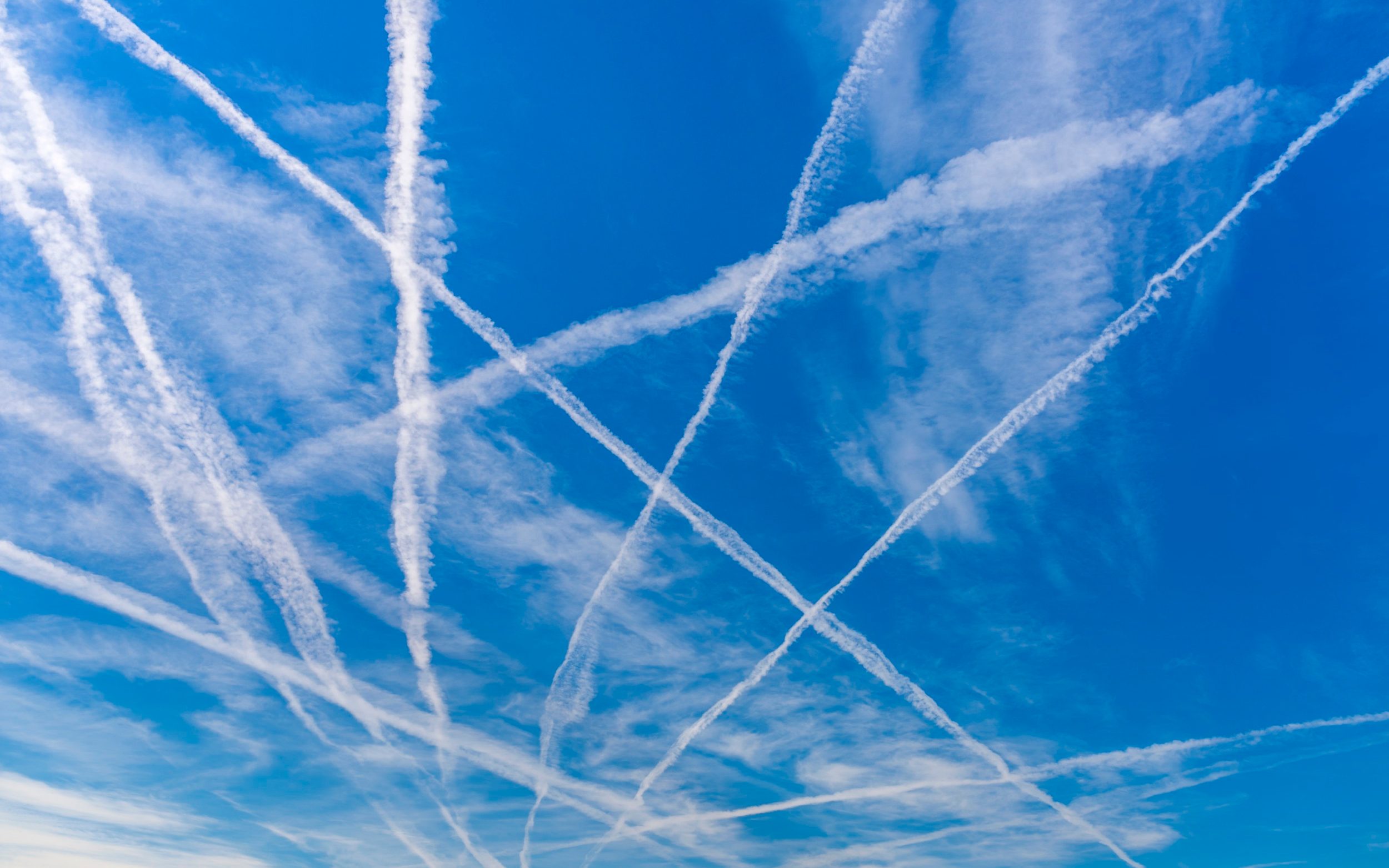
Contrails are essentially long, thin, wispy lines of cloud made from water vapour – Gajus
Karen Douglas, professor of social psychology atthe University of Kent, said: “A simple explanation is often not very appealing. People assume that there must somehow be a bigger explanation, or more going on than people know about.
Advertisement
“It is easy to find and share conspiracy theories on social media. People who are interested in conspiracy theories can find them almost immediately and they can spread rapidly.”
Although it is not a government conspiracy, contrails can influence the weather and climate by trapping heat reflecting from the Earth’s surface and acting like a blanket that warms the atmosphere below. They can also reflect incoming sunlight.
When planes were grounded during the pandemic, it provided a natural experiment in how much contrails impacted climate. Globally, the decrease in contrails induced minor surface cooling.
According to Prof Stettler, contrails are estimated to contribute about half of aviation’s total contribution to climate change and about 1 per cent of total human-caused contribution to climate change.
However, he has carried out research suggesting that the problem could be mitigated by avoiding the very cold and humid areas of the atmosphere that allow contrails to form.
He said: “It could be possible for airlines to avoid flying in those regions and so reduce a significant part of aviation’s climate impact – perhaps more quickly than other ways to reduce the impact of flying.”
It is unfortunate that chemtrails became mixed up with contrails, because weather manipulation is possible, and is happening. It is thought the US spends more than $20m (£15m) each year on weather modification research, while China may be spending more than $1bn.
During the 2008 Beijing Olympics, China used cloud-seeding to ensure dry, clear skies by firing 1,104 rain-dispersal rockets from 21 sites to force approaching clouds to “rain themselves out” before reaching the national stadium.
The country now regularly shoots particles into the atmosphere to trigger rain in drought-stricken areas and, according to Geoengineering Monitor, an interactive world map, there are plans for weather manipulation across more than 60 per cent of its land area.
Likewise, the United Arab Emirates carries out more than 1,000 hours of cloud seeding each year, to improve its annual rainfall, lower heat-related deaths and boost drinking water supplies.
Israel embarked upon 38 years of cloud-seeding experiments to bring more rain to the north of the country, but cancelled the programme in 2023 after results showed little effect.
Cloud seeding works by firing salt flares, silver iodide or dry ice into the atmosphere to try and speed up condensation, and create clouds, which in turn bring rainfall.
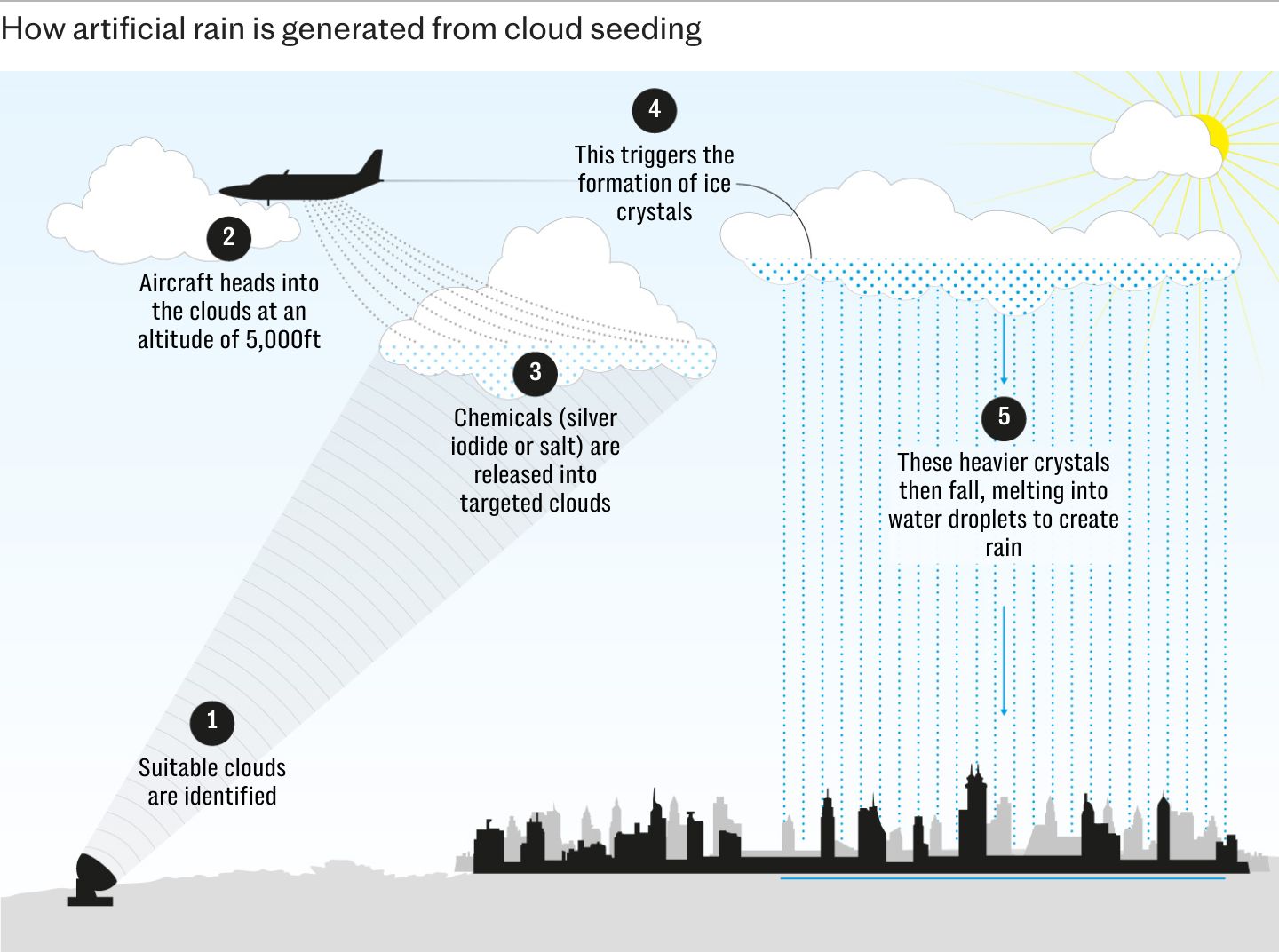
Experts in Reading are also working with the UAE on the electric charge method, which makes the droplets stick to each other, helping the growth rate, and have carried out initial experiments in Britain.
Last year, the Advanced Research and Invention Agency, a government body, announced nearly £57m for 21 “climate cooling” projects to “dim the sun”, including five outdoor field trials. It will include experiments to reflect sunlight into space by brightening clouds.
However, there are concerns about weather manipulation and cloud seeding, with experts warning it could do more harm than good, disrupting weather patterns and climate.
Last year, Dr Valérie Masson-Delmotte, head of the Climate Society Centre at Institut Pierre Simon Laplace in France, warned about the unintended consequences.
She told science reporters at a briefing: “This concept relies on the deliberate injection of different types of aerosols, for instance, through the injection of sulphur dioxide or sulphate aerosols, which are pollutants.
“Such injections could deplete ozone and could disrupt climate patterns, not just in polar regions, but at other latitudes. There could be large costs of liability related to adverse impacts and potential unforeseen impacts, for instance, disruption of weather patterns, effects on energy production, effects on health or agriculture.”
So, although chemtrails are not real, there are genuine reasons to be concerned about what is being sent into our atmosphere and scientists and the public are both worried.
A YouGov poll last year showed that just 16 per cent of Britons would back injecting aerosols into the atmosphere to fight climate change, while just 31 per cent supported marine cloud brightening and 18 per cent approve of space sun shades.
Perhaps the chemtrails conspiracy theory echoes a deeper mistrust we have in governments tinkering with nature, and that is entirely based in reality.